The alpha, twice a week
That was 4 min.
Get the best new moments in your inbox every Wednesday and Saturday. It's free.
Check your inbox
We sent a link to your address. Click it to finish signing up. Not there in a minute? Look in spam.
or
Sourcery · 4 min · Nov 5, 2026
Space-based compute could offer a cheaper power model
 Will Marshall
 argues that constant sunlight in orbit could make solar-powered data centers cheaper than terrestrial ones.
The episode’s best minutes
Full analysis- 20:33Space-based compute could offer a cheaper power model4 min
- 4:05Satellite intelligence can give countries an information advantage3 min
- 29:20Marshall expects signs of life beyond Earth within a decadePro pick 4 min
- 5 more moments in the full episode
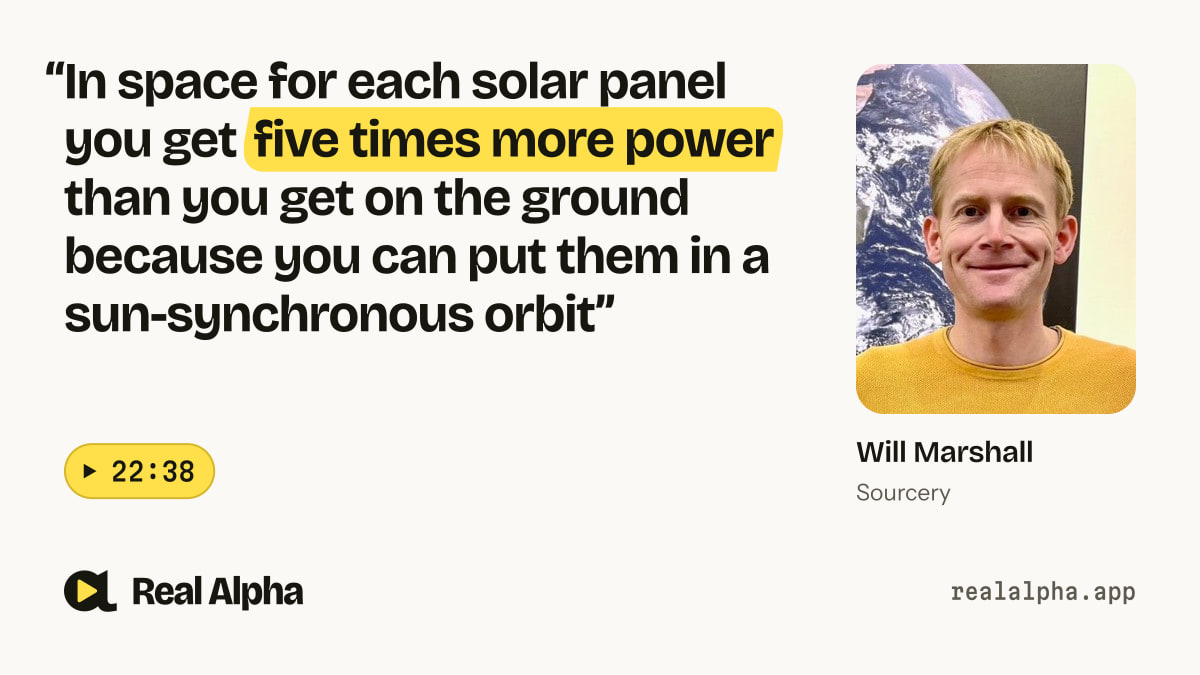
“In space for each solar panel you get five times more power than you get on the ground because you can put them in a sun-synchronous orbit”
 Will Marshallat 22:38 · Sourcery
Takeaways
- Orbit can provide five times more solar power per panel.
- Space data centers avoid clouds, night, batteries and gas power.
- Orbital compute could process satellite data closer to where it is collected.
About this segment
Will Marshall argues that constant sunlight in orbit could make solar-powered data centers cheaper than terrestrial ones. The first step is testing compute in orbit, where it can also speed up satellite data delivery.

Will Marshall is cofounder and CEO of Planet Labs.
Co-founded Planet and leads its Earth-imaging satellite network, after developing low-cost spacecraft at NASA/USRA.

Molly O'Shea, Host · Founder, Sourcery
Ex-Upfront Ventures investor; has interviewed Alex Karp and Palmer Luckey.
From “Planet Labs CEO: Why AI Data Centers Will Move to Space”, Nov 5, 2026. Watch the full episode
Answers “Is there enough power for AI?” See all 29 answers
Thanks. We'll look at and fix what's off.
Transcript
Transcribed by machine (Whisper) from the episode’s audio, so a word may be off here and there.
- 20:38
Satellites, I mean, between what we're seeing with Planet Labs, with Starlink, with even geopolitical issues, like they've just become a really hot topic. One of the hot topics is data centers in space. So have you thought about this at all? Is this rational, irrational? Why would this make sense? We've more than thought about it. We just launched last week the first data centers test project for Google.
- 21:06
Suncatcher is the name of their project. And before that, we've launched NVIDIA chips on our Pelican spacecraft. The reason we're putting more compute upstairs is to process the data quickly. It's great if we can do the image processing, recognize the chips, do the querying up there, and then just send down the answers. That means we can get the answers much quicker in the case of the LA fires We took an image within a couple of hours of the fires starting We got it down a couple of hours later and then had processing time Maybe that's another hour and then then they got the image. So now we're talking several hours into the fire What if we could have got that in minutes that could have meant potentially those firefighters saving more lives or those are the first responders getting more quickly to help people, right?
- 21:54
So we want to reduce that timeline, and so having compute in space helps with that. Separately, though, yeah, there's like, should we just put all of the computers in space? And yes, I believe it totally makes sense from a basic economic analysis. And why? The intuition comes down to something very simple. Data sensors are all an energy problem. So on the ground, you would naturally power them using solar panels if you were just thinking about the cheapest way to do it because solar panels are the cheapest watts per dollar. However, then you have intermittency because of cloud and nights but you don't want an intermittent data center so then you have to add gas power or you have to add nuclear power. Then now we're starting to get really complicated, much more permitting, much more time. In space for each solar panel you get five times more power than you get on the ground
- 22:51
because you can put them in a sun-synchronous orbit that is always looking at the sun. And that means that you just keep the panel facing the sun and it always is drawing power. No interruption from clouds, no interruption from day and night. So you don't have to have batteries, you don't have to have gas, you don't have any of those other power systems. Five times more power, straight to the chips, and then you just have to add radiators to cool those chips into the darkness of space.
- 23:19
We know how to do all of those things. and you can send your commands up via radio and get your answers back via radio. There's a little of a latency, but not very much, actually. So it all actually is just going to be cheaper. Notwithstanding that, it's also going to be better for communities that don't want these data centers in their backyard because of rising energy costs, water usage, and other challenges.
- 23:43
It's just going to be smarter to put that infrastructure in orbit eventually. Arthur C. Clarke talked about these sorts of ideas, the sci-fi author, many, many decades ago. But now it's finally becoming reality, and the first piece, it eventually will put power in space and... beam that down and other things. But the first piece, by far easiest, is compute. Back to the Google demo, we're just doing a demo to see how their TPUs do in space.
- 24:09
We already commissioned the spacecraft, it's doing very well in space, we're very happy, and Google's very happy and it's very exciting. We will test that TPU, we'll see how that goes, and we'll tell the world more about that as we go.