The alpha, twice a week
That was 2 min.
Get the best new moments in your inbox every Wednesday and Saturday. It's free.
Check your inbox
We sent a link to your address. Click it to finish signing up. Not there in a minute? Look in spam.
or
Bloomberg Surveillance · 2 min · Nov 19, 2026
Midterm gains give China hawks more leverage in Congress
 James Crabtree
 says a stronger Congress will scrutinize semiconductor sales to China and Trump's approach.
In this episode
Full analysis- 12:02Anthropic's IPO could validate the AI infrastructure buildout4 min
- 25:02Europe's capex wave will test its financing system5 min
- 33:20The U.S. may no longer be able to deter China near TaiwanPro pick 4 min
- 5:09A pullback in startup funding could expose a chip glut2 min
- 0:36Anthropic's share unlocks add supply risk to the IPO3 min
- 18:45U.S. China policy has more continuity than rhetoric suggests3 min
- 37:41Midterm gains give China hawks more leverage in Congress2 min
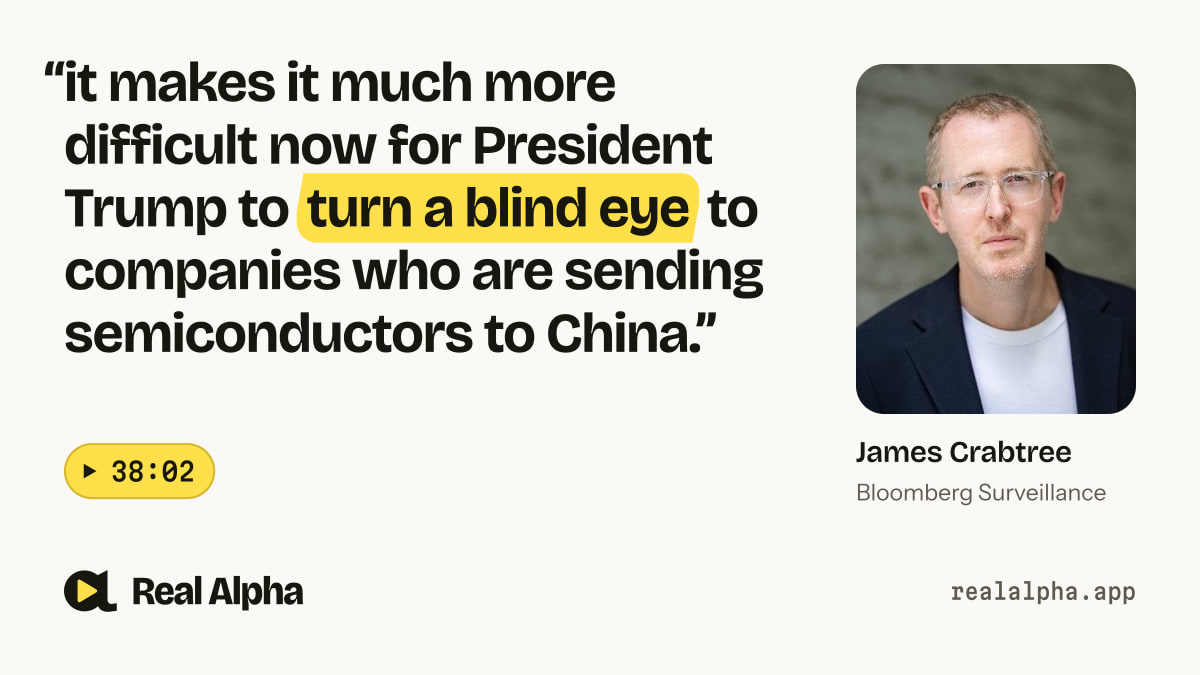
“it makes it much more difficult now for President Trump to turn a blind eye to companies who are sending semiconductors to China.”
 James Crabtreeat 38:02 · Bloomberg Surveillance
Takeaways
- New voices in Congress are more supportive of Taiwan and deterring China.
- Crabtree says lawmakers can make semiconductor sales harder to ignore.
- He says the president still has wide latitude in foreign policy.
About this segment
James Crabtree says a stronger Congress will scrutinize semiconductor sales to China and Trump's approach. He expects a future administration to rebuild the U.S. regional perimeter, while noting the president remains decisive.

Distinguished Fellow, European Council on Foreign Relations
Led the Shangri-La Dialogue and wrote The Billionaire Raj; analyzes geopolitics across Asia and the Indo-Pacific.
- TK
Tom Keene, Host
- PS
Paul Sweeney, Host
From “Anthropic Debut and Trump's Xi-Putin Trilateral Meeting | Bloomberg Surveillance”, Nov 19, 2026. Watch the full episode
Thanks. We'll look at and fix what's off.
Transcript
From the transcript Bloomberg Surveillance publishes with the episode.
- 37:44
James, we had a midterm election several weeks ago, pretty big change in the balance of power in the House, in Congress. How does that impact this Indo-Pacific issue?
- 37:56
Well, if you're a China hawk, it's good news. I mean, in a funny way, I think the China hawks in Washington think the Chinese Ministry of State Security has done them a bit of a favor, because it makes it much more difficult now for President Trump to turn a blind eye to companies who are sending semiconductors to China. It also means that you now have powerful new voices on the Hill who are basically much more orthodox. They're pro-Taiwan.
- 38:18
They're They want to deter China. So this softy-softly approach to China that the president has been taking is going to get a lot more scrutiny. But ultimately, the president is in charge. You know, he's the guy. He meets with Presidency, and he's reasonably unconstrained in what he can do. So I think when he meets We'd see this week and also again at the G20 in the middle of December, those China hawks and the government in Taiwan are still going to be feeling a bit of heat.
- 38:42
They're still going to be worried. Is the president going to do a deal with China for some illusory bag of magic beans?
- 38:50
I miss everyday James Crabtree. He's incredibly kind to me. Joseph Knight. of Harvard. And he was amazingly pliable and flexible about this odd America-Chinese relationship. With great respect, James Crabtree, what would Joseph Nye say about after Trump?
- 39:13
I think Joe Nye, he worked in the Pentagon, he worked in the State Department. I mean, he was a serious figure in U.S. diplomacy, in addition to being known as the chief exponent of soft power, I suspect he would want to go back to a more orthodox China policy of the sort that President Obama, Trump in his first term, and President Biden followed, which was to try and rebuild what I in my book call the perimeter line.
- 39:41
That's what the United States has been trying to do, to reinforce this perimeter in fits and starts, not perfectly. What's happened under President Trump is there's now a genuine debate about whether we are in business, as some in his government say of reinforcement, or we might be considering a retreat. Right.