The alpha, twice a week
That was 3 min.
Get the best new moments in your inbox every Wednesday and Saturday. It's free.
Check your inbox
We sent a link to your address. Click it to finish signing up. Not there in a minute? Look in spam.
or
Bloomberg Surveillance · 3 min · Nov 19, 2026
U.S. China policy has more continuity than rhetoric suggests
 Elizabeth Economy
 sees U.S. policy toward China as more continuous across administrations than presidential rhetoric suggests.
In this episode
Full analysis- 12:02Anthropic's IPO could validate the AI infrastructure buildout4 min
- 25:02Europe's capex wave will test its financing system5 min
- 33:20The U.S. may no longer be able to deter China near TaiwanPro pick 4 min
- 5:09A pullback in startup funding could expose a chip glut2 min
- 0:36Anthropic's share unlocks add supply risk to the IPO3 min
- 18:45U.S. China policy has more continuity than rhetoric suggests3 min
- 37:41Midterm gains give China hawks more leverage in Congress2 min
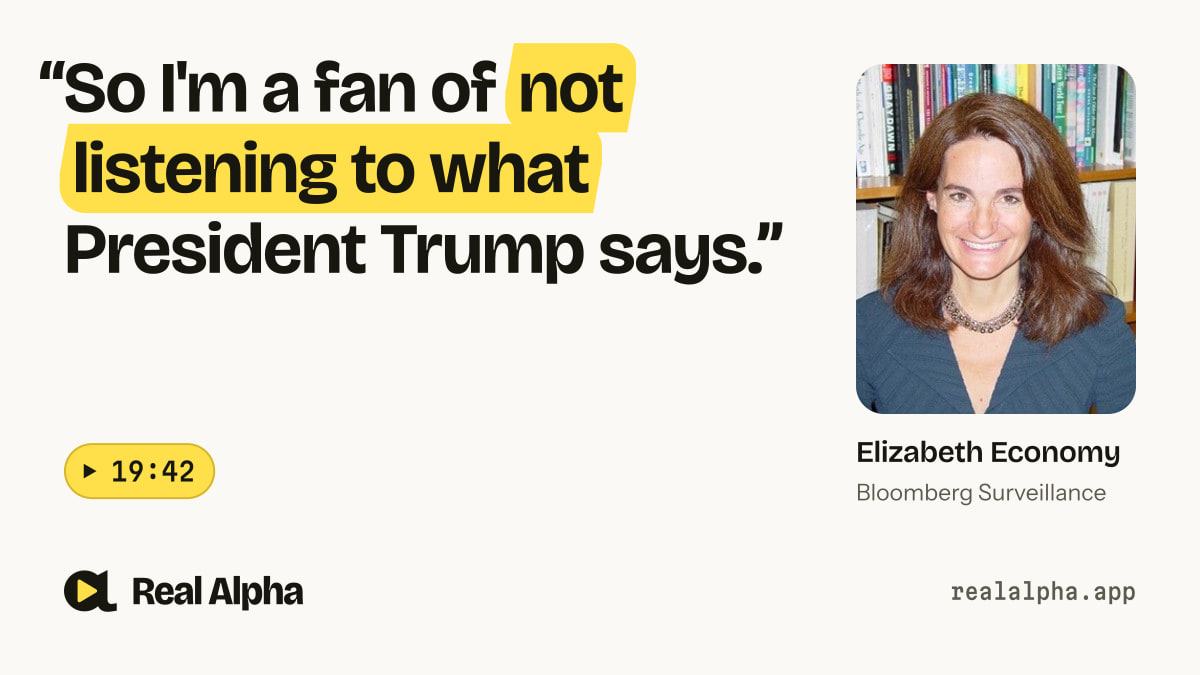
“So I'm a fan of not listening to what President Trump says.”
 Elizabeth Economyat 19:42 · Bloomberg Surveillance
Takeaways
- She sees continuity in China policy across Trump, Biden and Trump.
- She advises judging administration actions over presidential rhetoric.
- European allies expect trust-building and a relationship based on interests.
About this segment
Elizabeth Economy sees U.S. policy toward China as more continuous across administrations than presidential rhetoric suggests. She expects future leaders to rebuild ties with allies, though Europe now frames the relationship around shared interests.

Professor, Stanford
Explores Chinese domestic and foreign policy; authored The World According to China and The Third Revolution.
- TK
Tom Keene, Host
- PS
Paul Sweeney, Host
From “Anthropic Debut and Trump's Xi-Putin Trilateral Meeting | Bloomberg Surveillance”, Nov 19, 2026. Watch the full episode
Thanks. We'll look at and fix what's off.
Transcript
From the transcript Bloomberg Surveillance publishes with the episode.
- 18:47
Liz, within the arch of your books, from the River Run Black to all of your books on President Xi, how does America move on after Trump in our China policy? We've done this before, after Nixon, et cetera, after Kissinger, et cetera. How do you perceive our policy, Republican or Democrat, after President Trump?
- 19:09
So I think, you know, the good news, frankly, is that there's a lot more continuity in our policy from Trump one to Biden to Trump two than I think we often see based on President Trump's statement. So if you put aside all of the grandiose rhetoric that President Trump, you know, the signs of affection and Xi Jinping, his great friend and all of that, if you look at what this administration has done, in fact, whether we're looking at Indo-Pacific security or the competition on the trade and technology front, We've continued to maintain sort of the sensibility that China is our greatest long-term strategic challenge. So I'm a fan of not listening to what President Trump says.
- 19:50
as much as looking at what his administration does. So I think for the next president of the United States, my guess would be that there would be a step back. from this effort to promote sort of a at least theoretical notion of a G2 that President Trump seems to desire and a return to a greater focus on our traditional allies and partners. Because I think that if you look at Congress, if you look at sort of what moderate Democrats and moderate Republicans are pushing in Congress, that is, I think, the direction in which people are moving.
- 20:27
Assuming that's true, Elizabeth, how do you think our erstwhile allies will receive us after this administration?
- 20:36
I mean, I just came back from a 17-day trip to Hungary, China, and Japan. I can say for the Europeans, their constant refrain is, we are never going to go back. And so it will have to be a new form of a relationship. There will have to be some new trust built up. But There, too, they mostly say this relationship is about interest at this point. It's not about, you know, trust. So where do we find our shared interests?
- 21:04
So I think there's going to be work. I'm not as pessimistic as some of them are. I do think that we can find our way back to a really robust transatlantic alliance, but it's going to take a lot of work. I think in Asia, the sensibility, you know, is a little bit different, you know, from the very beginning of the Trump administration. They were of a mind that they've seen this before. They know what to do. So, you know, they were plying President Trump with gold crowns and scepters and other things. And, you know, I think they saw this as, you know, a long four years, but they would get through it. And frankly speaking, this administration has been much kinder to our Asian allies and partners than they have been to our European ones. So it'll be tough, but I think we can do it.