The alpha, twice a week
That was 3 min.
Get the best new moments in your inbox every Wednesday and Saturday. It's free.
Check your inbox
We sent a link to your address. Click it to finish signing up. Not there in a minute? Look in spam.
or
Cheeky Pint · 3 min · Nov 10, 2026
Nik favors quarterly performance reviews
 Nik Storonsky
He favors quarterly reviews because managers can be biased against exiting underperformers and annual cycles delay action.
In this episode
Full analysis- 3:58Revolut funds product bets only after validation3 min
- 12:28Credit lending makes profits vulnerable to downturns5 min
- 17:47Revolut scales products by early cohort performancePro pick 7 min
- 38:59US fintechs need to own the licensing stack3 min
- 28:09Revolut targets kids because adults are hard to switch3 min
- 33:05AI could shrink Revolut product teams to two people4 min
- 42:32Nik found product issues despite 60–80% trading growth3 min
- 48:35Nik favors quarterly performance reviews3 min
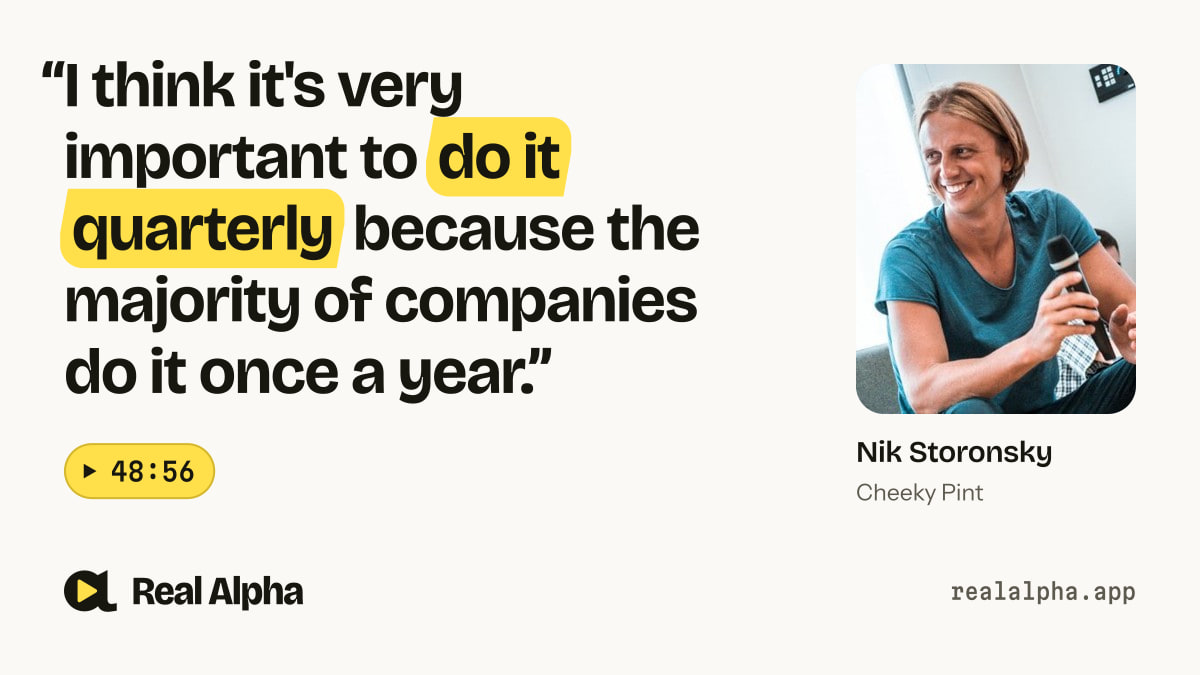
“I think it's very important to do it quarterly because the majority of companies do it once a year.”
 Nik Storonskyat 48:56 · Cheeky Pint
Takeaways
- Quarterly reviews shorten delays in addressing underperformance.
- Managers can be biased against exiting underperformers.
- Legal teams can track SLAs and contract deficiencies.
About this segment
He favors quarterly reviews because managers can be biased against exiting underperformers and annual cycles delay action. Revolut measures skills, deliverables and culture, and tracks team-level legal SLAs and contract deficiencies.

Nik Storonsky is founder and CEO of Revolut.
Co-founded Revolut, the digital bank valued at $115 billion, and founded the QuantumLight venture fund.

John Collison, Host · Co-founder & president, Stripe
Sold his first startup, Auctomatic, at 17, then co-founded Stripe in 2010.
From “Nik Storonsky: The most uncompromising banking CEO”, Nov 10, 2026. Watch the full episode
Thanks. We'll look at and fix what's off.
Transcript
Transcribed by machine (Whisper) from the episode’s audio, so a word may be off here and there.
- 48:39
You mentioned helping startups understand the Revolut playbooks. Where do you think the Revolut playbook is most differentiated? Like, you talked about performance management. You talked about a few things. Obviously, hiring performance management or product building as well. I think with AI, it might be irrelevant. It lasts three years. How do you do performance management differently? I think it's very important to do it quarterly because the majority of companies do it once a year.
- 49:06
I think it's too long. The problem is a lot of managers they are inherently biased against exiting other performers. So by having a process once a year you're not really helping the company because then you're forcing managers to exit underperformance once a year. Yes. Reality, you need to do it as kind of, you know, fast as possible, right? You can already do performance management once every month because it's kind of too time consuming.
- 49:39
Once every quarter you can. And do you try and make performance more quantitative than other companies? Like the mapping products to where they should be on the cohort curve is maybe one example of that. Do you try to do that in other places? Yeah, so we are trying to be as quantitative as possible. So every person is assessed on their skills, deliverables. Deliverables are measured, roadmap plus KPIs, and then culture.
- 50:08
So all these three aspects are assessed by manager plus functional manager. Plus there is a performance review on top of it, checking that everything is correct, and then a person is assessed. But some domains are just fundamentally more quantifiable than others, right? Like a salesperson, you can measure how much they sold, whereas a lawyer, you can only make that so quantifiable, right? Well, in our case, we have metrics for almost each lawyer, I think.
- 50:36
I mean, definitely for the team of lawyers, because what lawyers do, for example, if you look at commercial lawyers and the process contracts, right? and then are they keeping with the SLAs, it's number one metric. How many deficiencies are within the contracts, again, you can measure it. And so on. So you, I mean, on the team level, we definitely have KPIs. On the individual level, I'm not sure, but it's possible.
- 51:02
So you think most companies are, because I don't think most companies really believe that you can measure lawyers on a grid of KPIs. And so, do you think that, again, you can be more quantitative than you think? You can definitely be more quantitative than the majority of companies think. Can you quantify everything? No. So you need to have some other leading indicators rather than some KPIs. OK. We'll leave you there. Thank you, Nick.
- 51:32
Thank you.