The alpha, twice a week
That was 3 min.
Get the best new moments in your inbox every Wednesday and Saturday. It's free.
Check your inbox
We sent a link to your address. Click it to finish signing up. Not there in a minute? Look in spam.
or
Cheeky Pint · 3 min · Nov 10, 2026
Nik found product issues despite 60–80% trading growth
 Nik Storonsky
 says he attends conferences only two or three times a year and spends 95% of his time internally.
In this episode
Full analysis- 3:58Revolut funds product bets only after validation3 min
- 12:28Credit lending makes profits vulnerable to downturns5 min
- 17:47Revolut scales products by early cohort performancePro pick 7 min
- 38:59US fintechs need to own the licensing stack3 min
- 28:09Revolut targets kids because adults are hard to switch3 min
- 33:05AI could shrink Revolut product teams to two people4 min
- 42:32Nik found product issues despite 60–80% trading growth3 min
- 48:35Nik favors quarterly performance reviews3 min
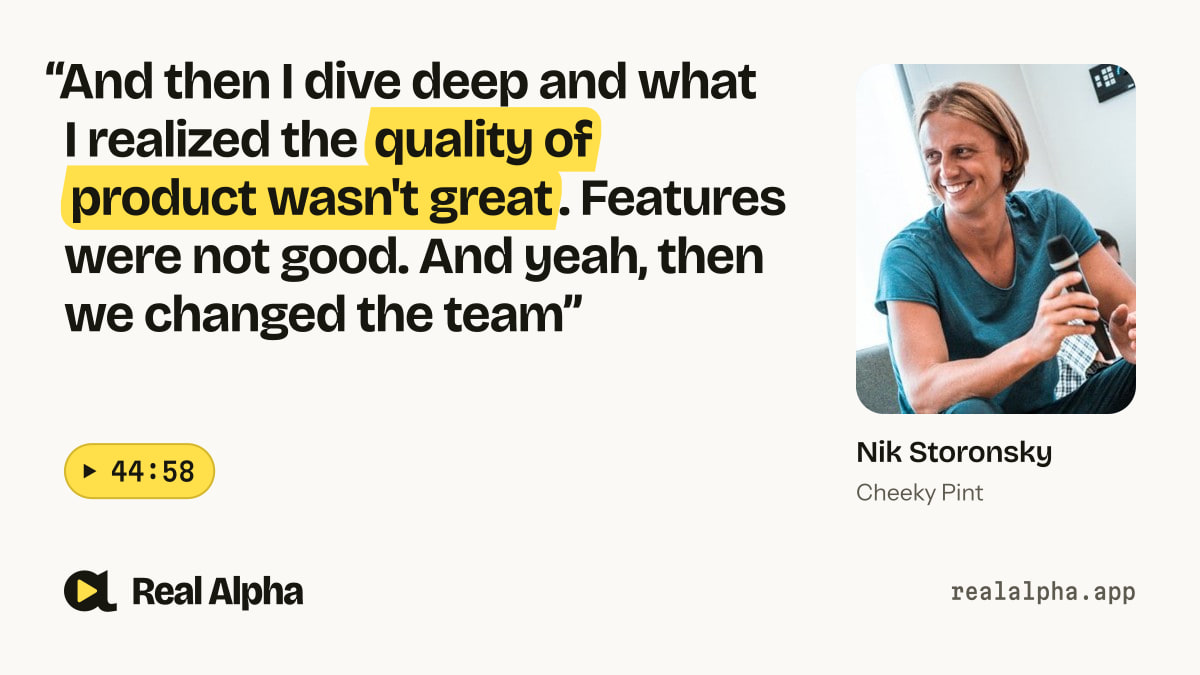
“And then I dive deep and what I realized the quality of product wasn't great. Features were not good. And yeah, then we changed the team”
 Nik Storonskyat 44:58 · Cheeky Pint
Takeaways
- He attends conferences only two or three times a year.
- KPIs can reflect luck or external factors.
- He checks product quality and delivery behind the numbers.
About this segment
Nik Storonsky says he attends conferences only two or three times a year and spends 95% of his time internally. He replaced the wealth-and-trading team after judging its product quality too weak for its 60–80% growth, which later reached 300%.

Nik Storonsky is founder and CEO of Revolut.
Co-founded Revolut, the digital bank valued at $115 billion, and founded the QuantumLight venture fund.

John Collison, Host · Co-founder & president, Stripe
Sold his first startup, Auctomatic, at 17, then co-founded Stripe in 2010.
From “Nik Storonsky: The most uncompromising banking CEO”, Nov 10, 2026. Watch the full episode
Thanks. We'll look at and fix what's off.
Transcript
Transcribed by machine (Whisper) from the episode’s audio, so a word may be off here and there.
- 42:36
Are you waking up and going wherever your curiosity takes you, or is it hyper-scheduled? Monday to Friday, it's hyper-scheduled, 15 or 30-minute slot, so usually it's like business reviews, product reviews, one-on-ones, and then Saturday and Sunday is more like freelancing and free-thinking. Revolut is the kind of company that has a work-from-home policy of, you know, you can work from home two days a week, Saturday and Sunday.
- 43:01
Yeah, that's true. I try to limit their external meetings as much as possible and spend 95% of my time internally. Do you think most CEOs are too externally facing on how they spend their time, going to conferences and all this kind of stuff? 100%. I do have a location for conferences, maybe two or three times a year. And you just want to be within the building, reviewing the actual product? Exactly. Products and the business process.
- 43:30
What are you actually reviewing? Are you looking at metrics dashboards with people? and kind of what are you, Nick, adding versus you'd also have an automated system that shuts down any product that's failing to meet its revenue goals. Yeah, basically we have all these KPIs, roadmaps, and processes actually targeting execution. So before I was doing it manually, and now it's all semi-automated with our performance team also reviewing everything, reviewing the KPIs.
- 44:00
Is it correct that roadmap is executed for each team department on the company level? So what I do is obviously product, product direction, product features, and then detecting bullshit as well. There can be a lot of cases when everything is rosy, KPIs are good, everything is mesh, but then things can be even better. And then I just know it. What is the bullshit that you're detecting? if the KPIs look good?
- 44:32
In what way are they trying to bamboozle you? I mean, you need to dive deeper than KPIs, right? Because KPI can be met because of external factors and because of luck. And then you dive deep and then you look at the product, product features and speed of development as well. I'll give you an example. For example, Wealth and Trading product, I think two or three years ago, it grew up 60 or 80% year on the year.
- 44:57
and then I thought it's not enough, right? It should have been like 300%. And then I dive deep and what I realized the quality of product wasn't great. Features were not good. And yeah, then we changed the team and now it's growing 300%. So it's like easy to have intuition for these things. What's the easiest way to annoy you in a product review? Incompetency.