The alpha, twice a week
That was 3 min.
Get the best new moments in your inbox every Wednesday and Saturday. It's free.
Check your inbox
We sent a link to your address. Click it to finish signing up. Not there in a minute? Look in spam.
or
Cheeky Pint · 3 min · Nov 10, 2026
Revolut targets kids because adults are hard to switch
 Nik Storonsky
Just 10–20% of monthly active users have salary paid into Revolut, so moving them to primary accounts matters.
In this episode
Full analysis- 3:58Revolut funds product bets only after validation3 min
- 12:28Credit lending makes profits vulnerable to downturns5 min
- 17:47Revolut scales products by early cohort performancePro pick 7 min
- 38:59US fintechs need to own the licensing stack3 min
- 28:09Revolut targets kids because adults are hard to switch3 min
- 33:05AI could shrink Revolut product teams to two people4 min
- 42:32Nik found product issues despite 60–80% trading growth3 min
- 48:35Nik favors quarterly performance reviews3 min
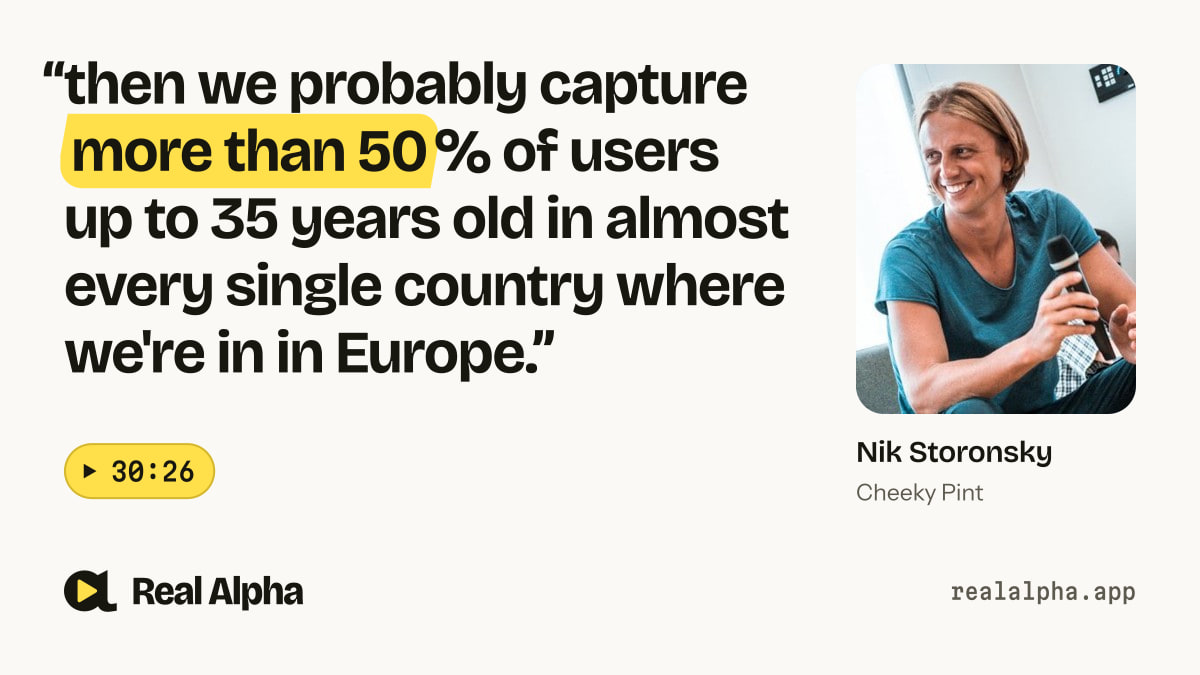
“then we probably capture more than 50% of users up to 35 years old in almost every single country where we're in in Europe.”
 Nik Storonskyat 30:26 · Cheeky Pint
Takeaways
- Salary deposits lead customers to use more Revolut products.
- Only 10–20% of monthly active users have salary paid in.
- Revolut reaches over half of under-35s in most European markets.
About this segment
Just 10–20% of monthly active users have salary paid into Revolut, so moving them to primary accounts matters. Nik Storonsky says kids are easier to capture than adults, and Revolut has accounts for over half of under-35s in most European countries.

Nik Storonsky is founder and CEO of Revolut.
Co-founded Revolut, the digital bank valued at $115 billion, and founded the QuantumLight venture fund.

John Collison, Host · Co-founder & president, Stripe
Sold his first startup, Auctomatic, at 17, then co-founded Stripe in 2010.
From “Nik Storonsky: The most uncompromising banking CEO”, Nov 10, 2026. Watch the full episode
Thanks. We'll look at and fix what's off.
Transcript
Transcribed by machine (Whisper) from the episode’s audio, so a word may be off here and there.
- 28:14
neobanks as I understand it, whether there's like an account or an account is whether people deposit their paychecks. And so you can use Revolut, like a majority of Ireland like uses Revolut in some degree, but they might just use it for peer-to-peer or something like that. But they have an account, and then there's using Revolut as your primary bank account, which in the banking industry, people basically think of as, do you get your paycheck deposited there?
- 28:40
How important is it that you move people from being a lightweight user to a heavyweight user from occasionally using certain features to actually being the place that the paycheck is deposited? It's super important, obviously, because as soon as you get salary into the account, then people use a lot of other products that we have. If they're just using PTP, they, I don't know, load $20, send money to someone.
- 29:05
It's not very profitable for us. So we spend a lot of effort to move salaries of these people to Revolut. And overall, I mean, it depends on the country. Like it's from 10 to 20% of monthly active users, we have our salary that counts. What moves people over? It's a very slow burner. So we actually spend a lot of time and effort building products for kids. Because as soon as we capture kids, then we can easily move them to 18 plus account.
- 29:41
Because it's very hard to move adults. Yes. It's a tale as old as time. I remember when I was in secondary school, maybe a similar experience, the local bank came and they gave us a soda and a bag of chips to sit through a presentation on how to save money, and then they gave us all a bank account. But they were in the school, age 13 or 14, doing customer acquisition on the theory that bank accounts are very sticky.
- 30:11
Okay, but you see very different behaviors from the people. Presumably, if you have 10% to 20% primary banking share amongst kind of the regular population. Presumably that's way higher amongst the younger population because they're Revolut native. If you look at different cohorts of users, then we probably capture more than 50% of users up to 35 years old in almost every single country where we're in in Europe.
- 30:40
And then where we have difficulties capturing 50, 60, 70 plus people who still hold a majority of liquid assets. but then it's very hard for them to move from a legacy bank to a digital bank. And Zuzair, what's that 50% of under 35 statistic? Well, basically, if you take all the countries in Europe, then if you take kids, then people from 18 to 25, 25 to 30, 30 to 35, and then older. In the majority of countries, we already captured more than 50% of people up to 35 years old.
- 31:19
Having any kind of Revolut account.