The alpha, twice a week
That was 4 min.
Get the best new moments in your inbox every Wednesday and Saturday. It's free.
Check your inbox
We sent a link to your address. Click it to finish signing up. Not there in a minute? Look in spam.
or
The Peterman Pod · 4 min · Nov 9, 2026
Nobel speculation can change how scientists present their work
 Venki Ramakrishnan
 says talk of a possible Nobel can alter researchers’ behavior, including how they discuss competitors.
In this episode
Full analysis- 0:33Experiments remain the bottleneck in AI drug discovery6 min
- 10:30A move into biology offered a second chance4 min
- 15:02Choose problems that are important and feasible2 min
- 18:11Ribosome research fell out of fashion before structural progress3 min
- 23:29An unusual CV made biology job searches harder3 min
- 35:08Nobel speculation can change how scientists present their work4 min
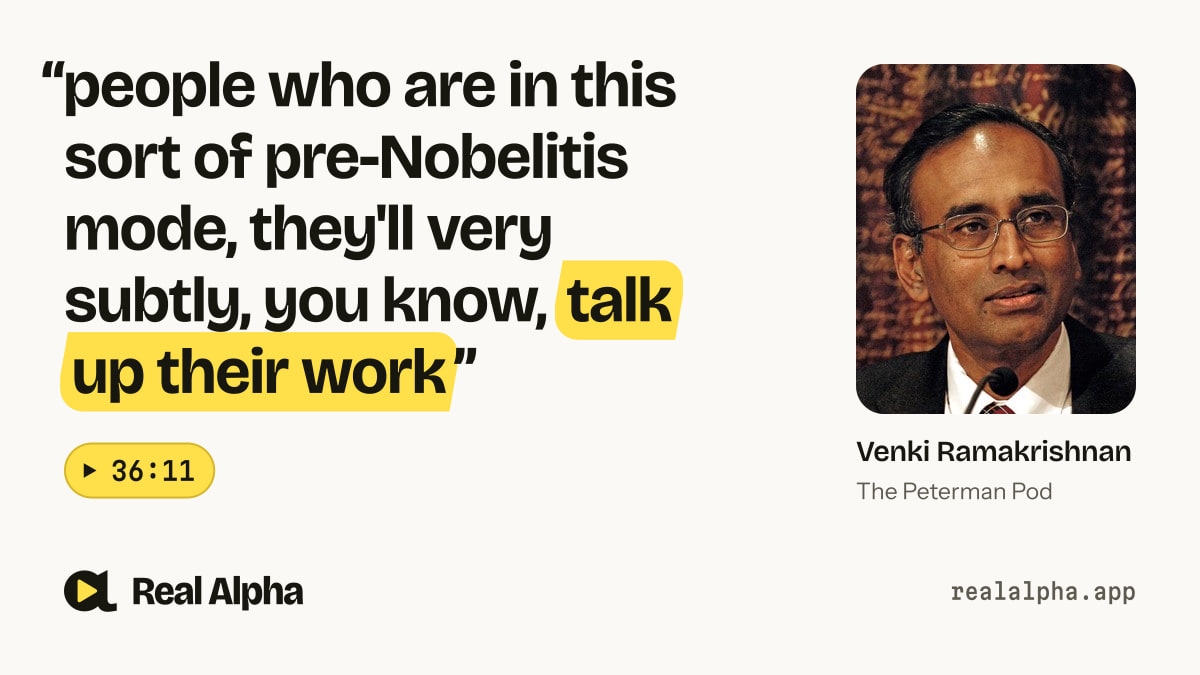
“people who are in this sort of pre-Nobelitis mode, they'll very subtly, you know, talk up their work”
 Venki Ramakrishnanat 36:11 · The Peterman Pod
Takeaways
- Researchers do not usually begin a discovery thinking about a Nobel.
- Outside talk of the prize can shift their attention toward recognition.
- Competitors’ work may get less attention in conference talks.
About this segment
Venki Ramakrishnan says talk of a possible Nobel can alter researchers’ behavior, including how they discuss competitors. He links the award’s status to its history and reputation.

Venki Ramakrishnan is a molecular biologist, Nobel laureate and Isomorphic Labs scientific adviser.
Determined the bacterial ribosome’s structure, advancing understanding of protein synthesis and how antibiotics inhibit it.

Ryan Peterman, Host · Host, The Peterman Pod
Went from new grad to staff engineer at Instagram in three years.
From “Nobel Prize Winner: AI’s Impact On Drug Discovery And Biology | Venki Ramakrishnan”, Nov 9, 2026. Watch the full episode
Thanks. We'll look at and fix what's off.
Transcript
Transcribed by machine (Whisper) from the episode’s audio, so a word may be off here and there.
- 35:11
And in that same lecture, you talked about the politics of recognition, especially in the context of the Nobel Prize. And you mentioned these terms of pre-Nobelitis and post-Nobelitis, or basically when you're getting close to the award, but not quite having it, or you've already won. And I was curious, did you get pre-Nobelitis at any point? I did. I mean, everybody did. I think, you know, what happens is that, you know, you do something important. The first thing you don't think is, oh, you know, I could get a Nobel Prize. That's not what you think about. You think, wow, this is fantastic. You know, and then, but then you get invited to lots of talks, conferences, and so on. And everywhere you go, people say, hey, you know, this could get a Nobel Prize.
- 36:00
And then suddenly that kind of warps your own thinking, and then you start thinking, well, okay, you know, it's limited to three people, and, you know, there are a whole bunch of people contributing to this field, and then you, and then I noticed that in conferences, people who are in this sort of pre-Nobelitis mode, they'll very subtly, you know, talk up their work, and, you know, they won't mention, you know, other people's work, especially competitors work as much and so on it's a kind of human psychology and uh you know i i just think that uh it's a little unfortunate and it's partly the community's fault and and society's fault that they give so much importance to this one award i mean there are lots of other prizes you know the lasker prize and breakthrough prize but if you walk down the street and and you know by the way
- 36:58
The Breakthrough Prize pays, you know, three or four times, you know, three times a Nobel Prize. And if you share a Nobel Prize, it's like, you know, it could be up to nine times, okay? So the thing is, but if you walk down the street, you live in Manhattan, you walk down the street, and you ask some random person, have you heard of the Nobel Prize? They'll say, oh, yeah, sure. And when you say, have you heard of the Breakthrough Prize?
- 37:23
They'll say, no, what's that, okay? So you see, because of its history, it got launched at a time when genetics was being discovered, the nature of chemical bonding and reactions were being discovered, and quantum mechanics and relativity were being discovered. So all three fields had this once in centuries kind of revolution. And so the prizes went to like these absolutely great scientists, you know, Einstein and people like that.
- 37:58
Okay, Paul Dirac and Linus Pauling. So it was just, you know, and Rutherford. So it created a kind of branding for the Nobel. And of course, you know, the people who get it now, some of them might be in that class, but most of them are not. Okay, let's face it. They're not, they're not Einstein's or, you know, or even Richard Feynman or something. So, so, so I think it's created its own cachet. And so it's not surprising that people, you know, who think they might have a chance really kind of, you know, ask whether they might get it.