The alpha, twice a week
That was 3 min.
Get the best new moments in your inbox every Wednesday and Saturday. It's free.
Check your inbox
We sent a link to your address. Click it to finish signing up. Not there in a minute? Look in spam.
or
The Peterman Pod · 3 min · Nov 9, 2026
Ribosome research fell out of fashion before structural progress
 Venki Ramakrishnan
 recalls how researchers moved on while key questions about the ribosome remained unanswered.
In this episode
Full analysis- 0:33Experiments remain the bottleneck in AI drug discovery6 min
- 10:30A move into biology offered a second chance4 min
- 15:02Choose problems that are important and feasible2 min
- 18:11Ribosome research fell out of fashion before structural progress3 min
- 23:29An unusual CV made biology job searches harder3 min
- 35:08Nobel speculation can change how scientists present their work4 min
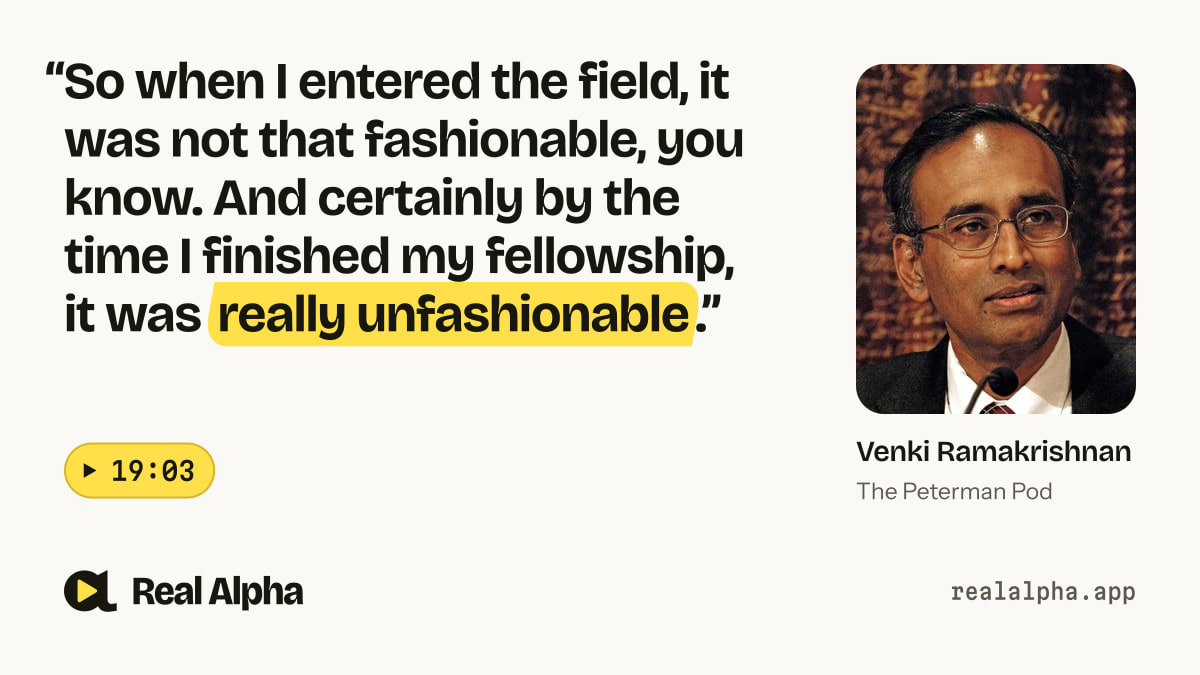
“So when I entered the field, it was not that fashionable, you know. And certainly by the time I finished my fellowship, it was really unfashionable.”
 Venki Ramakrishnanat 19:03 · The Peterman Pod
Takeaways
- Some researchers considered the ribosome’s basic function a solved problem.
- Mechanistic questions remained even after the field lost momentum.
- Improved methods renewed interest in solving the structure.
About this segment
Venki Ramakrishnan recalls how researchers moved on while key questions about the ribosome remained unanswered. Better methods later made its structure seem attainable again.

Venki Ramakrishnan is a molecular biologist, Nobel laureate and Isomorphic Labs scientific adviser.
Determined the bacterial ribosome’s structure, advancing understanding of protein synthesis and how antibiotics inhibit it.

Ryan Peterman, Host · Host, The Peterman Pod
Went from new grad to staff engineer at Instagram in three years.
From “Nobel Prize Winner: AI’s Impact On Drug Discovery And Biology | Venki Ramakrishnan”, Nov 9, 2026. Watch the full episode
Thanks. We'll look at and fix what's off.
Transcript
Transcribed by machine (Whisper) from the episode’s audio, so a word may be off here and there.
- 18:15
But then there were few people who still said, hey, wait a minute, this is a big, enormous molecule, half a million atoms. And it does these things, but we have no idea what it looks like or how it does it, you know. So if you're interested in that, in the actual mechanisms, then it was still an interesting problem. If you just were interested conceptually that, oh, ribosome binds mRNA, joins, brings in tRNAs, joins amino acids together to make a protein, then the problem was solved and you can move on.
- 18:46
So it's a slightly philosophical difference. And the problem was to get to that next level seemed almost impossible in the 60s and 70s, which is partly why these guys just left, sort of declared victory and left. And there were only a few people kind of banging away, trying to get little bits of information and so on. So when I entered the field, it was not that fashionable, you know. And certainly by the time I finished my fellowship, it was really unfashionable.
- 19:17
I had a very hard time getting a job. and then you know technology improved and so on and methods improved and it people realized it might be able to you might be able to solve the whole thing at atomic resolution and that would be a big deal and so then it took off again and now the field has drifted to more complex questions like how are ribosomes assembled in the cell? That's not a random process.
- 19:49
It's a very orderly process and highly efficient. And how are ribosomes regulated? You know, how do you turn off? First of all, how is the production of ribosomes regulated? But then also, how does the ribosome, how does the cell decide, oh, I want to make, translate this piece of RNA very efficiently and, you know, and not so efficiently in other cases? How do I look at protein quality control? Is the ribosome product, you know, really actually good or is it defective and what do I do about it?
- 20:29
So there are all sorts of regulatory questions, like if the ribosome stalls, the cell has to make a decision. Do I just now disintegrate this whole complex and start over, or do I relieve the stall somehow? And then viruses can hijack the ribosome to make its own proteins. So how does that work, and how can you maybe prevent that? So lots of higher level questions beyond the basic structure.