The alpha, twice a week
That was 3 min.
Get the best new moments in your inbox every Wednesday and Saturday. It's free.
Check your inbox
We sent a link to your address. Click it to finish signing up. Not there in a minute? Look in spam.
or
Founders · 3 min · Nov 8, 2026
Parents shouldn't use family wealth to make children feel guilty
 Nikesh Arora
 argues that reminding children how much poorer you were can create guilt rather than gratitude.
In this episode
Full analysis- 8:54More products make enterprise customer acquisition pay offPro pick 6 min
- 18:52Align on the product roadmap before signing an acquisition4 min
- 55:07AI raises cyber risk but does not replace security infrastructure4 min
- 16:15He buys the top two because profits concentrate there3 min
- 30:54M&A is a tool for executing strategy, not the strategy itself3 min
- 24:00Acquired founders need to learn to use the parent company's scale3 min
- 44:37Google's ad salespeople couldn't control price or volume2 min
- 52:04Parents shouldn't use family wealth to make children feel guilty3 min
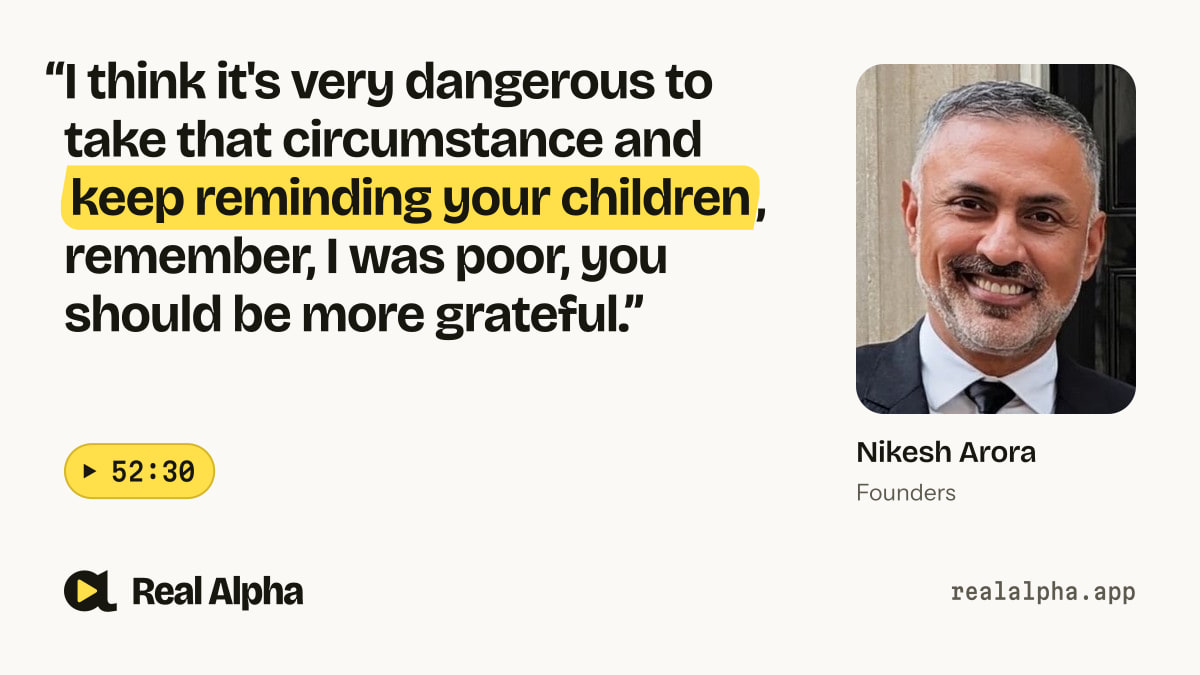
“I think it's very dangerous to take that circumstance and keep reminding your children, remember, I was poor, you should be more grateful.”
 Nikesh Aroraat 52:30 · Founders
Takeaways
- Avoid framing privilege as a debt to parents.
- Help children build ambition without dictating outcomes.
- Measure success by their happiness, health and balance.
About this segment
Nikesh Arora argues that reminding children how much poorer you were can create guilt rather than gratitude. He says to help them find their own ambitions and drive instead.

Nikesh Arora is chairman and CEO of Palo Alto Networks.
Chairman and CEO of Palo Alto Networks, which he grew into a $300 billion cybersecurity leader.

David Senra, Host · Host, Founders
Has read an entrepreneur's biography every week for Founders since 2016.
From “How to Win Deals & Grow a $250B Business | Nikesh Arora, Palo Alto Networks”, Nov 8, 2026. Watch the full episode
Thanks. We'll look at and fix what's off.
Transcript
Transcribed by machine (Whisper) from the episode’s audio, so a word may be off here and there.
- 52:10
And there is something that they almost universally struggle with, which is basically I was the son of a poor man, now my kids are the son of a rich man, what do I do about this? Nothing. You created a distinction by yourself. When you were the son of a poor man There was somebody way poorer than you And from their vantage point You were the the son of a rich man, right? So I think we all get born into a circumstance.
- 52:37
And I think it's very dangerous to take that circumstance and keep reminding your children, remember, I was poor, you should be more grateful. That's what happens, right? Especially for people who are very poor, not very, who are poor, rather to where they are today. They feel this notion where they have to keep reminding the kids, well, it wasn't like this when we were born. No, we used to do this and we used to do that.
- 52:55
Like, dude, get over it. They're born in this. Figure out a way that they can enjoy this and make sure that they learn how to yearn for more, how to go have drive, how to go get achievement, right? You got to be careful. So I think you have to be blessed if you can find a way that your kids want to achieve. They want to build, they want to make things happen on their own and they just don't take their circumstances for granted.
- 53:18
That's the hardest part in parenting is to make sure that your kids have drive, your kids have ambition, your kids want to achieve. My son is obsessed with basketball. Great, go for it. Let him follow his passion. My daughter wants to be a gymnast. He's got tremendous work ethic. She's great. He's extremely sort of, you know, friendly. He likes people. He likes to hang around people. He knows a lot about what he wants to know about.
- 53:39
That's great. If my kids can have passion, they can go chase their passion. They can show ambition and drive. I don't care if he becomes a basketball player, a basketball commentator, as long as he wakes up every morning and is happy and felt that he gave it his best. I completely agree with this perspective. Out of all the examples I've read about, I love what Sam Walton said in his autobiography, which he wrote when he knew he was dying.
- 53:58
It can't solve all of his body. And he says, I know I'm a fairly overactive fellow, which is the most understatement of a century. He's like, I don't put pressure on my kids. This is like, let them do. Why would I want them to be like me? But it's kind of interesting. If you do it the right way, you know, your kids will watch your behavior. They watch more behavior than you think. They know more about how we are, who we are, than we possibly can ever understand.
- 54:24
And sometimes they will want to do certain things like you. But if you try and force them to do certain things like you, you're never going to get there. I can see my kids would like to do certain things like me, and that's great. I'm very happy that they want to. And I'm sure sometimes they're looking and saying, I never want to do that thing that my dad does. So that's fine too. As long as they can find out what parts of what I do they like to do and what parts of what I do they don't like to, they're fine.
- 54:45
I'm okay with that. I'm thinking back to all the other people I've had on the podcast, and I'm like, I just feel, yes, AI is changing every single business.