The alpha, twice a week
That was 7 min.
Get the best new moments in your inbox every Wednesday and Saturday. It's free.
Check your inbox
We sent a link to your address. Click it to finish signing up. Not there in a minute? Look in spam.
or
TBPN · 7 min · Jul 13, 2026
Rising home prices don’t always make homeowners wealthier
 Morgan Housel
 distinguishes a home’s paper value from wealth you can actually use, then points to permitting as a key housing constraint.
The episode’s best minutes
Full analysis- 1:58:39Apple’s lawsuit may slow OpenAI before it reaches court8 min
- 1:28:49Rising home prices don’t always make homeowners wealthier7 min
- 51:15Live events can endure because human experience mattersPro pick 4 min
- 5 more moments in the full episode
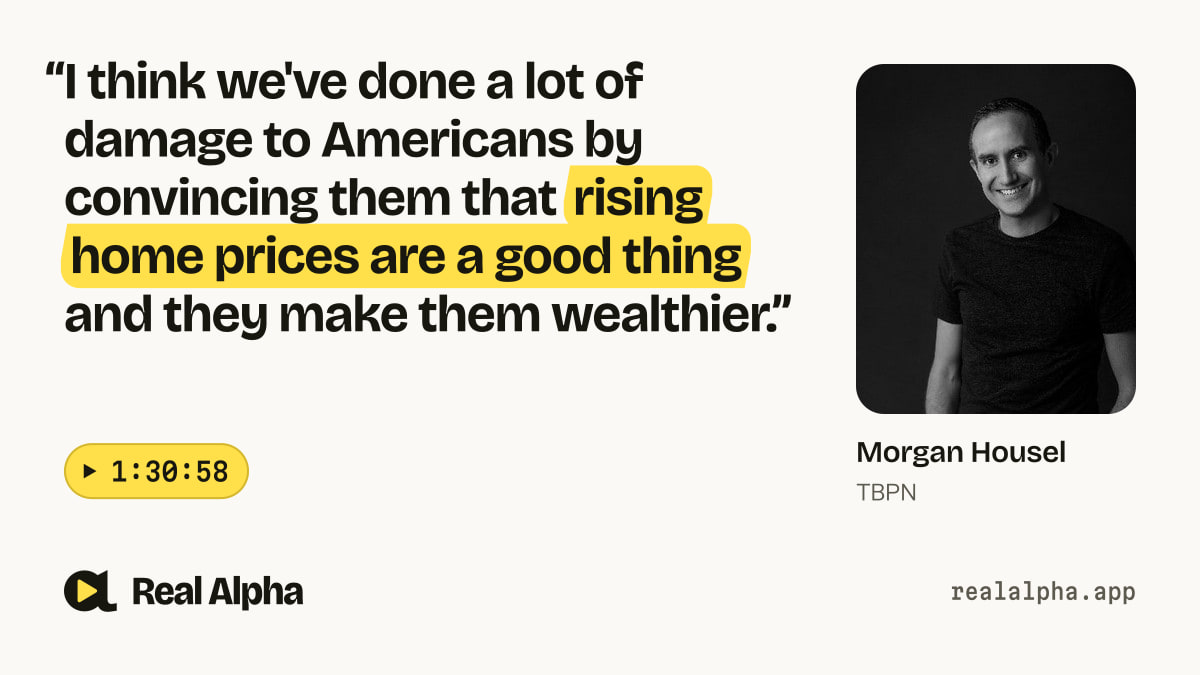
“I think we've done a lot of damage to Americans by convincing them that rising home prices are a good thing and they make them wealthier.”
 Morgan Houselat 1:30:58 · TBPN
Takeaways
- Selling an expensive home to buy another may not create real wealth.
- Permitting makes it difficult to build where people want to live.
- Levittown built thousands of modest homes at scale after World War II.
About this segment
Morgan Housel distinguishes a home’s paper value from wealth you can actually use, then points to permitting as a key housing constraint. The postwar Levittown example shows how building at scale once helped meet demand.

Partner, Collaborative Fund
Wrote The Psychology of Money and Same as Ever, bestselling books on behavior, investing and how people think about money.

John Coogan, Host · Co-host, TBPN
Co-founded Soylent and Lucy; OpenAI bought his show TBPN in April 2026.

Jordi Hays, Host · Co-host, TBPN
Founded Branded Native; co-founded fintech Capital, which Rho bought.
From “Apple vs OpenAI, Mustard Controversy, Mark Gurman, Alexis Ohanian, & Morgan Housel Join”, Jul 13, 2026. Watch the full episode
Thanks. We'll look at and fix what's off.
Transcript
From the transcript TBPN publishes with the episode.
- 1:28:56
I want your reaction to this chart that Joe Wiesenthal, a friend of the show shared, and we will have the team pull it up. It's the percentage of US household net worth over time. And for a long time, real estate was the dominant place where American households held their net worth. But for the first time, we are seeing that households are increasingly holding equities. Cash and cash equivalents peaked in the eighties and is sort of declining around 10 of household net worth, but equities have been completely up into the right.
- 1:29:34
Maybe it's just a temporary dislocation in the stock market. The stock market is doing very, very well. Houses are more expensive, so households are preferencing that. But I'm interested in your take on what this says about US households, but also the psychology of what it means to hold a, you know, a larger percentage of your wealth in equities versus your house.
- 1:29:58
Yeah. We always talk about, like, the stock market crash in 1929, and and I I think the the statistic was 5% of Americans owned stocks in 1929. That's right. So we had like, we we talk about it as, like, it started the Great Depression, but it was it was such a small number of people that actually got hit by that. Yeah. Whereas today, think the status 55% of Americans own stocks, the vast majority of them in their four zero one k.
- 1:30:19
Yeah. Now and and part of that, like, if you're an investor for the long term, the odds that you're gonna experience a 30% decline or even a 50% decline are are almost a 100%. That's just how markets work over time. Yeah. And does the do does the general population of just, ordinary Americans who are not watching this and listening to finance podcasts and reading finance books, do they have the stomach for that, or do do they even know that that's the game that they signed up with for? I think by and large, the answer is no.
- 1:30:46
And even if you do know it, knowing it and experience it in in real time can be completely different. The one thing is that, like, stocks have been over time. Nothing is promised in the future, but generating real growth above the rate like, well above the rate of inflation. Real estate is something completely different where, particularly if it's the house that you live in, not a rental that you have, I I I think we've done a lot of damage to Americans by convincing them that rising home prices are a good thing and they make them wealthier. And it is such flawed math because if you buy a house for $500 and then sell it for a million, how much money did you make?
- 1:31:19
Yeah. Well, for most people, once they sell it, they have to buy another house that also inflated in value by two x over the last same period. So you didn't probably didn't make anything. And so I I think there's a lot of, like, it looks like wealth on paper with real estate, but it's just a place to live in, and you have to exchange it for another place to live in, and you didn't really make that much over time. So maybe if we're talking real wealth over time, it's a much better situation that we're that we're in now.
- 1:31:42
Yeah. I am interested about I mean, I I know some people who bought in Mill Valley, like, years ago, decades ago just because that was a logical place to buy and it was a nice community. And, of course, the house prices are insanely high with the AI boom with San Francisco booming. But there isn't a logical like, oh, yeah, of course, they'll move to Florida at some point because that's not really what people do culturally. If you are in California, you sort of just retire in the town that you grew up in or live in Yeah.
- 1:32:11
And raise your kids in. If you can do that, if you can sell in Mill Valley and move to Oklahoma, that's great. That's real wealth. Yeah. But if you sell in Mill Valley and buy in Mill Valley, you can make anything.
- 1:32:19
You're not doing anything. What how do you how are you do you ever think about, like, the different prescriptions for solving the housing crisis? We're having Sagar and Jetty on the show tomorrow to talk about it, but I'm interested if there's if there's anything that you have that you've dug into, whether it's through the abundance or permitting or anything that stuck out to you as particularly exciting around the way America deals with housing broadly?
- 1:32:47
I think I mean, it's simple, but it's but it's not easy. It would it would be around permitting and building more. There's obviously demand for more. There is the ability to build more. It's just that in the vast majority of cities, it's virtually illegal to build where people wanna live or at least extremely difficult. And it's one thing to say, you know, build more homes. It's another if you're a home developer in California and you wanna go build 200 homes, you're gonna be waiting in line for years and paying a fortune to actually build that if you can actually get it done.
- 1:33:15
Yeah. And and so I think the idea that, you know, there's a great saying by Connor Senn, who's a great thinker, around these topics, he says, the future is a policy choice. And the reason that home building is so scarce and we don't have enough homes is because we've made a choice to be in that situation. There's no like, it's if you were left to its own devices, it would be solved not that, you know, in in due time. And we did this similar situation at the end of World War two when you had 16,000,000 soldiers come home. There were not nearly enough homes for them.
- 1:33:43
Yeah. But at the time, it was much easier to build than it is today. And so you had things like Levittown that sprung out of the middle of nowhere, and they were building 25,000 homes in a year. And you solve the problem in due time. And so it's it's simple, but just politically much more difficult to say, like, yes. I think by and large, it's permitting. It's not a it's not an exciting answer, but we've made the choice make it difficult to build where people wanna live.
- 1:34:07
Yeah. For for those who don't know, what what is the actual story of Levittown, and and can that be replicated today? I was I was in Irvine, and it feels like a very planned community. Of course, most of that town was built maybe a hundred years ago, but just driving around and seeing so many apartments and houses, it felt like this could be replicated, but I don't I'm not exactly sure how far it would be. Yeah.
- 1:34:33
It was the end of World War II, and there were like I said, there were all these soldiers who needed homes and buying like, most of them a lot of them moved back in with their parents Sure. Which is not what you wanted to do coming home from war. Yeah. And the Leavitt brothers were homebuilders. They started buying up abandoned farms Oh. In New York and Pennsylvania. They basically took what Henry Ford figured out for cars, which is like, you have to make the manufacturing process, like, very step by step Yeah. And every person has a specific step that they do all day long. And they they made very small, very cheap, not high quality homes, but they could just bang out tens of thousands of them. Yeah. And and it it it between that and, like, the GI bill that helped finance a lot of those homes, I don't think it's an exaggeration to say.
- 1:35:12
Like, it saved that generation who came home and had nothing, and within a couple years, allowed them to have a good dignified life going forward.
- 1:35:20
Yeah. I've been surprised that we haven't seen more spreading out of basically, like, longer commutes or longer distance commutes because we're on the cusp of self driving cars. Even just a basic Tesla Model three has self driving that can make an hour long commute much more palatable. And then you also have telecommute and a lot of companies have like a work from home Friday policy or some flexibility around that. And I was expecting that there would be some alleviation from the pressure.