The alpha, twice a week
That was 6 min.
Get the best new moments in your inbox every Wednesday and Saturday. It's free.
Check your inbox
We sent a link to your address. Click it to finish signing up. Not there in a minute? Look in spam.
or
Lex Fridman Podcast · 6 min · Nov 10, 2026
Russia is spending a large share of its economy on the war
 Michael Kofman
 says Russia may be able to fight into 2027, while elites warn current spending is unsustainable.
In this episode
Full analysis- 24:47Offensive success depends on suppressing enemy drone units5 min
- 1:03:21Analysts over-rationalized Russia's invasion planPro pick 8 min
- 1:25:58Bakhmut's symbolic value outlasted its military value6 min
- 1:34:51Russian battlefield reports can distort fire support8 min
- 2:39:20A ceasefire could leave Ukraine exposed to renewed attack3 min
- 1:47:11Political leaders may ask how to delay defeat, not win8 min
- 2:06:24The Russian military adopted Wagner's assault tactics3 min
- 2:20:56Russia is spending a large share of its economy on the war6 min
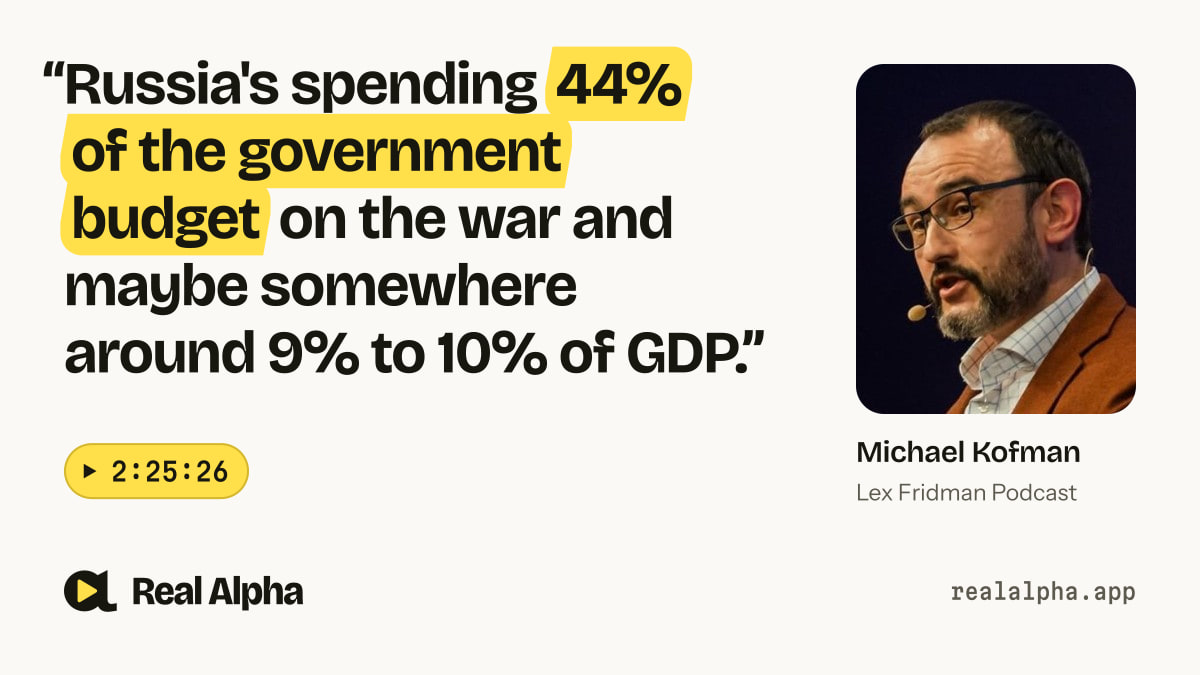
“Russia's spending 44% of the government budget on the war and maybe somewhere around 9% to 10% of GDP.”
 Michael Kofmanat 2:25:26 · Lex Fridman Podcast
Takeaways
- Russia's war spending is about 44% of its government budget.
- Military spending is estimated at 9–10% of GDP.
- Economic elites have warned the spending level is unsustainable.
About this segment
Michael Kofman says Russia may be able to fight into 2027, while elites warn current spending is unsustainable. He cites 44% of the budget and 9–10% of GDP going to the war.

Senior Fellow, Carnegie Endowment
Led foundational research on Russia’s military and studies Ukrainian forces and Eurasian security at Carnegie.

Lex Fridman, Host · Host, Lex Fridman Podcast
Robotics and AI researcher at MIT; started the show in 2018.
From “Russia-Ukraine War: Putin, Zelenskyy, Trump and the Future of Warfare | Lex Fridman Podcast #504”, Nov 10, 2026. Watch the full episode
Thanks. We'll look at and fix what's off.
Transcript
Transcribed by machine (Whisper) from the episode’s audio, so a word may be off here and there.
- 2:21:01
factors, forces that come into play, like the state of the economy, the will to fight amongst to people, like very simply manpower, as you've spoken about, like in order to fight, well, you need humans to be doing that fighting. So how does that come into play? How long can Ukraine last in this fight? How long can Russia last in this fight? Admittedly, the economy, I thought that the sanctions would have done a lot more damage at this point. I think a lot of people did and it just hasn't. Russia has found a lot of ways to bypass that. I thought the Russian people would have been frustrated long ago with the change in their status of living. That didn't materialize.
- 2:21:41
So there's no doubt that the Russian economy is feeling some pressure to the extent that that will impact the end of the war or could drive the end of the war. It's a bit of a black box from my perspective. The other issue that Russia is playing with right now is manpower. Overall, Russia has the manpower advantage and it's not close. They have more people than Ukraine and it's not close. Ukraine has done a good job of, while they are mobilizing and conscripting people into the force, they are doing what they can to minimize soldiers at the front in dangerous positions. They're handing a lot of this off to robots when possible. Russia is continuing to push men forward, trying to take terrain, not with robots and not with drones, but with soldiers.
- 2:22:27
And that's costing a lot of lives. Russia, in certain regions, has started to really struggle in filling their recruitment demands. And we're seeing what, in fact, I think Mike wrote a piece about this recently, but there was kind of a shadow mobilization, if you will, inside of Russia, where they're starting to coerce more and more people into joining the military. again they have far more people but what does it look like when you start having to pull in more people that don't want to fight ukraine has already had to deal with that they've already had to go through a number of people a number of different groups within society that maybe didn't volunteer right out the gate or i just read an article earlier today about a soldier uh who now is doing an incredible job in the ukrainian military they grabbed him at the
- 2:23:10
border he was trying to leave the country and now he's kind of found a purpose as a uh as a drone mechanic. Ukraine has done a lot of that. Russia is starting to get into that, and that's a big unknown, is how will the country react when they start having to tap into other portions of the population. I'm not overly optimistic because we've seen a number of things at this point that I thought would have pushed the Russian population over the edge. The casualties, for one, shocking.
- 2:23:38
At about the three-month mark, I thought that that would be enough for the people in Moscow to rise up and say, we're not going to do this. And my God, here we are 30 plus thousand casualties a month. And they're just, there's no one in sight. So I'm not optimistic that should there be a mobilization or a push to pull in more people that have not been fighting, that it'll change anything drastically inside of Russia. But that dynamic is changing. I think from a resource perspective, both of these are fairly large countries, and both of them have considerable external support. Ukraine has demonstrated immense resolve and will to fight, but clear without Western support, Western capital, Western military capabilities, okay, would not have been able to sustain the war for this long. Russia, too, has benefited significantly from China,
- 2:24:35
Chinese economy, access to machine tools, components. China, to a lesser extent North Korea, and much lesser extent Iran. But North Korea shipped so much. You know, at one point in the war, North Korea was providing 40% of Russian artillery ammunition in this war. And shipping artillery, and actually North Korean troops, if you remember, fought on the Russian side in Kursk during that battle for Kursk. So both sides benefit considerably from external support that And this is what enables Russia to continue the war.
- 2:25:12
I think from an economic point of view, it's difficult to predict. It's clear Russia has the resources to continue to fight into 2027. But key economic elites in Russia, early this year in the spring, began to publicly state that this war and this level of government spending is not sustainable. Russia's spending 44% of the government budget on the war and maybe somewhere around 9% to 10% of GDP. the russian economy has structural issues and so much of the money is going towards the military effort and production of military goods which are not economically valuable that the economy is slowly consuming itself so they have issues for ukraine the main challenge is that the war continues to damage the ukraine economy and also drive people from the country since a big part of the Russian military campaign is to try to hurt the economic viability of Ukraine and
- 2:26:12
sustainability of life in Ukrainian cities. And so, Ukraine is doing well on the battlefield, continuing the war naturally comes at cost. I don't know any country that hosted a conventional war in its territory that was the better off for it. It's very clear. And Ukraine's main challenge is it depends so heavily on financial support, military support, intelligence support from the West as well, that these are things that have to constantly be renewed.