The alpha, twice a week
That was 3 min.
Get the best new moments in your inbox every Wednesday and Saturday. It's free.
Check your inbox
We sent a link to your address. Click it to finish signing up. Not there in a minute? Look in spam.
or
Wall Street Week · 3 min · Oct 30, 2026
Ryan says debt plans were dropped as leaders judged them bad politics
 Paul Ryan
 recounts Republicans passing four debt-payoff budgets before party leaders decided the approach was bad politics.
In this episode
Full analysis- 26:55Federal borrowing costs show up in household loans2 min
- 16:40Data centers need local standards and federal safeguards2 min
- 32:58Tax reform and enforcement could raise more revenuePro pick 3 min
- 5:21Inflation measures miss some household affordability pressures2 min
- 7:47USMCA review puts trade enforcement and China in focus3 min
- 19:01AI job effects are uneven, and CEOs want rules5 min
- 29:13Ryan says debt plans were dropped as leaders judged them bad politics3 min
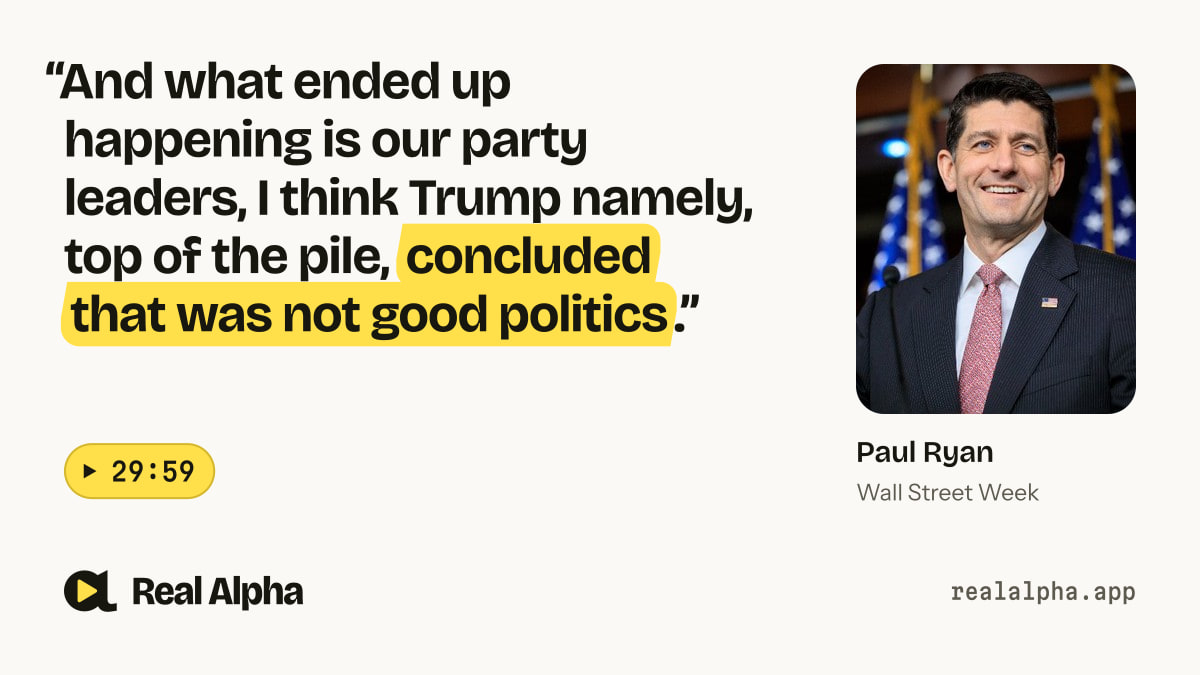
“And what ended up happening is our party leaders, I think Trump namely, top of the pile, concluded that was not good politics.”
 Paul Ryanat 29:59 · Wall Street Week
Takeaways
- Ryan says House Republicans passed four plans showing how to pay off the debt.
- He says party leaders, including Trump, later judged debt reduction bad politics.
- He argues credible entitlement changes could reassure bond markets.
About this segment
Paul Ryan recounts Republicans passing four debt-payoff budgets before party leaders decided the approach was bad politics. He says entitlement changes could still win bond-market confidence as Social Security faces a looming shortfall.

Partner & chair of the Executive Partner Group, Solamere Capital
Served two decades in Congress, including as House speaker, and chairs Solamere Capital’s Executive Partner Group.
- DW
David Westin, Host
From “Affordability Crisis, Data Center Divide, Debt Hits Households, Capitalism on the Ballot | Wall...”, Oct 30, 2026. Watch the full episode
Thanks. We'll look at and fix what's off.
Transcript
From the transcript Wall Street Week publishes with the episode.
- 29:15
a plan he moved forward when he was in Congress. Before I was Ways and Means Chair, I was the head of the Budget Committee for Republicans for four terms. So I really cut my teeth in Congress writing the federal budget. And back in those days, in the 2010s, we believed at the time that we could draft budget plans that actually paid off the debt.
- 29:37
Not just balance the budget, but paid off the debt. It takes years. to do it. We passed four budgets in those days in the House that actually showed you how to pay off the debt. We addressed Medicare and Medicaid and all the drivers of our debt. I think we had politics at a point where Republicans could offer specific plans at debt reduction and politically survive.
- 29:59
But we did not win the presidential election. And what ended up happening is our party leaders, I think Trump namely, top of the pile, concluded that was not good politics. And so it was jettisoned. But I think there was a time and day where Republicans were offering very specific, coherent debt reduction plans, which would have avoided a debt crisis, which I think we're heading toward one right now, frankly, if you ask me.
- 30:23
A lot has happened since those days. Among other things, we're now up to $ 40 trillion plus in debt. We're a lot farther down the pike than we were before. Is it too late?
- 30:33
It's not too late, but I think we're losing wiggle room. And it's really kind of a question for the bond markets. If we could pass a plan that solves the entitlement problem, which is all these massive unfunded liabilities, and show that it will take a long time to get the debt under control. But if we could pass a plan. Today that shows that debt reduction over time, I would like to argue that the bond markets will give us credit for that.
- 30:58
You said the magic word, entitlements. Yeah. And I frankly don't remember the last time I remember a prominent national politician of either stripe, even mention the word. But not anymore. I don't even hear it coming up.
- 31:10
Here's the way I would describe it. Our country has what we call a social contract. And this is something we fought bitterly over between the various parties in the 20th century. but you're going to have to change them from my Generation X on down. And the thing is, we can change them to make them work better.
- 31:25
So if we apply the lessons that we've learned in the last 40 to 60 years, how to fix.
- 31:29
These programs and address these things, I think we can fix the social contract, prevent a debt crisis, and guarantee people in near retirement that the promises government made to them will be kept. But if we don't do any of that, if we just keep going the way we're going, we're probably going to have a debt crisis.
- 31:46
Saron agrees that addressing entitlements is key to any plan dealing with the debt and deficit, and she warns that we'll be forced to do something sooner than many people think.
- 31:56
And a thing that people I think are insufficiently focused on is that the next president is going to inherit a social security trust fund that is going to extinguish within his or her tenure. And so we, these are not problems that are like, you can wait to see, and do we get some sort of fiscal crisis that requires us to act? These are problems that we are going to need to address. And there's kind of no two ways around it, unless you want to see across the board benefit cuts of 28% to current Social Security recipients.
- 32:29
That's crazy.