The alpha, twice a week
That was 3 min.
Get the best new moments in your inbox every Wednesday and Saturday. It's free.
Check your inbox
We sent a link to your address. Click it to finish signing up. Not there in a minute? Look in spam.
or
80,000 Hours Podcast · 3 min · Aug 11, 2026
Safety researchers may have more impact outside AI labs
 Geoffrey Irving
 says government roles connect safety researchers to national security, policy, and other governments.
In this episode
Full analysis- 12:22Good behavior on one task may not generalize to another3 min
- 21:00Debate can reward arguments that sound true but are falsePro pick 4 min
- 31:27A training pause could leave plenty of room for economic growth8 min
- 1:54:15Capability mistakes are easier to correct than alignment failures8 min
- 2:58Short task horizons don't rule out long-term plans5 min
- 1:05:48Data generation could speed progress on fuzzy tasks5 min
- 39:18Safety researchers may have more impact outside AI labs3 min
- 1:24:30Counterweights can expose power-seeking behavior5 min
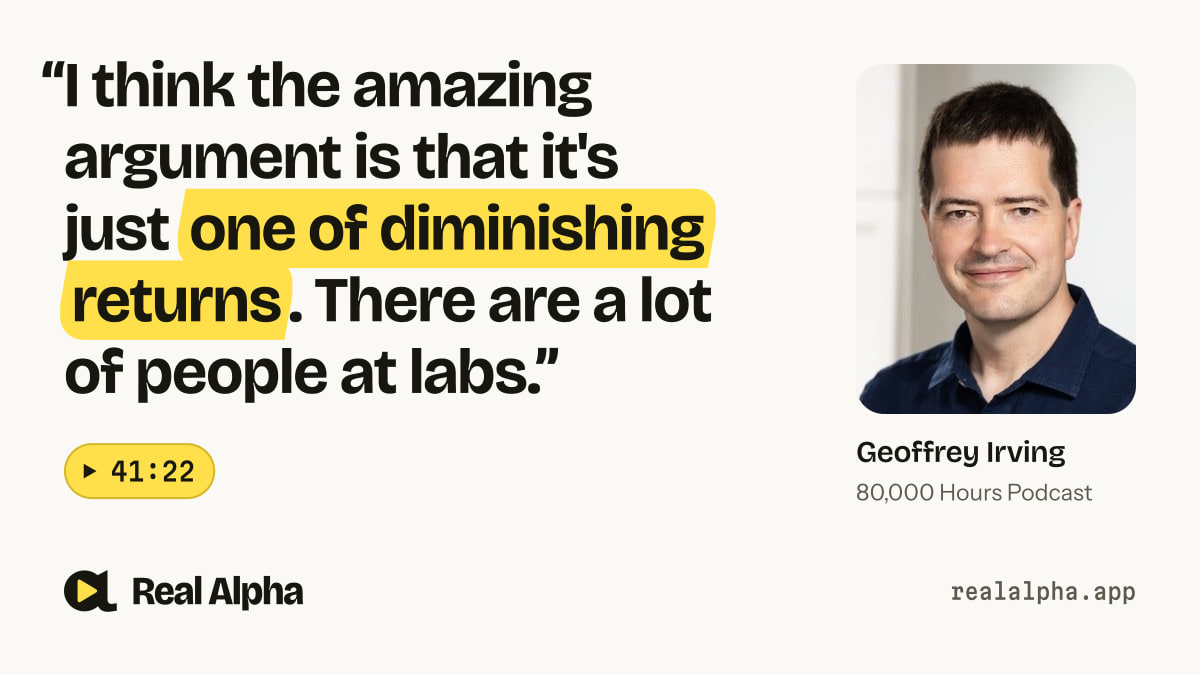
“I think the amazing argument is that it's just one of diminishing returns. There are a lot of people at labs.”
 Geoffrey Irvingat 41:22 · 80,000 Hours Podcast
Takeaways
- Government work connects technical research with national security and policy.
- Lab safety teams may face diminishing returns as they grow.
- Senior researchers can advise governments across a broad range of issues.
About this segment
Geoffrey Irving says government roles connect safety researchers to national security, policy, and other governments. Since labs already have many researchers, he argues senior people may have more marginal impact advising government.

Geoffrey Irving is cofounder and chief scientist of Resolution.
Led alignment teams at OpenAI and DeepMind; now co-founded Resolution to research confidence in aligned superintelligence.
- TR
Tom Reed, Host
From “We have 3 years to solve alignment before superintelligence”, Aug 11, 2026. Watch the full episode
Thanks. We'll look at and fix what's off.
Transcript
Transcribed by machine (Whisper) from the episode’s audio, so a word may be off here and there.
- 39:22
Let's go back to government work. So you worked in government before yourself. I'm curious, what affordances did you find that you had at UKAC that you didn't have at OpenAI or DeepMind for changing the world? Yeah, I guess there's a couple of them. So one is – maybe I'll list three of them, and then we can go from there. So one is just adjacency to national security, so like being close to national security because there's a bunch of ingredients out of the risk story that come from those sources, and you need collaborations with NatSec to have good takes.
- 39:58
The next one is – uh just adjacency to policy so if we want to do this kind of uh coordination across the world where governments play a role you could have have to be in a government to to be to be close to policy in that sense that's not the only actor like we want a lot of of third parties and non-profits and independent researchers doing this kind of policy development but you need part of the story just being in a government um there's a kind of a sub part of that which is that But there are, in many cases, sometimes governments only listen to governments.
- 40:33
And so at AC, we had a bunch of our own research, but often also we would just be able to go to another government and say, here's some of our research and some of someone else's research, like from Meter or Apollo or the like. And that package was much more received and listened to than if it had just been Meter and Apollo trying to go directly to a government of like various other countries. And so I think that proximity to kind of NATSEC and policy and other governments of the world I think is kind of the key thing.
- 41:05
It's very valuable. And if there's so many worlds where governments will need to play a role in things playing out well, like, what do you think about all the AI researchers who are very, very concerned about safety but are currently working at AI labs rather than in the government? Like, do you think they're – are they basically wrong to be doing so? Do you think they could have more – yeah. I think on the margin they are in fact wrong and many of them should leave and join governments.
- 41:26
I think the amazing argument is that it's just one of diminishing returns. There are a lot of people at labs. If you are a kind of a safety researcher at a lab, probably you're further out on the diminishing return curve than you would be if you joined a government or a nonprofit. And so if every one of the people at labs left all en masse and joined the government, that probably would be bad. But that's not the actual calculation.
- 41:56
The marginal move is very high value. It's pretty clear. And I think people look at themselves and think, I have – I'm an individual researcher. I'm kind of a special snowflake. I have like a very particular agenda. I'm the only one pursuing that particular agenda. I should keep doing it if it's an important agenda. And I think that is sort of making a calculation which is a bit too focused. And if you sort of blur your self-image a bit and just think of it as like, oh, I am a safety researcher.
- 42:26
I probably have broad takes and knowledge about a variety of things. I can advise governments on a broad range of issues. Probably the lab would pick up the slack on what I'm doing to some degree. It would work pretty well.