The alpha, twice a week
That was 3 min.
Get the best new moments in your inbox every Wednesday and Saturday. It's free.
Check your inbox
We sent a link to your address. Click it to finish signing up. Not there in a minute? Look in spam.
or
MTS · 3 min · Nov 17, 2026
Scientific AI adoption depends on training and proof
 James Sinka
Berk says scientists outside AI hubs often use chatbots instead of agent workflows; James Sinka says inertia changes when people see concrete results.
In this episode
Full analysis- 5:43AI narrowed 43 quintillion lung-rejuvenation options to candidates3 min
- 9:19Scientists can use AI as a co-scientist, not just an automation tool3 min
- 22:07AI could make existing research funding go much furtherPro pick 3 min
- 18:07Scientific AI adoption depends on training and proof3 min
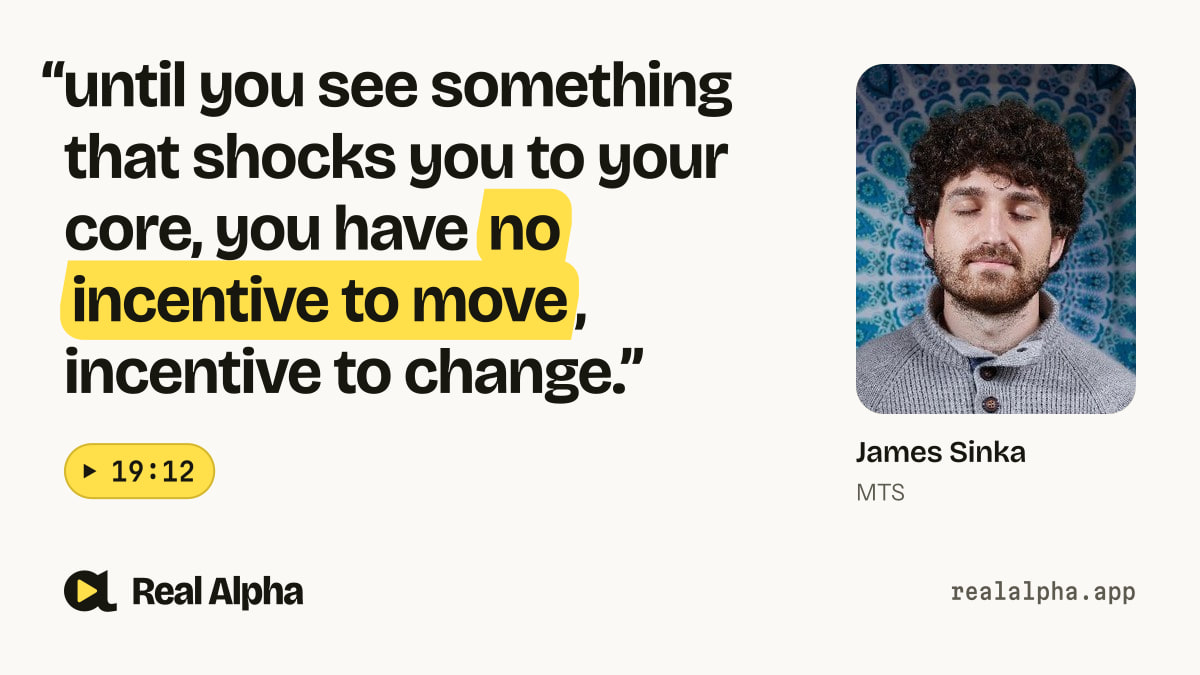
“until you see something that shocks you to your core, you have no incentive to move, incentive to change.”
 James Sinkaat 19:12 · MTS
Takeaways
- Scientists need workflows and agent capabilities beyond chat interfaces.
- Habit and institutional inertia can slow adoption of better tools.
- Demonstrated scientific outcomes can give people a reason to change.
About this segment
Berk says scientists outside AI hubs often use chatbots instead of agent workflows; James Sinka says inertia changes when people see concrete results. Adoption depends on training and proof, not capability alone.

Co-founder, Reactorfield
Commercialized scientific research across biotech, materials science and ML, and built deep-tech ventures and a science fellowship.

Sophia Dew, Host · Host, MTS
From “James Sinka & Berk Ozer Reactorfield w Sophia Dew”, Nov 17, 2026. Watch the full episode
Thanks. We'll look at and fix what's off.
Transcript
Transcribed by machine (Whisper) from the episode’s audio, so a word may be off here and there.
- 18:12
What are the other areas? Maybe Burke would love to start with you around what is hard? Yeah, sure. I think one big problem is that we live in a bubble here in SF. That's true. If I say, hey, do you use loops? You will probably heard of it. You are using it, right? Like graphs, whatever is popular in AI. Whereas in the rest of the world, they don't know that. They still use chatgpt.com, cloud, and they think that they are using the frontier AI.
- 18:42
They don't even know about those agency capabilities. That's one of the biggest gaps that we need to teach that, no, that's not the frontier AI. If you are just using chatgp.com as a chatbot, you need to build workflows around it. You need to know about context window. You need to build a great setup for your co-scientist so that they can achieve things with you. Yeah. What's your take on this? I think a lot of it is just inertia.
- 19:12
People are used to doing things the same way they have for a very long time. And so until you see something that shocks you to your core, you have no incentive to move, incentive to change. If you think back like 100,000 years ago to when sapiens were still on their path, I mean, we are still evolving. But that era, that time period, there was so little change. so like your children would have basically the same kind of environment that you did and that your parents did so on and so forth but if you think about how different our generation is from our parents and then your kids will be like we uh grew up in an era of social media your parents didn't have a smartphone when they were young right and so like there's a chance that like our kids might be born with like a neural link you know what i mean like like there's just so much
- 20:00
change is happening so so quickly and people are biologically used to evolutionarily to do the same kind of thing to resist change it's it's a natural phenomenon change is scary and so i think that the biggest issue is is culturally and so what we aim to do there is to give people that like oh shit moment right that like aha because when that happens you have this like um it's like a one-way door where you go through it and you can't unsee what a world where you use uh all these like additional helpers to help you do whatever it is that you're curious in so um fundamentally i think that that part of this is like a narrative issue we've had in the ai space like oh it's going to take everyone's jobs and don't get me wrong there will be some job displacement like absolutely of course with every technological revolution there is but we're not talking about what this means for
- 20:48
society right and so so showing what what the downstream outcomes are going to be and and again not just talking about them, but actually proving it, actually making mice that don't die from cancer or curing cancer from these radioisotopes or extending lifespan or fixing climate change. Like when we prove these things, people will like get on board societally. And then in the near term, it's making sure that we give people these like, oh, wow moments that we've all had when we first used the AI that we understood, okay, cool. I can't go back. Man, I can't wait for the oh, wow science moments. We had someone on from Electric Plant Company who was talking