The alpha, twice a week
That was 2 min.
Get the best new moments in your inbox every Wednesday and Saturday. It's free.
Check your inbox
We sent a link to your address. Click it to finish signing up. Not there in a minute? Look in spam.
or
TBPN · 2 min · Nov 21, 2026
SpaceX's GPU lenders may struggle to reclaim chips in orbit
 John Coogan
Apollo’s GPU lease financing lets lenders reclaim the chips if SpaceX defaults, but recovering collateral in orbit is a different problem.
In this episode
Full analysis- 2:08The Riemann hypothesis underpins many results about primes3 min
- 5:30The Nasdaq has lagged Treasury bills this year4 min
- 9:09SpaceX's GPU lenders may struggle to reclaim chips in orbit2 min
- 12:57Starlink's cash flow supports SpaceX's borrowing capacity2 min
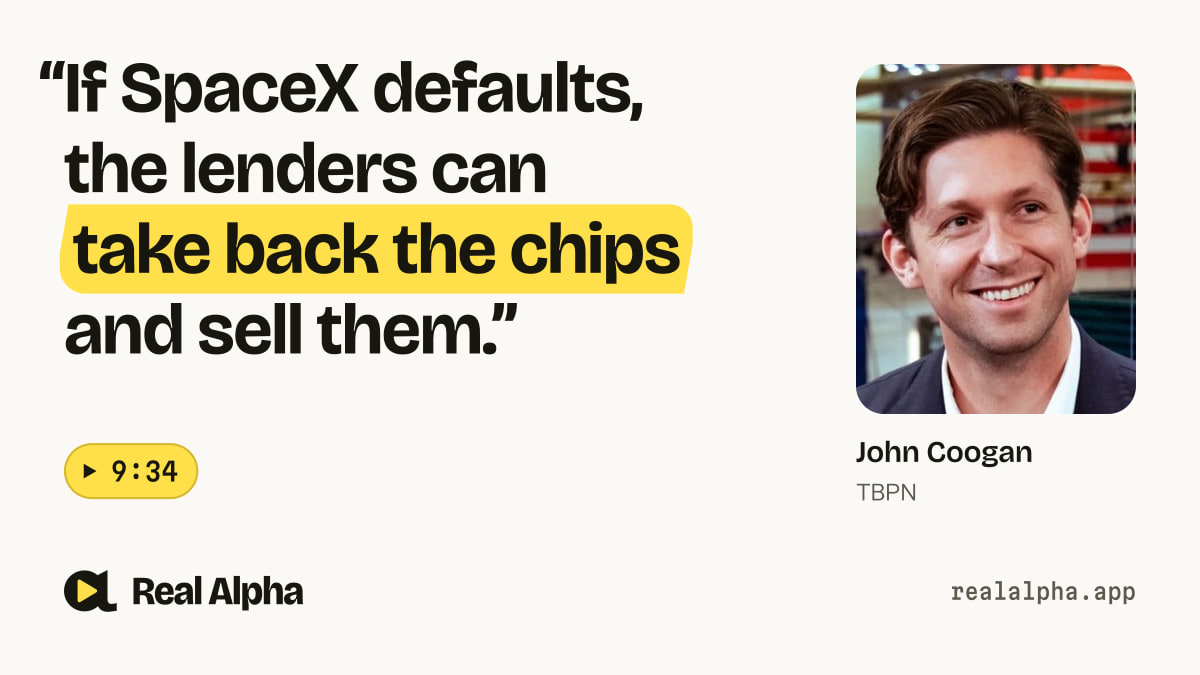
“If SpaceX defaults, the lenders can take back the chips and sell them.”
 John Cooganat 9:34 · TBPN
Takeaways
- Apollo buys NVIDIA GPUs and leases them to SpaceX.
- SpaceX repays the financing over five years.
- Lenders may struggle to recover chips sent into orbit.
About this segment
Apollo’s GPU lease financing lets lenders reclaim the chips if SpaceX defaults, but recovering collateral in orbit is a different problem. The hosts connect that risk to the shifting ownership and physical constraints of data center assets.

John Coogan, Host
Co-host, TBPN
Co-founded Soylent and Lucy; OpenAI bought his show TBPN in April 2026.

Jordi Hays, Host · Co-host, TBPN
Founded Branded Native; co-founded fintech Capital, which Rho bought.
From “AI Solves Riemann Hypothesis, Stock Market Plunges, The Mansion Section | Diet TBPN”, Nov 21, 2026. Watch the full episode
Thanks. We'll look at and fix what's off.
Transcript
Transcribed by machine (Whisper) from the episode’s audio, so a word may be off here and there.
- 9:16
SpaceX. There's news about SpaceX. SpaceX leaders want to – lenders, not the leaders. lenders, want to stop SpaceX from launching $40 billion worth of AI chips into space, according to the Financial Times. The chips back a roughly $40 billion financing deal led by Apollo. An Apollo-managed entity buys NVIDIA GPUs and leases them to SpaceX, which pays them back over five years. If SpaceX defaults, the lenders can take back the chips and sell them. That's the problem with space. Lenders worry that if SpaceX sends the chips into orbit for its planned space data centers, they couldn't reclaim them in a default. You just need a space tow truck. This is a new business. You need a repo man for space. Kind of pathetic from Apollo. Yeah, you should just launch your own rocket to go drag it down. Yeah, just say you're not getting into the launch
- 10:07
business yourself. Yeah, Apollo should get into the launch business with a tow truck for space. Don't yeet all of our collateral into space, please. No, that actually does change the economics because, yeah, there's been so much reallocation of compute, I mean, down to whole projects changing hands from one hyperscaler to another, leases and permit approval. We have Alex Epstein coming on the show from the Center for Industrial Progress at 1130, and he's going to help us understand some of what's going on in energy and permitting.
- 10:41
And it's very interesting because the land can change hands three times before something. And then the actual shell can change hands. The power rights and the water rights can change hands a bunch. Then the company that's building it can change hands because someone didn't have the right staff. And then the actual chips that go in there can be reallocated. Semi-Analysis had an interesting post about how some older data centers, the floors just aren't strong enough for new NVIDIA racks.
- 11:06
So that's sort of because the new the new Blackwell racks weigh, I think, three times or five times as much as they used to. And so you have to go and retrofit the building if you actually want to bring in the latest and greatest. So, yeah, there's very here's a question.