The alpha, twice a week
That was 4 min.
Get the best new moments in your inbox every Wednesday and Saturday. It's free.
Check your inbox
We sent a link to your address. Click it to finish signing up. Not there in a minute? Look in spam.
or
TBPN · 4 min · Nov 19, 2026
Strauss explains why he bet against VR entertainment
 Strauss Zelnick
 lays out why headsets, isolation and motion sickness made VR a poor fit for entertainment.
The episode’s best minutes
Full analysis- 46:50Strauss explains why he bet against VR entertainment4 min
- 1:04:40AI scale demands new ways to finance companies4 min
- 1:16:35Anthropic made Taneja rethink what venture scale means4 min
- 5 more moments in the full episode
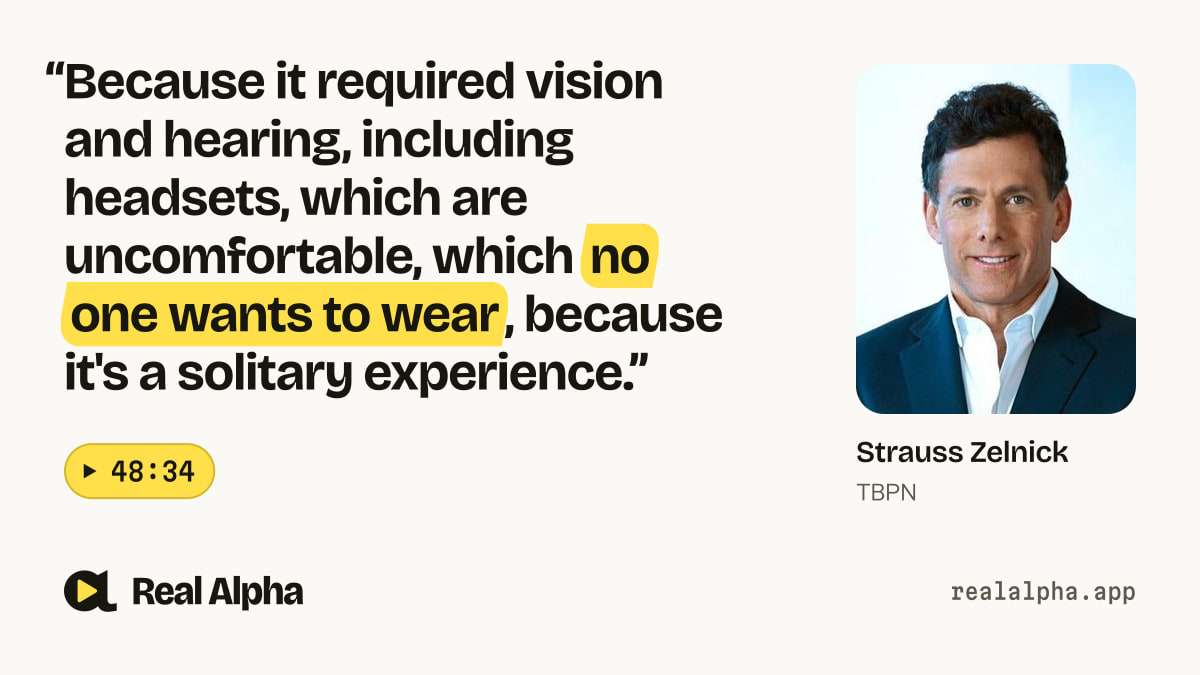
“Because it required vision and hearing, including headsets, which are uncomfortable, which no one wants to wear, because it's a solitary experience.”
 Strauss Zelnickat 48:34 · TBPN
Takeaways
- VR’s headsets and solitary format were major consumer barriers
- Motion sickness made long sessions unattractive
- He mistook mobile gaming’s lightness for a weakness
About this segment
Strauss Zelnick lays out why headsets, isolation and motion sickness made VR a poor fit for entertainment. He also admits he underestimated mobile gaming’s appeal as a light experience.

Chairman & CEO, Take-Two Interactive
Led Take-Two’s growth by backing creative talent behind Grand Theft Auto, NBA 2K and other global entertainment franchises.

John Coogan, Host · Co-host, TBPN
Co-founded Soylent and Lucy; OpenAI bought his show TBPN in April 2026.

Jordi Hays, Host · Co-host, TBPN
Founded Branded Native; co-founded fintech Capital, which Rho bought.
From “Ant IPO (Hemant Joins), GTA 6 Launch (Strauss Zelnick Joins Live)”, Nov 19, 2026. Watch the full episode
Thanks. We'll look at and fix what's off.
Transcript
From the transcript TBPN publishes with the episode.
- 47:00
Yeah. Well, I mean, with that with that framework, how do you assess the level of product market fit or level of industry maturity around a new paradigm? Clearly, you watched mobile, you got to know the Zynga CEO, you made the acquisition at a perfect time, you considered value and the fact that, that had seriously broken through, you understood the consumer and the market very well. How would you apply that to assessing the progress of virtual reality? I follow the technology and there's a lot every year, I'm like, it's this is the time.
- 47:38
It's the best it's ever been. And yet, when I check the actual revenues of game companies that are operating in the space, it's it's pretty minimal. So what what are you waiting for to see... Like, what what does success look like in a new paradigm like virtual reality?
- 47:54
Well, virtual reality, I mean, is sort of a good example in that. I was very clear that I wasn't a believer in it as an entertainment Mhmm. Medium. And I said that, I said, look, they remember there was a lot of hype around virtual reality. Right. I mean, you know, one big company changed their name to Meta, you may recall. Yeah. Right. And I was very, very skeptical, and I made sure that our enterprise across our labels was ready for it if I if I were to be wrong. Sure.
- 48:23
But I was pretty sure I wasn't gonna be wrong. Yeah. And I wasn't wrong. Yeah. So in the case of virtual reality, didn't... Many of our competitors invested hundreds of millions of dollars. We invested basically zero. We got paid for everything that we we tried. We did projects for other companies to to build expertise. Got it. That's because it just didn't just didn't strike me that that made any sense from a consumer point of view. Why? Because it required vision and hearing, including headsets, which are uncomfortable, which no one wants to wear, because it's a solitary experience. Entertainment is not a solitary experience, generally speaking.
- 48:54
And because it makes you nauseated within twenty minutes. And and it's a terrible kind
- 48:59
of Why would you pitch it like that? That's pretty bad. Wow. Kind of problematic. Mean and why do you entertained. Yeah. Everyone wants that. So I I found it problematic, and I was right about that. But I think that the point is a good one because in fact, to own this, like, we were slow on the uptake with mobile. And I actually, if you wanted to embarrass me, I appreciate that you didn't, you could go back and find quotes from me in the early days of mobile where I expressed a lot of skepticism, and I was incorrect about that. Yeah. And because I was incorrect, we had to play catch up, and we played catch up by acquiring our way into the business, and thankfully, it worked out.
- 49:31
But that isn't my preferred approach. And so I guess I'd wanna find the next thing, believe in the next thing, invest in the next thing before it requires, you know, our case, spending $9,700,000,000 on an acquisition.
- 49:42
Sure. Well, to go back to to mobile, was was... What was your miss there that it would open up a new category of gamers with women, with an older crowd? Was that what was unexpected or was there a different... Was everyone pitching like, oh, we'll take the current top franchises and you'll see this, we'll need to transfer over, but in fact it was new IP? Like what was the shape of the category here?
- 50:09
No. The Mist was more... I I thought it was kind of a flash in the pan Sure. Because it was too too light an experience. Yeah. And it turns out certain consumers want a light experience. Okay.... Multiple times a day. Just a light experience. Yeah. You know, the fills the time you're waiting for the bus, you're on the bus. Yeah. You know, you're tired at the end of the day, you wanna relax. Yeah. That makes a lot sense. You don't... You want a light kind of interactive entertainment.
- 50:31
You don't want heavy engagement. Yeah. And I just missed that. Yeah. Yeah. That makes no sense. Sorry, Jordan.