Free with a sign-in.
The best 12 min of 97
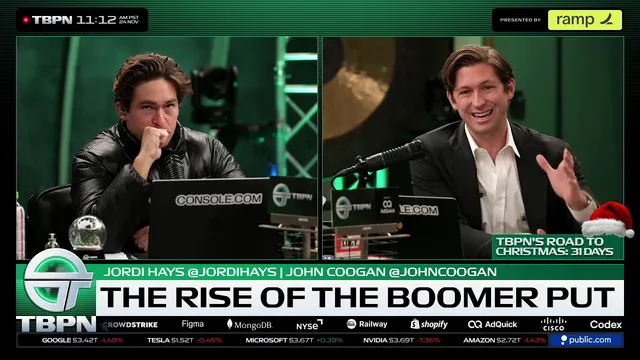
Ant IPO (Hemant Joins), GTA 6 Launch (Strauss Zelnick Joins Live)
Strauss Zelnick argues Take-Two pairs creative risk with financial discipline; Hemant Taneja says AI's scale calls for new ways to finance growth.
 TBPN · John Coogan & Jordi Hays
- Strauss Zelnick · Chairman & CEO, Take-Two Interactive
- Hemant Taneja · CEO, General Catalyst
The best minutes
- 46:50Strauss explains why he bet against VR entertainment4 min
- 1:04:40AI scale demands new ways to finance companies4 min
- 1:16:35Anthropic made Taneja rethink what venture scale means4 min
Also worth watching
- 13:45Take-Two budgets creative bets but leaves room for creators3 min
- 21:11Take-Two screens acquisitions for fit, returns and culture3 min
- 16:21Recurring spending now drives 80% of Take-Two net bookings3 min
- 1:11:12AI startups should prove demand before asking for more compute3 min
- 1:20:50Biotech exits can stop startups from building full businesses4 min
Skip the five-minute opener, the broad AI-and-entertainment discussion before the VR segment, and the final 12 minutes of timeline reactions and news.
Full analysis · 6 min read
Real Alpha · Nov 19
Strauss Zelnick says recurring spending drives about 80% of net bookings
- Recurring consumer spending supplies about 80% of Take-Two's net bookings, Zelnick said.
- That supports a durable catalog, but it is a bookings mix, not a disclosed profit margin.
- For founders, the lesson is to fund ambition against repeat demand, not launch hype alone.
Free with an account
Read the rest of the analysis
6 sections, the 3 other voices it tests Zelnick against, and what it means for you. Every episode we cut gets one.
Check your inbox
We sent a link to your address. Click it to finish signing up. Not there in a minute? Look in spam.
or
Signed up before? The same buttons sign you in. The episode, its moments and the transcript stay free.
Recurring spending now carries Take-Two between releases
Zelnick's most useful operating number was that recurring consumer spending accounts for about 80% of Take-Two's net bookings. He described a shift from selling launches alone toward keeping consumers engaged between releases. That makes the calendar less singularly decisive than the company's blockbuster image suggests.
Earlier, Zelnick described the goal as making money year in, year out regardless of its frontline release schedule. A powerful catalog and recurring engagement are meant to support that aim. GTA V sold over 235 million units across three console generations and resonated with audiences for thirteen years.
Zelnick said GTA V and GTA Online could keep serving millions after GTA VI's launch. For example, NBA 2K's online mode keeps consumers engaged year-round, rather than for three months, he said. But Take-Two gave no breakdown by franchise or type of recurring spend.
The 80% figure measures net bookings mix, not profit, margin, or customer retention. Zelnick did not disclose recurring-spend margins or how much each franchise contributes. So the number supports a recurring base, but cannot show how durable or profitable it is.
Our read
The figure supports a recurring-revenue base, not proof every franchise will convert. It reduces reliance on tentpole launches only if engagement holds.
Take-Two buys creative freedom with budgets
Take-Two's financial discipline is not a blanket cap on imagination. Zelnick said creators and business leaders review projects quarterly, budget them, and assess possible returns and risks. The checkpoints make creative bets legible without giving every project a blank check.
Within an agreed budget, teams get creative latitude, while Zelnick said Take-Two can fund exceptional work generously. For example, he pointed to GTA VI's 99 Metacritic score as evidence of creative execution. That reception does not prove the process reliably predicts returns.
As CEO, Zelnick is making the case for Take-Two's own system, not an audited industry comparison. He gave no project budgets, cost overruns, or hit rates, leaving outsiders unable to check the return math. The review cadence is visible, but its effect is harder to isolate.
“we then get out of the way creatively.”
Our read
The evidence is a process description, not proof that latitude caused a hit. Still, regular budget reviews let management govern risk without dictating every creative choice.
Zelnick's VR miss shows why forecasts need humility
Zelnick's strongest forecast check came from his VR skepticism and his admitted mobile mistake. For VR, he cited uncomfortable headsets, solitary play, and motion sickness, and said Take-Two invested basically zero. Paid projects still let the company build expertise without making a large bet.
That decision looks prudent against his description, but the episode offered no revenue series comparing VR publishers. On mobile, Zelnick said he thought the light experience was a flash in the pan. He later called that wrong, said Take-Two had to catch up, and acquired its way into the business.
Yet his framework did not make him right in advance. The signal he missed was specific use, such as playing while waiting for a bus, not science-fiction appeal. His account is a reminder that an attractive technology story does not establish consumer demand.
Our read
The admission adds credibility, but remains retrospective and self-reported. His account supports watching real user behavior rather than mistaking a compelling demo for adoption.
Anthropic's scale resets venture expectations, not evidence
Hemant Taneja said General Catalyst expected a three-times outcome from Anthropic, but the company grew ten times. He described that surprise as a reason to recalibrate venture scale, not merely celebrate a mark. He said GC must rethink how to help founders build $100 billion and trillion-dollar businesses.
That is an investor's account from General Catalyst, which backed Anthropic, and it concerns an outlier. Jason Lemkin on 20VC in November cited Q3 Carta data showing deal counts down 21% as dollars rose. That pattern fits concentration, but not a universal case for bigger checks.
One host said Anthropic briefly notched a $2 trillion fully diluted valuation at its Nasdaq debut. He explained that a separate current-share calculation was lower because the fully diluted figure includes options, restricted shares, and potential dilution.
Ed Elson on Prof G Markets in November said a five percent public float could delay price discovery. An IPO pop and a venture return are different tests.
 Jason Lemkin · 20VC · Nov 19Anthropic’s IPO is raising the bar for venture returns
 Ed Elson · Prof G Markets · Nov 18Anthropic’s IPO structure could support its price at first
Our read
The IPO demonstrates that extreme scale is possible, but cannot turn one path into a base rate. Different share-count calculations and a small float make day-one pricing a weak proxy for durable value.
Compute needs financing, but first needs demand
Taneja said equity alone may not carry AI infrastructure needs. He treats compute as an asset that needs separate financing. He also said capital must offer founders more than stock purchases.
Taneja said 70% to 75% of compute goes to the same seven or eight companies. He put 40% to 50% of capital with a couple of frontier firms. His test is whether a startup can show its business is interesting with very little compute.
He treats compute as growth capital, except for model research. For example, he said most companies should be able to demonstrate interest without massive access. That puts the burden on founders to show demand before labeling GPUs the bottleneck.
Evan Conrad on Upstarts in October described physically settled GPU markets as a way to finance capacity beyond startup credit. Ed Elson on Prof G Markets in November said Anthropic was not close to profitability and remained exposed to investor sentiment.
 Evan Conrad · Upstarts · Oct 29GPU markets can make compute easier to finance
- Ed Elson · Prof G Markets · Nov 16Anthropic’s growth must outrun a steep compute bill
Our read
Compute belongs in a capital plan when usage proves demand, with model research as the stated exception. Financing can widen access, but cannot establish whether customers value what it powers.
AI lifts productivity while biology faces bottlenecks
Zelnick said Take-Two has not seen a reason to slash back-office headcount overnight. He sees staff using AI to make work less mundane and more productive, while the company spends money on tokens. His example was faster pie charts, which he said create no value.
Taneja sees AI supporting clinical work and personalized life-sciences products, but said FDA safety and efficacy reviews may slow commercialization. That puts deployment and approval between model capability and patient impact.
He added that pharma companies often buy startups after product-market fit, before they build full platforms. So the financing goal is not just a promising result, but a company able to commercialize it. Neither interview supplied measured AI savings or clinical outcomes.
Our read
Both executives describe productivity or technical promise before proving full commercial impact. Budget workflow gains separately from headcount cuts, and account for regulatory time separately from model capability.
What it means for you
- Track repeat spend. Compare the 80% share with retention and contribution margin by franchise. The episode offered neither breakdown.
- Gate creative budgets. Keep quarterly investment reviews, but separate approved budgets, expected returns, and creative checkpoints. Record which assumptions change.
- Prove compute demand. Ask teams to demonstrate customer demand on limited compute before calling GPUs the bottleneck. Separate ordinary growth needs from model research.
- Measure workflow gains. Baseline time spent on low-value work before approving AI budgets. Measure time returned and output instead of assuming near-term staff cuts.
What to watch
- Take-Two's next sales update, after Zelnick said preorders exceeded expectations but gave no launch totals.
- Whether Anthropic's debut price holds after the reported five percent public float.
- Whether compute financing reaches startups that can prove demand but lack conventional credit.
Send this to product and finance leaders planning AI infrastructure budgets.
Watch the minute where Zelnick gives the recurring-spend figure
Written by Real Alpha from the episode's transcript and the other moments it links, then checked against the transcript. Quotes are the speaker's exact words.
Minute by minute
- 6:20Zelnick's route to Take-Two
Strauss Zelnick says he entered video games in the early 1990s, becoming pre-revenue CEO of Crystal Dynamics before a stint at BMG Interactive. After founding ZMC, he took over Take-Two in 2007 and found a company with financial and compliance problems but strong creative teams.
- 8:49Live services support creative bets
Zelnick says Rockstar's GTA IV downloadable content helped start Take-Two's recurring consumer spending model, and GTA Online became a standalone business after GTA V. He says GTA V sold over 235,000,000 units across three console generations, while recurring spending now represents 80% of net bookings. Take-Two reviews budgets and potential returns quarterly, then gives teams creative latitude within the agreed plans.
- 19:41Acquisitions need strategic fit
Zelnick says Take-Two follows creative teams rather than trying to fill every genre. He says acquisitions need strategic fit, financial accretion and cultural fit, citing Zynga as a way to expand into mobile and reach an older, more female audience. He spent three years getting to know Zynga CEO Frank Gibeau before the deal.
- 24:48Art needs room to take risks
Zelnick says Take-Two aims to make art, giving Rockstar teams latitude and encouraging them to approach creative boundaries while discussing choices that feel near the edge. He says the company takes ratings and age-appropriate marketing seriously; he describes GTA VI as an M-rated game intended for ages 17 and up. He says Rockstar has updated GTA's humor as culture changes, unlike humor in an earlier Duke Nukem game that had aged poorly.
- 35:09AI makes work less mundane
Zelnick says AI adoption is early and has not led Take-Two to see an opportunity for major back-office headcount cuts. He says employees use it to reduce mundane work and improve productivity, with making pie charts faster as one example. He expects AI to become a normal part of work, while hit-making and marketing remain difficult.
- 43:37Interactive entertainment has room to evolve
Zelnick says technology may help with long development timelines, but hard creative work will remain hard. He argues that interactive entertainment has not reached a creative ceiling and expects new formats to emerge beyond today's mobile and PC and console experiences.
- 47:44VR missed consumer needs
Zelnick says Take-Two invested basically zero in VR, while competitors spent hundreds of millions of dollars, because he saw headsets as uncomfortable, isolating and nauseating. He admits he misread mobile as a passing trend because its games seemed too light, then recognized that some players want short sessions during downtime.
- 52:52Growth can come from new markets
Zelnick says Take-Two has roughly 13,000 colleagues and is selectively hiring, with titles including WWE 2K, PGA Tour 2K, BioShock and Judas in its announced slate. He sees room to grow in markets such as India, Africa and Latin America, and expects streaming to expand access to console and PC games within two or three years. He says the company expects to be net cash by fiscal year-end and may consider acquisitions that meet its strategic, financial and cultural tests.
- 58:06Anthropic's IPO clarified valuation
John Coogan and Jordi Hays distinguish Anthropic's $2,000,000,000,000 fully diluted valuation at its peak from $1,260,000,000,000 based on shares then available, saying the difference reflects potential dilution rather than a sudden fall. Hemant Taneja says Anthropic's rise shows that a new AI leader can emerge and makes the IPO a positive signal for the industry. He describes the pace of growth as unusually compressed and expects more large AI businesses to follow.
- 1:04:49AI investing needs new capital models
Taneja says venture outcomes now require far larger pools of capital, and that financing needs to evolve beyond buying equity. He says 70 to 75% of compute goes to seven or eight companies, while 40 to 50% of capital goes to a couple of frontier-model companies. He points to asset and infrastructure financing as possible ways to fund growth.
- 1:09:12Compute creates a financing gap
Taneja says early- and growth-stage rounds are blurring as some companies grow to multibillion-dollar run rates within months, making structured rounds messy workarounds for scarce capital. He says compute financing is a key gap because companies may need infrastructure without investment-grade credit. He advises founders to show evidence of demand with little compute, except when doing model research.
- 1:17:42Scale expectations are shifting
Taneja says General Catalyst expected a 3x result from Anthropic but saw a 10x result. He says the outcome reinforced his belief that responsible innovation and values can help companies succeed, and pushed the firm to rethink scale and how it serves founders.
- 1:20:01AI could reshape health care
Taneja says AI could change hospital operations and help build more personalized pharmaceutical solutions, but warns that the FDA process and safety and efficacy rules need to evolve alongside the technology. He also says life-sciences companies that reach product-market fit are often acquired by pharma companies before they can build larger standalone businesses.
- 1:25:31First-day gains lift investor mood
Coogan and Hays discuss Anthropic's IPO pop, arguing that a rising stock can create a positive reception even as critics say the company left money on the table. They then react to posts about flooding and Waymo's driving in rainy conditions, along with other robotics and AI stories.
Published Nov 19, 2026.
Transcript · 1 h 18 m read
TBPN, hosted by John Coogan and Jordi Hays, with Strauss Zelnick and Hemant Taneja.
From the transcript TBPN publishes with the episode.
You're welcome to TBPN. Today is Thursday, 11/19/2026. We are live from the TBPN Ultradome, the temple of technology. The fortress of finance. The capital of capital. Let me tell you about RAMP. Time is money. Save both. These use corporate cards, bill pay, accounting and... We're back in the Ultra Dome. Rumors about us having to sell it. False. We were on the road a bit. Two days in Austin, Texas. They sold the Ultra Dome. It's always a gambit when we go on the road. It's a lot of travel. It's exhausting. We got to bring the team. We're operating on new gear. Can't really read the chat. Yeah. We can't read the chat. There's so many things, so many parts of the show that we can't do. If there's breaking news and there's a founder that sells their company like what happened yesterday, It's hard to cover it while we're there, but I think we did a great job. Really interesting conversations.
Love talking to TK and so many other folks who came on the show. So thank you to the Tomorrow X team. Stop calling it Yesterday X. It's still Tomorrow X forever. Road to tomorrow x 2027. Starts today. It starts today. Let's check-in on the road to Christmas. What week. Right? Deal book yesterday. Lot of interesting moments Yeah. Coming out of that.
Yeah. I saw a bunch of Palmer clips, Elon clips. I listened to the Elon Palmer was clip farming. Interview. There there were a bunch of interesting details. They read... Sorkin does a good job. There's like some... Every single time he manages to get --... Dives. Yeah. Like really newsworthy Yeah. Kind of like moment Masterclass. Out of it. Masterclass. Yeah. No. Great event. Tons of tons of news. I mean, today is GTA six launch. It's also Anthropic IPO day. It's also Taiga's birthday. It's also this many days till Christmas. We're gonna tell you because that's why you come to TBPN. You wanna know how many days until Christmas. There are thirty six days until Christmas. John Collison, 36 years old.
Read the whole transcript
Is that right? I feel like he's older than that. Is that right? Double check that. I think that might be fake. It is also But it is thirty six International Men's Day. International Men's Day.
Monaco National Day. Monaco National Day. They have a whole National Day for... Monopoly Day. Okay. Play Monopoly day. Apparently... Oh. Maybe that's I can't the message that Anthropic is sending. They're saying, it's national play Monopoly day. We're gonna try and build a Monopoly, you know? I don't know. I think I I I really do think that the day that they picked is because of the... Can you get a national day as an ad? Because national play monopoly day feels like an ad. Yes. It's also national carbonated beverage with caffeine day.
Yes. I saw that. Cheers from the good folks over at Diet Coke. Yes. No. No. You can actually just start a day. We can start National Livestreamers Day if we want. All it takes is a little bit of a marketing push, some announcements. There's no... It won't become a federal holiday, like, but it will become something that people can celebrate and brands can jump onto. It's a purely organic grassroots movement these days. Powerful. But you get on Wikipedia. On national day calendar Yes.
You can just... There's a button that says register a day. So you can just register Yeah. Cosgrove day coming soon. Barber jacket day, I guess. Couldn't put on a suit. Getting...
We should register every day with like national and then it's how many days till Christmas day.
Oh, yeah. Days till Christmas day today. November... Historic historic day. Absolutely. We have Hemant Yep. The big investors in From General Catalyst coming in. Calling in from New York City. He was at the NASDAQ this morning. And we also have friend of the show, Strauss. Strauss Zelnick coming in. Man behind CEO of Take Two. GTA six.
Behind GTA six. He's been with the company since before GTA five. So he's overseen this entire saga. We'll have so many interesting stories to dig into there.
And we There's one more You were hanging out. The chat called it Jack Dorsey. It's his birthday today too. So big day. That's Also, before we move on, let me tell you about Codex. Codex is a powerful workspace for getting work done with AI agents. Whether you're writing code, analyzing data, creating content, or automating business workflows, Codex helps you move... Speaking of Codex, it's also Andrew over on the Codex team's birthday. Oh, yeah. That's right. So there That's right. Happy birthday. A lot of birthdays today. But it was gonna take us back in history. Yeah. We were hanging out with Strauss here in Southern California. Yeah. I think in like... January, February?
No. No. No. It was later. Think it was like May. Oh, sure. But we were, you know, wanted to... He's just Okay. An incredible human being, incredibly talented Yeah. And and super fun to hang out with him. Forget who threw out the idea. I think it might have been him. He was like, you guys wanna hang out on the show on launch day? And we were like Absolutely. 1000%. Yeah. So super super excited to have him on and Yeah. I think we can bring him in right now.
Yeah. That sounds great. I believe he's here, so let's bring in Strauss Zelnick. See you at the too. Strauss, how are you doing? Welcome to the show.
I'm doing great. It's great to see you both. Thank you so much Great to see you. For coming on. Strauss, thanks for the kind words.
First question. I'm just... I'm shocked that you have the time to do this Yeah. On on a day like today. It's different than it's different than like a CNBC hit or a Bloomberg hit where you pop on for a few minutes. Yeah. So we appreciate the time and and we just wanted to say congratulations to the Congratulations. Entire team. Everything.
I I played a little bit last night. Reviews are incredible. The sales numbers that are rumored are incredible. Everything about this, it's a royal flush. So congratulations. Thanks.
We feel really really, really good about it. And I feel really grateful to the team at Rockstar Games and the entire team at Take Two Yeah. Who pulled this off Yeah. So so far. It's early.
So the first question everyone's asking, when do we get GTA seven? I'm, of course, kidding. Take us back in time. Once you get through several hundred hours of the most incredible fun you've ever heard, ask the question again.
No. I mean, I imagine you were getting sick when do we get GTA VI. But take me back even before that. I want everyone to be, you know, at least familiar with your journey to Take Two. That's a fascinating story. And then I want to hear a little bit about the road to GTA V before we go into GTA VI. So can you can you give a little bit of the backstory since it is the first time on the show and and how you how you wound up running this incredible company for so many years?
Well, I I started the video game business long ago. Was in the Yeah. Television business and the motion picture business. Yeah. And I left the motion picture business to to get into the video game business, not really on the ground floor. It was in the early nineties. So the electronic arts already existed. Yeah. Activision had already been founded, Bobby Kotick was already running it. Oh, that's right. Microsoft was not in the business yet. Sony had just gotten into the business. Yeah. And and the leaders were Sega and Nintendo. Yeah. So it's a very different time. That's right. But I I did have the feeling that the next big entertainment business would be the video game business. Yeah. So I went to a small company, tiny company called Crystal Dynamics.
As the pre revenue CEO, and began to learn about technology and and how it applied to entertainment. Then I actually went and did a stint in the recorded music business at BMG That's right. Where we started BMG Interactive. And the CEO of Bertelsmann, the parent company, forced us to divest that business, which we did to a tiny little fledgling public company called Take Two Interactive in the late nineties. And then in o one, I started ZMC, and in o seven, we took over Take Two Interactive, which at that time was an exceedingly troubled company with one franchise, which was the Grand Theft Auto franchise.
Yeah. And really nothing else, sort of very small property in NBA two k, which was far and away number two in a two player market.
So coming into Take Two at that time, you know that there's sort of... Are you thinking about GTA as a franchise as the Golden Goose? What are you changing? Because it does feel like there were there's GTA three, then Vice City, then GTA four. There were a variety of games. Was there a focusing effort to put more wood behind GTA five, take that product take and make it go even longer because the numbers of just sales for GTA V, I think it's greater than the cumulative sales of the entire franchise before it. And then you add on online and you add on everything around it. Was that was that your first goal? I mean, know you were working with all the getting through all the troubles, but from a product strategy perspective, what were you thinking?
Well, first of all, when we got to take two in March of 'seven, GTA four was in development, not five. Oh, that's right. And so we're working on four. Mhmm. And the team at Rockstar made a deal with Microsoft at that time to do what became the first digital downloadable content as in, you know, what was called then an expansion pack. Yeah. And and that was the beginning of what we call take to recurrent consumer spending. Yeah. Which is ongoing engagement after the initial release by consumers and where they pay for that engagement. And and so Rockstar really innovated in in this field. Then, of course, began to work on GTA V. Mhmm. And when that was launched, Rockstar launched the first online companion GTA online just weeks after GTA five was was released.
Yeah. And we we thought of that at that time sort of added value for consumers that would enhance enhance the experience. We did not think of it as an additional standalone business, which is what it became.
Yeah. And so how much of that did... How how much of the learnings there informed the development of GTA six? I mean, I imagine just from a financial perspective, it sets you up...
Maybe maybe I guess maybe before that, I I just wanted to jump in. From the entertainment business, you know, you have this insane power law with all IP in these different franchises. You had been a founder in the past. Joining Take Two at that point. You I'm sure had like infinite optionality to join other companies, start other things. Like did you you have a vision on GTA becoming as big as it is today? Or has it even surprised dramatically to the upside?
Oh, I think the success of GTA five surprised all of us. Mhmm. You know, it remained our standard bearer and the industry standard bearer over three console generations and sold over 235,000,000 units. It's not something we could have reasonably expected. Yeah. It's amazing. It's it's a testament, I think, to the just the extraordinary quality that Rockstar Games seeks in everything that they do, and that they created something amazing here that resonated with audiences for thirteen years, and it's continuing now. And I have no doubt that GTA five will continue to sell. That GTA Online based on five will continue to be successful because it's amazing and it serves millions of consumers. I I think that will go on even even as we have had very successful launch of GTA six.
Yeah. So how much of the GTA recurring revenue sets you up for success with GTA six? Does it allow you as a CEO to support the artists and the teams that want to take extra time to get everything absolutely perfect? Does it allow you more breathing room? Or is there are there any other knock on effects of that because it's pulling people to continuing managing that ongoing service? How how have the last few years been sort of managing both of those projects simultaneously?
Well remember, we have a lot of other things going on Yeah. TikTok as well. We have the two ks label and the Zynga label. Yeah. We're one of the largest mobile publishers with Zynga. Yeah. We have NDHK.
By the way, you handled that question. I forget the name of the the journalist that asked you. That's basically was implying you're a one hit wonder. You just rattled out. You had the most Four titles. Kind answer to that question that I could imagine given given the circumstances. But why don't you why don't you fill people in if anyone didn't get to catch that and they've been living under a data center?
I mean, John, I think it's a really great question, which is, you know, how can we do what we do? And when we took over the company, was it was in terrible trouble in so many ways. Trouble from a compliance point of view Mhmm. And certainly in trouble from a financial point of view, but it was not in trouble from a creative point of view. There were a lot of great creative people at take two. Yeah. And it was my job to sort of clear out all the underbrush, and give them the opportunity to shine. And what I what I said then is that I hope to build a company that would be creatively risk forward and financially risk averse.
Yeah. A company that would make money year in, year out without regard to its frontline release schedule. A company that had a very powerful catalog. Mhmm. And it turns out live services came along, which we discussed briefly earlier, which has made catalogs even more valuable. And all of those things have have come to fruition. And, yes, you're right. The success that we've had for which we're incredibly grateful does give us the opportunity to make these very, very big bets. But bets, I think, really no one else in the industry is willing to make. Yeah. Because we have the sound financial underpinnings, which will support and protect us in the event something doesn't go exactly according to plan.
And by the way, things don't always go according to plan. We've... And we've had things that have not gone according to plan.
“within within the rubric of the agreed upon budget and approach, we then get out of the way creatively.”
“And today, recurrent consumer spending, represents that engagement, is like 80% of our net bookings.”
Are you do you think that way? Do you have a strategy for build versus buy when you see different pieces of IP come up for sale? How do you think about building out the overall world of everything that Take Two is doing?
You know, look, we're we're an entertainment company. We're not a grocery store. I I don't need to sell like meat, potatoes, like milk, eggs, yogurt. Like, we just need to make the best entertainment on earth. Yeah. And we we never thought about, you know, should we have like... I mean, once upon a time there were like music oriented video games. Like Guitar Hero. Was a really big deal. I I was asked at that time, by the way, in similar settings. Don't you have a music game? It's like Yeah. Look, if our creators had a great idea for a game that involved that much music or music performance, I I have no doubt we'd pursue it. But right now, that's that's not the case. So we don't really sort of sort of go to consumer, genre, game.
Yeah. We go with team, creativity, passion Yeah. Game, consumer, hopefully, success.
Yeah. How do you think about post merger integration, just integration across the different teams? You've made some acquisitions. How much value is there in co locating teams? I know the company is extremely distributed. But is there value of someone from the NBA team spending time with the GTA six team and vice versa? Or do... Does everyone just kind of want to be able to focus on their own goals?
Well, look, season three of NBA two k 27 is GTA six themed. Sure. And last night, there was a live basketball game in Miami. Yeah. You know, where where the heat played as Vice City. I mean, we actually... And I'm really proud of this.
“I spent three years getting to know the CEO of Zynga, Frank Gibeau, before we decided that it was a good idea to merge.”
Very. What is... How how do you and the team at Rockstar think about controversy? Like if somebody is on the team and they wanna do something Mhmm. In the storyline and they're... And and you guys are talking internally they're like, hey, I think this is the right decision but I know there's gonna be a certain reaction around this. Like, how do those conversations go and when when does it make sense? Because I think in entertainment, it's not like if people don't really know what they always want. Right? Mhmm. And it's like the customer isn't... Not every customer is right. Some customers might be right.
Yeah. But it's like an interesting kind of like thing to wrestle with as like, you know, everybody... It seems like everybody I'd... Everybody I know has been made an effort last night to start playing this game everybody has such a wide range of opinions. But to me, I look at it and I was like, this is a perfect, like absolutely perfect launch. So you're not just talking about the fact that GTA six is live, you're talking about like minute details in the in the storyline, and then people are debating over like, you know, the different kind of stages of the game. So controversy, how do you think about it?
We aim not just to make popular entertainment properties, we aim to make art. Mhmm. And and we really mean that. And that means that our teams have enormous latitude to create art. And we all understand intuitively the difference between art and, for example, exploitation. And within the sort of the lens of is this art, the question is okay, and is this something we're all comfortable with? And we have... We've worked together for so long. We've been at this for twenty years that I think we have an intuitive understanding of what feels appropriate and what does not. And if something's on the edge, we all talk about it and decide.
I would say if anything, I I push the teams to take more rather than less creative risk. And then, of course, we're we're rigorous about working with the ESRB to make sure that all of our titles have the appropriate rating, and we're incredibly diligent about marketing to the appropriate audiences. Mhmm. So for example, I've... This happened just last week. I've had a number of friends say, hey. My kid can't wait to play the game, and I will immediately say, well, how old is your kid? And they'll say, well, I don't know, 12 years old. And I'll say, hey, listen, you're a parent, you can make your own choices for your for your child. To be clear, this is an M rated game.
This is meant for 17 and above, and I do not advocate this title if if the consumer is not 17 or above. Mhmm. So the way we protect our creative teams is to encourage them to make great art, and to support their vision, and in my case actually encourage them to seek out the edge. Really go for it. And and no, don't go over the edge. Seek it out. Now if you think you might be at or near the edge, let's let's talk about it. Yeah. But they know very well that my my approach is gonna be, is this... Does this fit with what you're trying to achieve? Is this is this consistent with the art that is here? And you know, if we if we didn't see this as art, like we could all go sell bonds for a living. I don't know, like why do this?
If you're not interested in making art, why do this? No. And great great art makes you feel something. Yeah.
And and to be honest, as I see people online that are like complaining about like fixing the sink, you know. Oh, yeah. This is like this... This is art. Every... Yep. I know. I've I've been there. I've felt that. Yeah. Like being in that situation where you're trying to do something else. Like you think you're you think you're like the the greatest gangster that's ever lived. And then you're like, I gotta... My wife's making me fix the sink. Know? It's like the most like real thing. And so it's like it's it brings a level of real... Welcome to my world by the way. No. I know. I know. I'm last night... You're real.
Your wife's like, Strauss, like, can you go drop this off at at the post office on your way home? You're like, honey, I'm I'm just launching GTA six. No. But I I I think great art...
You actually think this is a joke, but this is not a joke. I'd be like No. We're launching GTA six and what should I be cooking for dinner? Yeah. But that's okay.
That's what good art is. It actually reflects reality and and has a commentary and emotion. And celebrates. And celebrates reality and and and comments on reality and 100 satirizes reality. Yeah. In the service of service of having fun. Yeah. You gotta have fun. It's supposed to be a lot of fun.
And it's also the the highs, the the... You need you need this sort of like high low. You need to have people be taken on that journey. And if you're just driving cool cars Yeah. You know, and shooting guns, it's just like it's all like, you know, peak Yeah. At least personally.
I know you I know you hired some literal comedians for voice acting. But is there like a comedy step of the interview process? Because I feel like there's some designers who might be three d modeling but they still have some humorous chops because you'll see all these little Easter eggs and details and it feels like the chain of command cannot be there's someone at the top who says make it funny and then it goes through seven levels of approvals to have someone actually instantiate humor into the world somewhere. It feels like everyone on the team has some level of frivolity around them. But what what is that like?
And how diffused is the is the comedic chops within this organization? Well, I mean, we have a lot of writers, a rock And there's no doubt that this this property has always been known for its sense of humor. Yeah. And and so I think if if your question is, is there a sort of culture of humor within Grand Theft Auto, the franchise? Undoubtedly. Sure. And actually one of the challenges has been for that to evolve Totally. Over And I think Rockstar's done a really great job with that. Yeah. And and you know, if it's... We've we've made titles. There's... We had a title at two k called Duke Nukem. I don't remember that.
I remember Duke Nukem. And when Duke Nukem was first launched, like the humor was considered really cutting edge, really bold Yep. Really dirty. Yep. And people loved it. And then the last Duke Nukem we made, and this is my fault, of course. You know, it hadn't aged well. And and we were we're still engaging in the same kind of humor and like the moment it passed. Yeah. And I think one of the great things about Rockstar is as as the world has changed Yeah. Despite the long development cycles, the team has been able to tune the property. So it still still achieves the same thing, but achieves the same thing in a different way. If we're doing the same thing in the same way that it was doing in '19... Late nineteen nineties, it wouldn't work.
And the reason that this title continues to work is that it remains so incredibly fresh. And Mhmm. So I think you're right, like, that's that's cultural, but it's also it's also the way that the the senior creative team at Rockstar Games thinks about the property, and then it's a reflection of the extraordinary communication that that threads through thousands of people as they develop as they develop the title.
Yeah. You mentioned something earlier about age gating marketing, targeting adults, targeting people who are 17 and over because it's an M rated game. Is that getting easier in the age of targeted marketing online? Or is it getting harder because GTA, anything you put out will go massively viral everywhere? I think the launch video broke the record or the first trailer broke the record for most views on YouTube ever. And so how are you actually marshaling the efforts around targeting the marketing to a particular audience?
No. It's a big part of what ESRB is concerned about. And we... Our marketing materials are rated as well. And we're incredibly careful. Mhmm. We want we want our creative material in the right hands and in no other hands. Mhmm. I can't I can't sufficiently stress Yeah. How important that is to us. And I think our industry in general does a very good job. Mhmm. As a matter of fact. Yeah. The ESRB has had for years the equivalent of mystery shoppers, and we much more rigorously comply with ratings than any other entertainment business.
Yeah. Are are are you... Do I remember this right? Are you involved with the ESRB directly?
At the ESA. I'm the chairman of the ESA. That's right. That's right. Fantastic. It's sort of a... It's a rotating chairmanship. Got it. Yeah. Makes sense. It's my it's my turn in the seat.
Got it. Yeah. What else can you tell us about the goals for this? Do you have a dashboard up actively looking at sales? Or are you thinking about things on a bigger perspective? What... Is there a funnel that you're tracking? Like, what is today?
Right behind right behind the camera is just a massive screen with the number. No. It's actually... If you if you come visit my office in New York, I actually do have a large screen Okay. That visually tracks everything that's going on with all of our properties, all of our labels Yeah. Daily, weekly, monthly, and year to date sales. I also have a heat map where all of our users are at any given time worldwide. So I can actually buy property. Yeah. So I can actually see exactly what's going on. And you may ask, but you haven't yet. Okay. That's awesome. What do you do about that? And the answer is, I don't know.
It's a nice conversation piece. I mean, really, what am I gonna do? Oh, Bolivia's light right now. I better dive right in to Bolivia marketing. I don't... There's not much that I can do. I I I will be able to stay current, and then there are times when, of course, we actually do have to make decisions. So for example, if a if a launch is slightly lighter than we would have hoped, and that that was true with NBA '2 k '27. It's our second, best release ever in the history of the franchise, but it did slightly disappoint initial expectations. Well, that data is available to us. We know exactly what's going on. We we have telemetry with our players. We know who returned and who didn't. And that will inform marketing decisions that we make.
We also have a consumer database across all of our labels that's cross referenced with more than a billion customer records. And that does legally and in a way that's compliant with all local regulations allow us to target our marketing, I think more effectively than anyone else in our business, and to do so at virtually no incremental cost.
Yeah. I I want to talk about artificial intelligence before we go into actual design and It's it's required. It's required. I'm interested in in maybe the more anodyne application of AI. Are you seeing value in using AI to analyze data, look at those dashboards? I'm just thinking about even if you said we're not going to generate any textures with Gen AI or something, that's completely separate from if this invoice needs to get paid, let's have an AI look over it. So operationally, what role is AI playing in the back office of Take Two in the finance, legal, in the marketing, in the different organizations?
What have you learned from the adoption over the last couple of years? It's early still. Yeah. I mean, we haven't... One of the things that we've learned is for those who think you're going to, you know, vastly reduce your headcount overnight, that clearly is not happening. Yeah. What what does appear to be happening is that people are using this new technology to make their work less mundane Mhmm. More interesting Yeah. More value added Yeah. And to be more productive. But, you know, we have not... I I've been saying quite publicly, you know, new technology doesn't tend to reduce employment. It tends to increase productivity, which increases GDP, which actually increases employment. Yeah.
As you know, The US employment rate has been stable for the past two years despite the explosion in all things AI. Yeah. So we too, like other corporations, aren't seeing, you know, an opportunity to vastly reduce our our our back office head count or anything of the sort. And we are spending money on tokens, which is, you know, something we have to think about. Yeah. But we're beginning to see some meaningful efficiencies in areas of work that no one's ever gonna miss. Yeah. So for example, it's quicker to make a pie chart than it used to be. Pie charts don't create any value whatsoever. They're nice they're nice to look at, but they just don't create value.
So if we could have our people spend a lot less time on pie charts, I'd be thrilled.
Yeah. Of course. Yeah. Do you on on the AI in the in the unemployment picture, do you chop that up to game theory? Like, if there was one company that had access to AI and the rest didn't, would they be laying people off and running things super smoothly? And it's just because everyone has access, everyone's more efficient, so let's get the humans doing more creative, more valuable things, and then that allows us to create better products and compete in the market?
Well, this is... I mean, I'm gonna answer a slightly different question, but I I really love the the backdrop. This is what I've been saying about AI, that people who are moaning what it might mean sort of sort of forget that everyone's gonna have access to the same Yeah. Like a a rising tide lifts all ships. Yeah. And in the eighteen hundreds, you know, late eighteen hundreds when electricity started to be deployed. Mhmm. There are whole bunch of companies, you could find this in, like, newspapers, financial newspapers, late eighteen hundreds. People would be like, we're... We we use electricity at our company.
And how amazing that... And companies were changing their names. Like, companies that had nothing to do with electricity were changing their names to, like, x y z electricity Yep. Company. Yeah. Like, in the same way that in 1999 and 2000, people were, like, changing their name to .com, no matter what it was. Yeah. Yeah. Like, burgers.com. Really? Burgers are burgers. But okay. And so AI is going to be everywhere. And, you know, we don't walk into an office today and look around and say, wow, it's amazing. You have electric lights. That's so cool. Like, I can actually see. This is... Technology becomes a backdrop. And and so when people say, look, we think that AI is going to disadvantage a big entertainment company. I'm like, I understand that competitive dynamics might shift, entry barriers might be reduced. But making hits, marketing hits, financing hits, employing creative talent, all that's going to remain very, very difficult.
Yeah. And if technology makes parts of it easier, why wouldn't we avail ourselves of that technology? Like, we're not going to sit on our hands and say, oh, no, no, we wouldn't do that. Of course. Let someone else do that. Yeah. And I haven't run into one AI company yet who said, we're gonna make our our technology available to your direct competitor, but not you. Yeah. Like, no one's offering their services exclusively.
Yeah. Yeah. Yeah. The the electricity example is funny because some of the most unique and and, like, beautiful experiences are sometimes like a candlelit dinner or hanging out by a campfire or or by a fireside. And there's still this urge to go back and both have sort of lived on in this odd way that you would assume just disappeared. There's even if AI becomes useful in writing and creating ideas and storylines, I'm firmly in the camp of strong demand for something that's opinionated, that has the story behind it, and has humility.
Well, look, when, you know, when the camera was first developed Yeah. There were a lot of people who thought that was the end of art. Yeah. And in fact what happened is art has flourished. Yeah. Like, fine art's worth a whole lot more today than it was when cameras were first developed. And an entirely new art form, photography, has also been developed. Yeah. And I think the same thing's going to happen here. Like, the stuff that came before that human beings love will continue and and flourish. Elements of the human experience that were clunky, that technology can make less clunky, they're going to change, and they should change. Yeah. And say otherwise would imply like, oh, there must be a buggy whip company around here somewhere.
No. No. They're gone. Yeah. They're actually gone. Yeah. But no, automobiles get you there faster and quicker, cheaper.
Can... But but here's the most important question. Can you use an AI agent to book a restaurant reservation in GTA six? Or do you just have to go to open table I'll let you figure or call that the restaurant. That's going be the easter egg we're looking for. But does it does does it the the people on the team that are excited about AI, does it does it do you think it raises their ambition? We saw we saw someone earlier this week recreated the one the world one to one in Minecraft. It was a one person, you know, and I'm I'm sure it's buggy and I'm sure there's issues and things like that. But I think that... But but if you're getting a productivity increase and you keep the same number, you know, if you keep the team the same size, you should be able to, you know, expand your ambitions dramatically and that that should ultimately be great for consumers and...
No question. And by the way, I don't understand why people think that AI's ability to clone something is so astonishing. You know, before generative AI, before three years ago, people could clone exactly what we're doing with technology. It just might take a little longer and cost a little more. But who wants a clone of Minecraft? Like, go to Minecraft. Yeah. Like, why do you want a... What is so exciting about it? I mean, how long have we found good painters who could paint an exact replica of a Picasso? Like, that's been around for a really long time. Like, how many of those do you have on your wall?
There's literally And has that... And by the way, has that reduced the value of a Picasso? No. Not at all. Not a bit. Not at all. So I... I'm not compelled when people say, look, technology is gonna make asset creation more efficient. It's like, well, that's what technology has been doing for the video game business since its inception. Mhmm. You know, what we could do when I got to Crystal Dynamics in the nineties, you know, was rudimentary and very rudimentary. And today, NBA two k 27 looks photorealistic in spots. And and Grand Theft Auto six doesn't aim to look photorealistic per se, because it's a stylized world, but it looks amazing.
It looks amazing. Looks really, really amazing. It's remarkable. And and and tools help us create beautiful images. Yeah. And better tools will help us create more beautiful images. Yeah. That's that's that's sort of the way technology works. Yeah. But the fact that you could... Like, I can steal someone else's someone else's images, like, I could do that before. Yeah. Yeah. You can take a picture of it. No. I I I guess going back to my original question, I was like, theoretically, GTA seven could just be a live version of the entire of the entire world. Right? But would that be more fun? I'm not saying I'm not I'm not saying...
I mean, I I can't help myself. Like, we we at Take Two just went live with GTA six November 19. Wait. Let me check my watch. Oh.
It's still November 19. And you're asking a question about GTA seven. No. We're always... We we have goalposts. We have goalposts. Have goalposts. We're gonna move them for you. I don't know. Yeah. What do you My father-in-law my father-in-law had a line about whenever he he had many great business achievements and a lot of admirers. If he ever said anything nice, he'd say, oh, those are yesterday's headlines. But it's not even yesterday. It's today. It's today.
Hey. Hey. Didn't you? We had access at 9PM. That's true. That's true. Early access. Yeah. How do you think about Hofstadter's law in the age of AI? This idea, Douglas Hofstadter said, It always takes longer than you expect even when you take into account Hofstadter's Law, this idea that the first 90% of the code accounts for the first 90% of development time. The last 10% is another 90% of work. It feels like AI is maybe not changing that. You you one shot something, and then you realize that there's so much more to actually take something across the finish line, ship something. But how how...
It also feels like as you get closer to the game, like, you need... Like, what I think you guys have done so well is making the game feel like so culturally relevant in the moment despite that a lot of, like, the work that you're experiencing was Yeah. Years ago. Taking place years ago. And so it's like bringing that sort of making it feel like extremely current on launch day, even though it's been an eleven year process.
I don't know that... I don't know whether certain technological advances could could address Hofstadter's law Mhmm. As as you put it. I think it's possible. Mhmm. But I think what will remain the same is that really really hard things remain really really hard. Yeah. And the, you know, the things that are really worth doing tend to be very hard. Mhmm. And if they weren't hard, everyone would do them. I also think that as technology enables us to be more efficient and to do better work, yeah, our ambitions will grow. They will grow, and they should grow. And and every entertainment business reaches sort of a creative asymptote at certain point, a certain point, but we're not there yet in interactive entertainment. We're not even close. So the creative asymptote in my opinion was reached in motion pictures, I don't know, certainly thirty years ago.
Sure. Where you had special effects. I think they weren't anywhere near as vivid or realistic or spectacular as they are today, but you had digital special effects thirty years ago, actually more than thirty years ago. And you have a three act structure, and it's in color, and it's two dimensional because three d didn't really do anything. That's what a movie is. And we know what a TV show is. It's sort of half an hour, an hour early, twenty two minutes or forty four minutes, depending on the format. And we know what pop music is. It's three minutes for a song and and their album still. We don't have the creative asymptote for interactive entertainment.
You know, we have the the mobile free to play form factor, and then we have the PC and console, long form, big screen form factor for which you typically pay almost always. Mhmm. And, you know, the mobile experience is seven to nine minutes, seven to nine times a day, and the PC and console experience is eight hours to unlimited hours, maybe once a day or or fewer times than that, actually. But I still think we're going to see an evolution, if not a revolution, in the form factor and the type of entertainment that interactive entertainment brings to consumers. And that's really exciting. The technology will will help us get there. That's what we call take to the unknown unknown, you know. And if I did know what it is, I wouldn't tell you.
But Well, how do you know? What our teams are really working on. That really excites us, the notion that we can be part of that.
“Because it required vision and hearing, including headsets, which are uncomfortable, which no one wants to wear, because it's a solitary experience.”
Please. Do you think so many people fell so in love with VR given that you at every point you've been able to try the experience and have the experience you described. And a lot of those things don't improve as the technology gets better. Right? It's amazing for nineteen minutes. They're sort of like... Because we hype. But it's almost like Americans. You Yeah. Yeah. Like you felt like I think like so much in like the tech industry like is so influenced by science fiction where like if something was popular in a story, in a made up story, they're like, well, will certainly come to fruition in the real world.
Yeah. And sometimes it does. Yeah. Often times it does, but... You know, it's like three d. In the movie business, there have been sort of generational tries at three d, and the last one wasn't even that long ago. All kinds of hype around three d, oh, this is where we've really been waiting for. Well, it turns out the way we process visually, two d looks three d to us. Like right now, all of us on the screen are in fact two d, but we experience ourselves on the screen as three d. We don't really need, like you don't need it jumping out at you. Certainly don't want me jumping out at you. So, it's not technology that really changes anything. And I think with VR, there are a few situations where that technology actually enhances an entertainment experience. So what I have said is the technology is powerful for medical uses, training uses, simulation uses, and indeed it is.
Yep. I mean, and it will be. It's just not great entertainment technology. Yeah. It's almost like you need to give more credit to the human brain and what your processing can do on the fly with taking a two d image and it feels three d. I I I feel the same way with AI sometimes where someone will send me something that was generated from a prompt and I'm like, you can just send me the prompt because I can hydrate that and imagine what that chart looks like or imagine what what it looks like as a 20 page slide deck. Give me the takeaway that you put into the prompt anyway. It it happens all too often.
What is the future for Take Two in terms of scale? Are you hiring? What does it take to get a job these days? What's some advice for young people? Take me through the next couple years of the next We're selectively hiring. Yeah.
And and have been. We've been in growth mode. We have roughly 13,000 colleagues all around the world. Yeah. And you know, sometimes we have to downsize as well, but in general, we're a growing company. And what's next? Look, we have a great release schedule coming up that's announced. So, know, WWE two ks is coming, PGA Tour two ks is coming. Bioshock will be coming back to market. Judas is coming. And and other titles, course, are coming. GTA We have bunch of unannounced titles coming. I beg your pardon?
GTA VIII. We can get there. Since you don't want talk about GTA We'll push you on VIII. Seven was minutes ago, actually.
Seven was minutes ago. That's old news. We got to talk about nine, 10, 11. On the mobile side, we have Yeah. Top Gold coming from Nordeus. We have other titles coming from our mobile division. Really excited about Top Gold. Yeah. So we have a lot of new titles coming. We also see expansion in international markets in which we're, the rest of the industry, currently underrepresented. Places like India and Africa, where people love to play games and have mobile phones, so it really aren't served all that well. Mhmm. We see growth in other parts of Asia, apart from where we're well represented, Latin America, even Russia.
Yeah. So international expansion. We think there'll be distribution driven expansion. So I do think streaming technology will become effective, I think latency will be addressed, think within two or three years we ought to have effective streaming that will massively expand our TAM Yeah. For our console and PC properties, maybe less so for mobile. Because, you know, we'd need to buy a console or necessarily have the same level of connectivity or quality of your connectivity that you need today to... You you need a console or a PC, you'd be able to bring your own device, your own screen, and still, you know, immediately consume a very high quality title as long as you have an outboard controller. Yeah. Which are easy to get.
Yeah. So I think that's an example of enormous growth to be had. Mhmm. And then, you know, we've always said that our capital allows us to support organic growth. Our company story has largely been an organic growth story, but not entirely. You know, we had a big step function forward when we acquired Zynga. Yeah. And we're going to have a very strong balance sheet by the end of this fiscal year. We will once again be a net cash company, and given that we took on some debt to buy Zynga just a few years ago, that's pretty amazing actually. Was, you know, nearly a $10,000,000,000 deal. Yeah. And that once again puts us on the position of considering inorganic growth as long as it fits strategically, is accretive, and fits culturally. So, you know, we feel like this is kind of day one Yeah. For our company. You know, this is a massive step forward. There's a massive creative achievement on the part of Rockstar, and third parties agree with that.
We haven't talked much about what happened economically except to say the preorders were far in excess of expectations, and we'll be able to tell you more about how we're doing relatively soon.
Yeah. What's your... What's like historically yeah. Historically, you guys have shared numb... Some numbers. So even though you don't have earnings until February, people will have a great idea of of the initial performance like in the next week or event. We're certainly gonna let let everyone know how how it's rolling out. And and as I said, you know, last information we gave is that preorders far exceeded our expectations. It's great. Gives you a sense. Yeah. And and undoubtedly, as you know, as wonderful as we expected the title to be, to have a 120 perfect review scores, to have a 99 medic critic score. I mean, the the Rockstar Games team just outdid themselves.
I think we got to hit the gong for the Rockstar. We're hitting the gong. We're hitting the gong. I'll take that. Incredible an incredible achievement. I'm not there in person. Yeah. It is definitely It is it is something, but but you guys are really something. And I don't... Like, think about how many people that you know that have worked on something for over a decade. Yeah. Like a single product for over Yeah. A It's almost almost no one. It's like you guys are in a really unique... Such a unique business and it's such a unique challenge to try to actually... Everyone says, oh, I think in decades, realistically, they're like, how do we win this month and this quarter?
Get out of this thing. And we, you know, we actually we actually do think in decades at Take Two. We do. We couldn't do this if we didn't. We we simply wouldn't be in this position if we didn't. Yeah. We wouldn't have developed the company this way. We wouldn't have developed the hits that we've developed this way. We wouldn't have the breadth of intellectual properties that we have. We wouldn't have 15 massive franchises. We have to think long term. We always have. We've always told the market that. You know, we report quarterly, but we think long term.
I love it. Well, thank you so much for taking the time on such a huge... Yeah. We're honored to be able to spend some time with you on this day and congratulations to the entire Yeah. To the entire team. It's really... Thanks for having me. Really enjoyed it. Yeah. Thank you so much. See you soon, Strauss.
Catching up again soon, Strauss. Cheers. Goodbye. Let me tell you about Cisco. Critical infrastructure for the AI era. Unlock seamless real time experiences and new value with Cisco. And let me also tell you about Shopify. Shopify is the commerce platform that grows with your business and lets you sell in seconds online, in store, on mobile, on social, on marketplaces and now with AI agents. Let's get an update on Anthropic, which went public today. There were sort of mixed headlines because there are actually two numbers that people are using to calculate the market cap. So you'll see the share price reported today. Anthropic briefly notched a valuation of $2,000,000,000,000 on the Nasdaq debut this Thursday.
That is the fully diluted price. This 1,260,000,000,000 is based on the current shares that are available. So when you see those two, it's not that it dropped from 2,000,000,000,000 to 1,260,000,000,000. It's that even at the high when it was 2,000,000,000,000 that was the equivalent of like 1,400,000,000,000 here, which is what the number that you've been seeing. There's just more stock in the company that is that includes options, restricted shares, other potential dilution. But you can think about it like a $1,250,000,000,000 price. I believe it's the twelfth largest company in the world right now. Saudi Aramco, a little bit higher. But if AI is the new oil, that probably won't last long. Let me tell you about Figma.
Agents, meet the canvas. Your AI agents can now create and modify your Figma files with design system context. A lot of people sharing takes GT6 or Anthropic or both? What is it? Barben barbenheimer Barbenheimer. Moment of like playing playing GTA Yeah. While having the Ant chart. Sure. Sure. A lot of people sounding off. Lucy Guo shared, if you ever feel stupid, just know that I didn't invest in Anthropic at a 183,000,000,000 because I wanted to continue supporting my ex's lifestyle. Luckily, my seed investment did well and I landed 9 figures of Anthropic stock though. And a lot of people are calling this the most relatable post after saying like thank you. Yeah.
Thank you for sharing this. I saw someone who's like, congrats. Make... Me feel a lot better. Really appreciate you sharing.
Yeah. Happy make this about yourself day. That's the that's the day of the day. But there are a bunch of other knock on effects. We we have Hemant Taneja from General Catalyst here to talk to us more about this. Very interesting. I mean, the market has been tumultuous. The Dow is down 2%. The NASDAQ's down 2%. The IPO still went well.
Well, that's almost certainly selling because people want to But free up even even with the market chaos, things went smoothly. Anthropic got out and we're very excited to be joined by our next guest. Before we bring him in, let me tell you about Console. Console builds AI agents that automate 70% of IT, HR and finance support, giving employees instant resolution for access requests and password resets. And I believe you have Hemant here with us on TBPN live. How are doing, Hemant? Are you there? Hi. Hey. Good to see you. Welcome to the show. How are you? How are you? Doing great. Welcome back.
Huge day. It's GTA six day, Anthropic IPO day, Tiger's birthday. There's a lot of other stuff going on. It's a fun day. How are things with you?
It's very good. I think half the firm is excited about DTS six and half about Anthropic. Perfect balance. The kind of team we have. But, no, it's been a great day. Think we're... And I would say probably industry at large is excited about, you know, this going as well as it has given all the turbulence because Yeah. This is an important milestone for the space.
Yeah. Large. It's sort of a new... It feels like a new high watermark for American business. I believe it's superlative in that no business this big has ever been built this fast. But take me through the the implications of this as well as sort of General Catalyst's journey with Anthropic.
Yeah. Yeah. So first of all, was like... I loved Danielle's comment when she was giving the remarks. She said, you know, humanity can make intelligence. Yeah. And this is the first company there. So I think in that sense, it really is a profound statement Yeah. When you think about it. And the fact that there's a company like that, and so many observations about it. I think if you go back to the chat GBT moment in the year or two after that, you would have said, you know, you've got a clear leader in AI. And, you know, if you think about this investor sentiment and so many of the people that invested in in public over the last couple of years were big investors, you know, because it was sort a de facto, this is gonna win. My first observation is the fact that you can have somebody come in that environment Yeah.
And become a leader and come out, that's actually good for the agency in the space. Yeah. Makes me think that others can do that again as well Sure. Because there's existence over there. So, like, let's be excited about the fact that that's actually really good. So I like that. Yeah. Yeah. We invested in we got involved almost couple of years ago. This is when sort of the the end like the cloud was starting to show. It was it was just a few weeks old. Yeah. And we made a venture capital bet that that's gonna be a product and that's gonna be a business. Yeah. And, you know...
And one thing I would say is like it... Know, saying like it's less than two years ago, but in many ways that feels like four or five or six years ago and these like crazy crazy compressed time....
Of revenue. A $100,000,000 of revenue. Like, if you go back and look at other tech companies, how long did it take them to get there? So we are just living this incredibly fast movie. Yeah. You know? I mean, we start seeing decades of progress in a couple of years. And you see that all these financings that kept happening on a financial basis, those few months would have been years in the history of any other company before. So it's been sort of just like a complete recalibration on how to think about time to progress and scale of progress and how to think about capital allocation in that. Right?
I mean, really, really interesting. And then don't forget, the question over the last eighteen months for every other opportunity you see is why we're gonna drop into it, why we're opening it. Right? So it sort of also becomes it's just it. And, you know, from my standpoint, just, you know, coming out of that, having, you know, a company go out and be embraced, hopefully, you know, continues to go well and sort of stabilizes out of stock, that's a good sign for the industry. Now, you know, I am really optimistic that there's much more to come after this. A lot of great business is getting built right now. Yeah.
“The capital not only has to scale for us to serve founders well, it also has become much more nuanced and much more innovative.”
so fast. Metrics. Yes, so fast. Yeah. How real is that shift in early stage founders, growth stage founders? It feels like deals are getting more complicated with tranche rounds out of the gate. Are you seeing more sophisticated financial operators come in and leads companies? Or are you seeing engineering talent get sharp on structured rounds and the use of debt? Is that something you anticipate happening or it's already happening?
Couple of things. First is the line between early and growth blur. Mhmm. You know, we seeded Merkord a couple of years ago. Yeah. But that's a business that's like multi billion dollar run rate business and rapidly growing. It became a fast growth business within a couple of months of starting. Yeah. Right? So that's the line where I felt like, what does that even mean any? Yeah. So the reason you end up seeing these structured rounds, and I wouldn't call that financial engineering, I'd call that sloppy hacks Sure. To be honest. It's just because we need a certain amount of money, and so how do we make sure it's not that dilutive to founders? But investors are kinda coming in at the same time paying different prices. It's messy.
Mhmm. It it actually doesn't feel good, but the good founders are able to sort of grab it. But it comes down to the fact that we just won't have the capital stack required to really finance this properly. But, mean, I'll tell you, like, when we look at these businesses today, and you say, yeah, there's numbers, but these numbers are fragile and young, even though they're big Mhmm. In terms of finances of a business. And so keep going back to, you know, are these founders that we want to be part of our family and we wanna back them because they're they have the right ambition, they have the right values, and and they have the ability to navigate the ambiguity effectively. Mhmm. Because there's so much changing. Like, in our own business, I feel like we're retesting assumptions every three months.
So are we on the right path with what we're doing? So every founder has to be doing that. So it's just a really dynamic time. It's fun. It's fun, but it's also one of those where I'm really hoping that we will come out as more sophisticated businesses in the venture industry itself, you know, as a brand, like, given the needs of the founders are changing so much.
Yeah. It's it's it's fascinating way back in way back in 2021. I still remember getting advice and hearing people like, never have two offerings going on at the same time. Everyone everyone will end up being pissed because the people at the higher price will just be like, wait, why am I paying that? You know?
“So you should be able to produce enough evidence of your business as interesting with very little compute.”
Yeah. As look back on this latest cycle post 2021, 2022, how do you think about the hole that was left by the early stage technology banks that are still operating through acquisitions but have fundamentally changed. Would they have, in a different world, scaled up to meet the moment for compute financing? Would there still be a role for other financial institutions to come down and offer that product? Is there still a hole or has it been fully resolved at this point for the gap that was left by the SVB, the First Republics, banks that had such a tight relationship to the Silicon Valley startup ecosystem.
Yeah. If you remember, we we we were pretty involved in Yeah. Solving the business dilemma around deposits that was going on back then. I mean, I think I think that part of the problem has largely been solved. I think, you know, JPMorgan and others have done a good job of Yeah. Investing heavier into saying how do we really serve... Service better. And, you know, Mercury, there's other banks that have sort of merged Oh, more. And and some of the gaps. I I think, to me, the the financial problem really is around how to think about computer infrastructure. Because here's why. When you raise a $100, you used to spend, you know, I'd I'd I'd submit probably $70.80 of that in human beings. Yeah. Now you have to go spend that in computer because that's the replacement for the intelligence that you use for a bunch of you... The work you're gonna do.
And that replacement, the fact that it requires investment grade credit, you know, access that in any kind of a duration, you know, it's just a new problem. We never had to deal with that. So I I really think that's that's really the thing we need to focus on for founders from a financial engineering perspective. The rest of the stuff, I think, generally works.
Yeah. I had one more. Jordan, do have anything?
“We should abandon the word unicorn with any kind of respect anymore.”
Yeah. Last question for me. I want to talk about life sciences, biotech. General Catalyst has a lot of experience in life sciences. It feels like so many green lights are flashing that now is the time to be thinking about biotech. You saw that with Dario's roadshow. He's very optimistic about the impact that Anthropic can have in the space, but it feels like something where there will probably be multiple winners. And just like in the AI boom, there's been so many up and down the stack. You've a core weave and all the different providers and the more cores of the space. How are you thinking about getting into something that's now enabled by AI, by pure tech, leveraging the experience in life sciences, not overstepping into a new area and trying to be too much of a generalist.
“If you get part of market fit in life sciences, what happens is a pharma company shows up and they buy it.”
Yeah. Yeah. I mean, reading the Wall Street Journal, there's a there's a biotech acquisition that happens, like, every week, and it's, like, single digit billions. And for a lot of the scaled platform venture funds, it's going to be hard to string a lot of those together and get the math right to beat the IRRs that are available in the AI world. So, yeah, very, very interesting. But I mean, no one is set up better than you to succeed in the next era. So congratulations on the Anthropic IPO. Congratulations on all the success of General Catalyst. Great to I wanna hit the gong for the second time in this show.
For the whole Anthropic cocktail. Thank you so much for coming on the show. Wonderful. Wonderful story. Fun today. Enjoy it out there. And have a... We'll talk to you soon. Goodbye. Cheers. Let me tell you about MongoDB. What's the only thing faster than the AI market? Your business on MongoDB. Don't just build AI, own the data platform that powers it. And also, let me tell you about public. If you're interested in a company that's going public, do it on public. Invest across all asset classes, automate anything with AI agents, run trading strategies, risk management, money movements and monitor market with AI agents for investing on public.
Sarah Guo says respect to the GOAT. Yep. Yasmeen... Incredible. Incredible. Raza Raza Raza.
Yeah. One of first real Watching it. He sees to back up the truck for Anthropic. That big You got to back up the truck. And her victory in total silence. Yeah. Total silence. And I've heard a little bit of rumors about the process that went into backing up the truck for Anthropic. It was very very early. It was a huge check for Spark Capital. I think she did a ton of research, put together a huge huge document outlining the full thesis. Without access to the today's models. Yeah. Yeah. Yeah. Yeah. And and and got a board seat. One of the few venture capitalists with a board seat at Anthropic. And so absolutely master class in investing and right to the top of the Midas list?
I think so. I mean, where else do you... I think she's going straight to the top.
Straight to the top, I think. It's a it's a fantastic outcome for Yasmeen. So congrats to her. The rain is hitting San Francisco, but to celebrate the Anthropic IPO, over Sand Hill Road there was a double rainbow that was spotted. Sand Hill Road. Over Sand Hill Road. This is such a great omen. The rain has cleared in San Francisco. It's a sunny day. It's a bright new day. Everyone's feeling optimistic about the AI future. Except if you're running the Waymo program because Waymos are getting stuck in the floods. I don't know how this was not in in the the hard coded or in the training set, but Waymo's are are stopping in a bunch of rainy conditions and causing a little bit of traffic. Nothing too terrible. I'm sure you can...
The flooding across California has been Yeah. The drive... My my drive to the studio this morning, I was at multiple points in like about two two feet of water Yeah. At least.
You self driving through it or did you take over? It kept beeping and saying take over immediately. No. And then it would and then it would be like, never mind. I got it. And then it would just like go back and forth. Was on... Was...
It's flooding? Good. I have the opportunity to show you what my Good. Girl network is capable of. This post also from Paula Ramble showing a waymo plowing into a a huge pool of water. Hopes says, drive through flood water. You will make it. You will be fine. You're not like the other people.
I'm seeing images of of offices and the emission that are like have a... Actually flooding? That are completely flooded. No way. Really really intense. Be safe out there everyone. We're working on air dropping a number of umbrellas. We have an air drop coming in. Keep an eye on our on our ex account tomorrow morning.
Yeah. We got two more stories I wanna take you through quickly. First, I'm going to tell you about the New York Stock Exchange. Want to change the world? Raise capital at the New York Stock Exchange. So Applied Compute, Josh has been on the show multiple times. Nikesh Arora has been on the show multiple times. They linked up. It's a $4,500,000,000 deal Palo Alto Networks is buying Applied Compute, a San Francisco based Relative AI to our market cap, it's a relatively small deal. But for the Applied I Compute love it. It's a big one.
Founded by former OpenAI researchers. It's an all stock deal and it's a fantastic outcome for the folks over at applied compute. And you gotta ask the question, did he sell his company the day before GTA six comes out for a reason? Is he like, I just wanna be able to take some time off, play GTA six from start to finish with no interruptions, no investors calling you.... Like, you're gonna be working all weekend. Yeah. I think he's gonna be extremely locked in. Think the whole applied compute team is is is gonna rise to the moment. There's a lot of work to be... Do...
This makes so this makes so much sense Yeah. Given that Palo Alto is gonna... Is... Has their hands full already Totally. With agent swarms attacking all of their customers. And, yeah, the applied compute team is gonna be able to be able to immediately start executing on a much bigger scale. Well, if you're running an agent swarm of AI powered fire suppression systems, make sure you don't put any flame looking designs around them if they're vision only because this robot which is designed to see fire and then shoot water at it saw just a sign for a delicious barbecue spot and started spraying it with water. You saw this video, Jordi?
I did not. It's absolutely insane. Let's pull it up. It's in the timeline right after the Palo Alto Networks deal news. Watch this, Jordi. Good music in the background. But you see what's happening here? If you zoom in, you will see that store has fire on their signage and the AI fire suppression system is... It's like, don't worry, I got it.... Water. Yeah. It's stepping up to the challenge. Nobody asked but it's doing it anyway. The other the other robot that you were enjoying was someone taught a five ton John Deere skid steer loader to do complex aero acrobatic maneuvers on honestly. It's perfect. This is extremely cyberpunk.
Basically, when when the robot takeover happens, this thing is showboating and dancing in your face Yeah. Before it takes you out. Yeah. That is that... It shouldn't be able to move like that.
I feel like I've seen this done by humans in some sort of forklift championship type of thing. I think that there's people. This is maybe not superhuman yet, but certainly impressive. The the the Lamborghini launched a new product, the Temeraria Spider, the convertible. And have you seen how the top goes down in this thing? It's absolutely incredible. Pull this up from Victor on Instagram. The new Lamborghini Temerario Spider. Look at how the roof clicks down. It splits up in two sections, folds and then tucks vertically, so you have a hard top that just clicks right there.
So good. I was... A friend of the show invited me to the Launch event last night Fantastic. I passed to Brutal. Spend time with my lovely family. Brutal. But I... This is this is great.
Yeah. This was the first sort of feature integration just like fun for the sake of fun, interesting new engineering thing that I've seen on a on a Western car. I mean, it's an Italian car, but that felt at the level of what we're seeing out of China. It feels like China's taking all these sorts of risks with karaoke machines and random features and it can jump and bounce and do all these things. This was that sort of forward thinking engineering and just cool design that I expected from Lamborghini for years and years and years and hadn't really been getting and had been seeing time and time again of, oh, China can now shoot the battery out of the side of the car if they want.
So Doug DiMiro has a review of the new Temerario Spider 2027 edition and what a remarkable engineering feat on that roof. Let me tell you about CrowdStrike. Your business is AI. Their business is securing it. CrowdStrike secures AI and stops breaches. Is there anything else in the timeline that you want to go through? Gemini Neon is out getting very good reviews. I saw Theo enjoying this model, the latest from Google. And semi analysis is saying they got to hand it to Google and the RL scaling team there. They printed out the article where semi analysis called them no longer Frontier Lab. They, of course, have put out some great products since then and earned a lot of accolades since then. Also, hacking continues. There's an interesting deep dive in Wired. We don't have time to read it today, but all explaining how these things are breaking down and what's actually going on. Sort of a combination of DeepSeek 4.1 plus an open source tool called RTX, which is a sort of a harness for DeepSeek and a number of other models to run effectively an agent swarm at whatever you want.
And so a lot of people are doing this. And I saw a very, very disappointing statistic. Hacking attempts are 100 times more common in non Chinese companies than Chinese companies. The cyber, what are they calling it, Black October that has continued into November, all of the cyber incidents, the patches, the systems that are going down doesn't seem to be affecting China at this point, which I'm sure will become more of a dialogue in the coming months as AI exports are restricted and remote access is restricted. But we'll continue to cover it on the show. Yeah. But I highly recommend reading this Wired article. Criminals have a new favorite point and shoot AI hacking tool. It orchestrates everything for you and it basically is automated penetration testing, which basically gets you into any system using all of the different... So it can try all of the different exploits that are known, all that it can come up with across every possible endpoint of a service and that's a big reason why we've seen so many cyber attacks recently.
Well, you. Massive day for tuning into TBP. Congratulations to the Anthropic team. Yes. Finishing as we finish up the show here. I am 15... 14.73% up from where it priced at On a choppy $83. Yeah. And Joe Weisenthal makes a good point. Mhmm. Bill Gurley will be upset about it, but he says, one thing I've never heard of is a company's founder's despairing because their IPO had a huge pop. This whole big pop means money left on the table. It's this purely academic concept that has no bearing on how people see these things in the real world. Interesting. And I think it's a I think it's a great point. Like, the pop is engineered. Yeah. It gives people like positive feel, you know. Yeah.
Again, not not great for the people that bought it at 01:10 or eleven or twelve Yeah. Right when it started listing. But I'm sure, hopefully, they're holding for the long term.
No one's talking about the structured round pops. Because you you you raise money at a 100,000,000 and then you raise it at a billion. You could have taken less dilution if you didn't give the second tranche the pop. So it's the same it's the same principle that's happening. Yeah. I wonder if Bill Gurley will weigh in on that anytime soon. Well, yeah. I mean, it's just like a lot of good news. Like, you got the company public. You got capital on the balance sheet. And then also the stock went up. These are three good things. Yes. Yes. There's the dilution issue, but that is mitigated by all the good news That's when something goes well.
Well... Have a wonderful afternoon. Have a wonderful afternoon. Get some... Get an umbrella. Get a rain jacket. Make sure you stay in... We'll be back. It's rainy. Tomorrow. We'll be back tomorrow. Leave us five stars on Apple Podcasts and Spotify. Sign up for our newsletter, TBPN.com. And thank you for tuning in. Have the best Thursday of your life. Of your entire life. Goodbye. Thank you for tuning in to TBPN. And that's Flashback. And the Flashback. It's good to be back. Goodbye.