The alpha, twice a week
That was 3 min.
Get the best new moments in your inbox every Wednesday and Saturday. It's free.
Check your inbox
We sent a link to your address. Click it to finish signing up. Not there in a minute? Look in spam.
or
TBPN · 3 min · Nov 17, 2026
The biggest AI value may come from future applications
David Solomon agrees AI should be distributed widely, but says it is too early to know what “normal” looks like.
The episode’s best minutes
Full analysis- 9:09AI tools help defenders find and patch vulnerabilities faster6 min
- 17:22Investors need durable expertise, not a me-too strategy5 min
- 25:23The biggest AI value may come from future applications3 min
- 3 more moments in the full episode
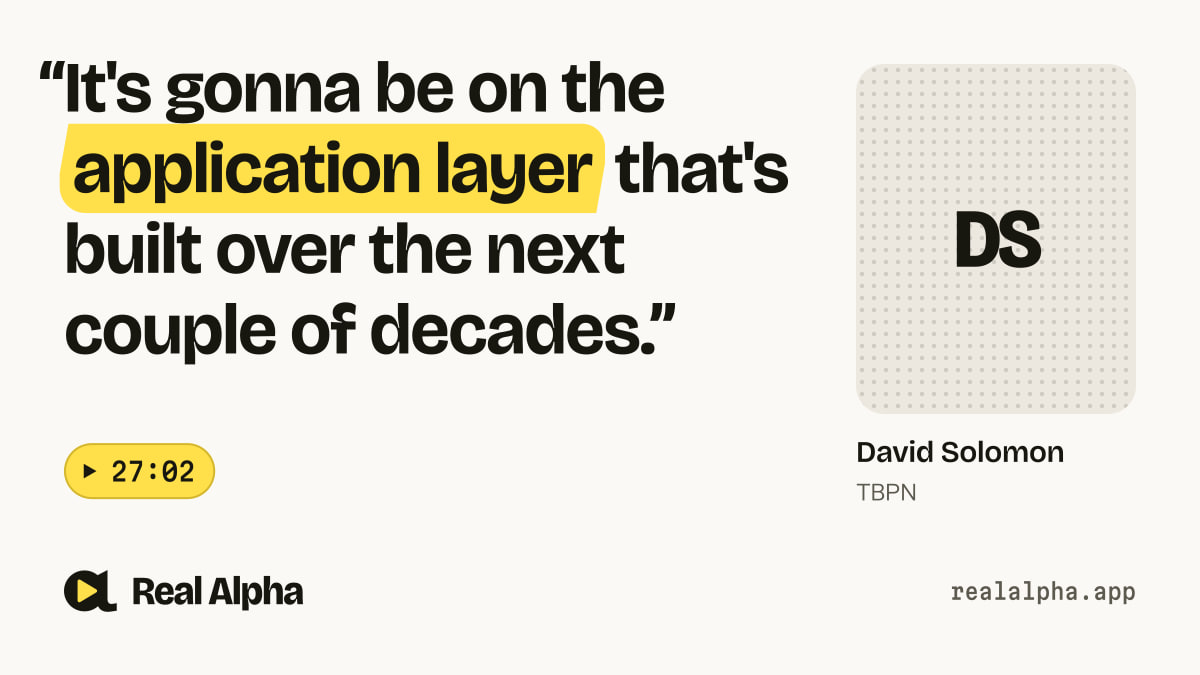
“It's gonna be on the application layer that's built over the next couple of decades.”
Takeaways
- AI may be moving faster than earlier technology shifts.
- He expects major value creation at the application layer.
- Future applications could reshape health, food and supply chains.
About this segment
David Solomon agrees AI should be distributed widely, but says it is too early to know what “normal” looks like. He expects major value creation from applications built over coming decades, not just infrastructure or models.
David Solomon is chairman and CEO of Goldman Sachs.

John Coogan, Host · Co-host, TBPN
Co-founded Soylent and Lucy; OpenAI bought his show TBPN in April 2026.

Jordi Hays, Host · Co-host, TBPN
Founded Branded Native; co-founded fintech Capital, which Rho bought.
From “Goldman Sachs CEO Reacts to Jensen Huang's Potential Return to NVIDIA”, Nov 17, 2026. Watch the full episode
Answers “What will AI look like in the next few years?” See all 395 answers
Thanks. We'll look at and fix what's off.
Transcript
From the transcript TBPN publishes with the episode.
- 25:25
Do you view AI as a normal technology or something greater? Know, I'm And not I would I and I would say like my... Our view on on Jensen the last couple years is despite being the number one promoter of the potential of AI, he viewed it... The way that he operated was very much as though AI was a normal technology, something like the Internet. And it would impact the economy but it was something that he wanted to distribute as widely as possible.
- 26:00
Yeah. If you if you put it in that lens, I actually agree with his thesis that like the Internet, you wanna distribute it as widely as possible so people can participate. You know, I don't like words like, you know, normal. You know, people say to me this is unprecedented and I say, nah, probably not unprecedented. Okay. You know, it's technology. Yeah. Okay. Again, go back to where we started. People matter.
- 26:23
Relationships matter. Judgments matters. Brand... Yeah. Brands matter. This technology can make all those things more powerful. Sure.
- 26:31
But all those We're building the AI native Goldman Sachs. Yeah. It's like, great. You're telling me that you don't understand Goldman Sachs.
- 26:39
Yeah. I mean, all all those things matter and they're still gonna matter. So is this going faster Yeah. Than certain other technological revolutions are going? Yeah. I think it's going a little bit faster. But you're really not gonna know what normal is until we get ten, twenty, thirty years out. Yeah. I mean, I just sat on stage here. One of the big big value creation around all this, I don't think is gonna be on the infrastructure build or the large language models or the hyperscalers. It's gonna be on the application layer that's built over the next couple of decades.
- 27:08
Sure. So many new companies, ideas, platforms that we can't even imagine. Mhmm. Think about health, wellness, food, supply chains. Yeah. I mean, it's it's it's it's an enormous, enormous opportunity and that's super exciting but that's that's gonna be our normal. And I I think when we get there, I'm still very confident. People, relationships Yeah. Judgment Yeah. Hard work Yeah. Excellence Yeah. Showing up. Yeah. You know, those things are still gonna matter.
- 27:38
How do you think about x, the social platform? A lot of the a lot of the reason I think this event is happening is because there's a handful of people in the audience where when they put out a note on something, even though they might have like an animal as their profile picture and and be anonymous, it ends up moving the market. How do you think, you know, firms like yours have had to adjust to this kind of new media environment where anybody at any time, if they're compelling enough, can put out things that actually drive drive the markets.