Free with a sign-in.
The best 14 min of 30
Goldman Sachs CEO Reacts to Jensen Huang's Potential Return to NVIDIA
David Solomon says AI’s biggest long-term opportunities will come from applications, while relationships and judgment will remain central to Goldman Sachs.
 TBPN · John Coogan & Jordi Hays
- David Solomon is chairman and CEO of Goldman Sachs.
The best minutes
- 9:09AI tools help defenders find and patch vulnerabilities faster6 min
- 17:22Investors need durable expertise, not a me-too strategy5 min
- 25:23The biggest AI value may come from future applications3 min
Also worth watching
- 4:10Durable revenue now makes up about 60% of Goldman’s mix2 min
- 6:17Goldman will use technology to expand its institutional reach2 min
- 15:15Goldman’s senior leaders stay involved in IPO pitches2 min
Skip the opening dress-code and Lululemon stories, the reindustrialization discussion, and the X and Jensen closing exchange.
Full analysis · 6 min read
Real Alpha · Nov 17
David Solomon says about 60% of Goldman revenue is more durable
- Depending on how measured, Solomon says approximately 60% of Goldman revenues are considered more durable.
- His AI outlook points to applications over decades, while investors need expertise in chosen markets.
- For operators, the near-term tests are safe deployment, real demand, and repeatable economics.
Free with an account
Read the rest of the analysis
6 sections, the 3 other voices it tests Solomon against, and what it means for you. Every episode we cut gets one.
Check your inbox
We sent a link to your address. Click it to finish signing up. Not there in a minute? Look in spam.
or
Signed up before? The same buttons sign you in. The episode, its moments and the transcript stay free.
Solomon says the AI funding ecosystem is broader
The host asked whether losing Jensen Huang's investing role could unsettle private markets. Solomon narrowed the concern to AI infrastructure companies, not private capital as a whole.
He said broad private capital formation was still in its early innings. He also described the ecosystem as much larger than one executive or company.
Solomon credited Huang with a powerful role backing startups. But he said investors should not assume how Colette would approach those investments, and called her a competent executive.
He said a lot of capital remained available and the best companies would continue to find funding. He allowed that slower capital formation might be healthy.
On Huang's later conditional return statement, Solomon did not judge its merits. He said NVIDIA's board should move slowly, understand the facts, and choose what served the company and shareholders.
“The best companies will continue to get funded.”
Our read
Our reading is that Solomon separates one executive's role from the market's overall capacity. He remains positive on funding for the best companies, while leaving the pace and board outcome open.
Solomon ties sustained investing to real expertise
When the host asked about hedge funds taking crossover roles, Solomon answered for hedge funds and asset managers. He said teams should choose where they want to play and build capabilities there.
He named public securities, private securities, venture, startup technology, and growth investing. Managers with deep expertise, he said, can do well across good and bad cycles.
The host suggested private-company exposure might help investors see developments earlier. Solomon did not address access as a standalone advantage; he said information arbitrage can work for a year, while sustained success requires capability.
That distinction matters for a finance team comparing private opportunities with public holdings. Faster information may help a trade, but his advice concerned repeated competence, not promised outperformance.
He also warned against me-too positioning without core investing competence. The practical test is whether a team's skill matches the market it chooses, rather than whether it can enter another one.
“But to do it on a sustained basis over years and decades, you have to be really, really good where you're choosing to deploy capital.”
Our read
Solomon's advice is specifically about investors deploying capital across different markets. It favors durable expertise over a short-lived information edge, without prescribing one investment strategy.
Solomon expects applications to create value over decades
The host described Jensen's approach as treating AI like a normal technology and distributing it widely. Solomon agreed on broad distribution, but said he dislikes calling the technology normal.
He thinks AI may be moving a little faster than some earlier technological shifts. Still, he said it would take ten, twenty, or thirty years to know what normal means.
His forecast was that major value creation would come from the application layer built over the next couple of decades. He contrasted that expectation with infrastructure, large language models, and hyperscalers.
He named health, wellness, food, and supply chains as fields where new companies or platforms might emerge. Those were possibilities, not individual product predictions or revenue estimates.
For a product leader, the forecast points toward testing workflows where AI changes the user outcome. It does not specify when adoption arrives, what customers will pay, or which layer retains value.
“the application layer that's built over the next couple of decades.”
Our read
Solomon offers a long-range view, not a deployment schedule. Operators can treat the named fields as hypotheses to test, rather than established winners.
AI security gains depend on careful patching
Solomon said Goldman had access to powerful models, kind of from day one, going back seven, eight months. The period was his loose estimate, not a precise deployment date.
The firm runs thousands of scans, tens of thousands every day, around the clock. Solomon said it was more secure than seven months earlier, while noting that every network still has vulnerabilities.
But he also said scanning and patching too fast can create volatility if teams do not get it exactly right. Vendors, open source connections, and legacy technology make the work wider than one company's systems.
On Cheeky Pint in October 2026, Sam Altman said models had barely reached the internet's vast codebase. He expected broader scans to expose more serious flaws.
Satya Nadella on The Pragmatic Engineer in November 2026 described stepwise hardening of legacy systems. Ali Ghodsi on All-In in November 2026 called the legacy vulnerability backlog finite, while stressing attackers' advantage.
These perspectives differ on scale and pace, but all bear on the work after a flaw is found. Solomon's caution is concrete: patch cycles themselves can upset live systems.
“This technology and these tools make people that want to do bad things more powerful more quickly.”
 Sam Altman · Cheeky Pint · Oct 29AI scans may uncover more serious software vulnerabilities
 Satya Nadella · The Pragmatic Engineer · Nov 16Legacy products need staged AI-driven hardening
 Ali Ghodsi · All-In · Nov 17Ali sees legacy code as a finite cyber-risk backlog
Our read
Scan volume alone does not show whether systems are safer. Teams also need to track fixes, vendor exposure, and disruption caused by changes.
Goldman classifies about 60% of revenues as durable
Solomon said Goldman's leadership team has spent eight years trying to build more reliable revenue around trading and transaction businesses. He described that work as continuing, not finished.
The firm combined asset and wealth management businesses and lends more to clients. For example, he said Goldman supervises a little over $4 trillion in assets.
He put the share near 60% of revenues, with the measure depending on how it is calculated. Solomon said that base was growing faster than its stated target.
He said Goldman has highlighted annual durable revenue growth of about 9%, or eight or nine percent, and is currently doing better. More lending and management fees are part of that case.
Yet these numbers are Solomon's account as Goldman's CEO. They explain his interest in durable revenue, but do not independently establish how the mix performs through a full cycle.
Our read
The useful distinction is between a target and a completed transformation. Goldman says it is growing the mix, while its durable-revenue figure depends on classification.
Goldman expects technology to broaden institutional reach
Solomon sees technology as a way to make Goldman more efficient and broaden its footprint. He did not describe a move into direct mass-market wealth management.
Instead, he said Goldman expects to stay focused on institutions, governments, enterprises, and very wealthy clients. Technology could support more reach among clients the firm does not touch today.
He described two possible uses for efficiency gains. Goldman could keep the margin, or reinvest it in growth and a broader footprint.
Take the IPO pitch: Solomon said CEOs expect access to the firm's senior leaders when taking a company public. He said he makes tens of calls to CEOs each week to check on the team's work.
That account also shows the commercial context. Goldman wants to lead major IPOs, and Solomon presented senior attention and trust as part of its service.
Earlier, he said technology makes bankers more powerful as connectors, while trust still comes from people. The operating claim is augmentation, not an automated substitute for relationships.
“our business is still a business of human connection.”
Our read
Our reading is that efficiency could extend Goldman's institutional model without changing its stated client boundary. But Solomon is describing his own firm's strategy and sales advantage, not neutral evidence.
What it means for you
- Set an application test. Pick one workflow and measure repeat use and customer outcomes before extending a long-range AI revenue forecast. Solomon's application-layer view spans decades, not a near-term estimate.
- Track patch outcomes. Measure vulnerabilities found, fixes completed, and service disruption together. Solomon's account shows that rapid scanning and patching can also create system volatility.
- Define investment capability. Ask what a team can evaluate repeatedly in each market it enters. Solomon's advice to hedge funds and asset managers centers on expertise, not a temporary information edge.
- Check revenue definitions. Ask how the durable-revenue share is calculated and compare it across reporting periods. Solomon qualified Goldman's approximately 60% figure by how the measure is viewed.
What to watch
- Whether NVIDIA's board provides more information about its decision on Huang's possible return.
- Whether expectations for slower AI ecosystem capital formation continue, or the pace changes.
- Whether Goldman continues growing durable revenues and broadening institutional reach as Solomon described.
Send this to the investment committee chair and the leaders owning AI products and security.
Watch the minute where Solomon gives Goldman's durable-revenue estimate
Written by Real Alpha from the episode's transcript and the other moments it links, then checked against the transcript. Quotes are the speaker's exact words.
Minute by minute
- 1:46Personal touches build trust
Solomon recounts Goldman’s team wearing head-to-toe Lululemon for a pitch to the company, which he says delighted its management team and private-equity owner, Advent. He says technology can make Goldman employees stronger connectors, but winning business still depends on personal relationships and trust.
- 4:10Goldman grows durable revenue
Solomon says Goldman has expanded asset and wealth management and lending to balance its more transactional businesses. He says the firm supervises a little over $4 trillion in assets and that about 60% of its revenue is now more durable; he has outlined annual growth of 8% or 9% for that revenue base. He says Goldman plans to remain focused on institutions, governments, enterprises and very wealthy clients, using technology to improve efficiency and broaden its footprint.
- 8:41AI can strengthen cyber defenses
Solomon says cyber risk has long been one of his biggest concerns. He says Goldman has used AI models to run tens of thousands of vulnerability scans a day and believes the firm is more secure than seven or eight months earlier, though still vulnerable. He warns that rapid scanning and patching can destabilize systems, points to vendor and open-source exposure, and calls for a public-private effort to upgrade, scan and patch software across the economy.
- 15:15Senior leaders join IPO pitches
Solomon says he and other senior Goldman leaders make themselves available to CEOs taking companies public, including through frequent calls. He argues that senior access, balanced advice focused on companies’ long-term interests and trust help Goldman compete for major IPO roles.
- 17:22Expertise matters more than chasing trends
Solomon says broad private-capital formation is still in its early stages, even if funding for AI infrastructure companies slows. He cautions against assuming how Colette will approach NVIDIA-related investments and says the strongest companies should continue to attract capital. For investors, he argues that lasting expertise in chosen areas matters more than chasing trends or relying on one-off information arbitrage.
- 22:12Capital can support reindustrialization
Solomon says Goldman advises, finances and invests in companies working on technology and manufacturing. He identifies US entrepreneurship and risk-taking, capital markets, and the ability to attract smart people from abroad as economic advantages. He argues that reindustrialization should use technology to bring critical industries back to the United States.
- 25:23AI’s value may come from applications
Solomon agrees with Jensen Huang’s view that AI should be distributed widely, while resisting the label “normal.” He says it may be moving faster than earlier technology shifts, but its effects will take ten, twenty or thirty years to understand. He expects much of the value creation to come from application businesses over the coming decades, citing health, wellness, food and supply chains, and says relationships and judgment will still matter.
- 27:35Solomon urges caution on Huang’s return
Solomon says he posts occasionally on X but focuses on where stocks may be in two, five or ten years rather than short-term moves. Asked about Huang’s statement that he would return as NVIDIA CEO if the board decided it was best, Solomon says the board should move slowly, understand the facts and that he lacks enough information to comment.
Published Nov 17, 2026.
Transcript · 26 min read
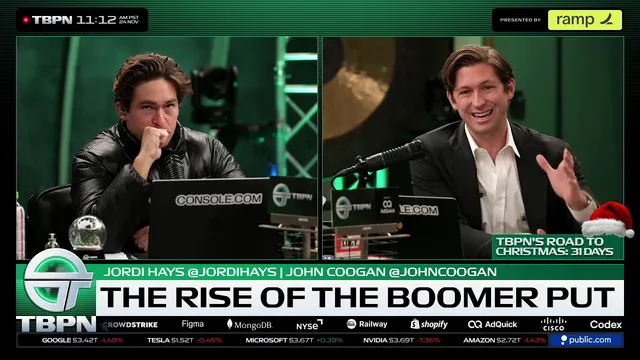
TBPN, hosted by John Coogan and Jordi Hays, with David Solomon.
From the transcript TBPN publishes with the episode.
David Solomon, welcome to TBPN. Thank you so much for taking the time Great to have you. To come chat with us. No. You're fine. You're fine. It looks great. I like the the the quarter zip and the Yeah. Would it kill you to put on a suit? The offshore is fantastic.
Mean, forty some years, I've worn a suit most days. This is like the new... This is like the cowboy boots? Is it true or is it apocryphal that you're responsible for a little bit of the more casual dress on Wall Street or at Goldman? Is that true?
Well, I I think society is responsible for the fact Okay. That the world has gotten more casual. I Okay. There's there's been a bunch written about the fact that when I became CEO, shortly after I became CEO, I walked into the office one day in New York and I kinda looked around and I was the only guy on a screen time. Okay. So you're reacting. So I asked asked, do we have a dress code? Yeah. Yeah. And I got this document that was like pages and pages that had put together over decades and decades and decades. And I said, you know, I think we need a clearer policy. I think the policy should be dressed in a way that's appropriate for your day and the clients you're going to see. Sure. And that could be a suit and tie. That could be dressed like this.
Read the whole transcript
So you tore up the 500 pages? I kind of put it in a shelf. It's now in what we'd call the Goldman Sachs Museum. Yes. Where it could be looked at as a historical artifact. But look, the world's much more casual. I mean, I literally... I mean, I've been I've been at this for like forty three years and I would say that literally every single morning for the first thirty five years, I woke up and the decision was white shirt or blue shirt. There you go. You know, red tie or blue tie. Yep. Yep. And, you know, now I've actually gotta look at my calendar and say, who am I meeting with? What's appropriate? Do I have to change in the middle of the day? Because, you know, I've a government official. And then I've got some, you know, young entrepreneur.
And, you know, he's gonna like it better if I'm dressed like this. And so it's it's much more complicated.
What about the Lululemon IPO? Is that story true or apocryphal? No. That story is true. Okay. Tell us. I mean, that story is... We we we went... It was up in Boston. The company was owned by Advent, which is a private equity firm. Yeah. And I mean, I I I can't take credit for the idea of the team. Oh, interesting. The team... I was I was asked to join the pitch and the team the team said we're gonna all put on Lululemon. Okay. I mean, head to toe. Yeah. Yeah. I like Head to toe Lululemon, we walked in. At the time, I don't know if I was running all the capital markets businesses or investment banking. I don't remember exactly what it was, but I was a pretty senior guy in the firm and I walked in. I was the most senior guy at the pitch and the whole team was head to toe in Lululemon gear. I I mean, I loved the reaction of the management team and the private equity firm Advent at the time.
But the reaction I really loved is after our pitch was done, we walked out of the conference room. Okay? And one of the competing firms was standing out there waiting to come in Yeah. And their faces, they're on suit and tie. And they're like, uh-oh. We we just... We lost that.
That the craziest hijinks you've pulled to win a deal to win a... There a lot of there are a lot of other Yeah. You know, gimmicky things that that have been done but little...... Custom deal toys and stuff. When when you you think about our business this is really interesting because with all the technology Yeah. That exists in the world, our business is still a business of human connection. Yeah. And that's not gonna change. Technology tools make us more powerful as connectors, but that human connection is not gonna change. And, you know, the way you win business is by earning trust. Yeah. It's by earning trust. It's by building relationships and earning trust. And so taking the time to do something Yeah.
That shows, you know, people that you really care about them, about their business, about what's important to them. Yeah. You know, that's a great way to start. That's a great way to to Yeah.
Technology is table stakes. Brand is always in flux in in development. And then the the real loyalty comes to the individual people.
People to people. People to people. That's... Mean, the power of Goldman Sachs. And I mean, I'm credibly fortunate to steward this organization. But one of the things that's... That I'm so fortunate about is it's an extraordinary collection of people Yeah. That are really, you know, highly motivated, highly incented to, you know, to really do great things. And people build trust with people. That's... No matter what happens with technology in the world, in my humble opinion, that's not gonna change it.
“depending on how you look at it, approximately 60% of the revenues would be considered more durable revenues.”
“I don't think new clients, but I think an expanded footprint”
I wanna get into some of the topics of the week. One of which is cyber. Every single CEO I've talked to over the last month that is running a company significant in whatever category it's in, whether it's social media to these inference providers, they all are under attack and it's a very scary time. What conversations are you having with other CEOs and at the firm around navigating this this period of of heightened cyber risk?
“We've been running thousands of scans, tens of thousands of scans every single day, seven days a week, twenty four hours a day”
Yep. Mhmm. Go for it.
“there isn't a week that goes by. That I don't make tens of phone calls to CEOs to check-in with them.”
Yeah.
“what people get into trouble is when they're kind of chasing the me too and they haven't developed the real core investing competence”
Well, we we finance a lot of these companies. Yeah. We we advise them. We finance them. We Yeah. We bring them capital as an asset manager. We invest in a lot of these companies. And so, you know, our role, we sit in a very powerful place in the ecosystem of tech innovation and, you know, business innovation in The United States because we we serve as an adviser, we serve as a capital former distributor and also investor. And so, you know, we see a lot and we participate in a lot of that. You know, I think your comment about re industrialization, I've loved the narrative around our... I think there are I think there are a few things that really differentiate The United States. The United States economy is the premier economy in the world, not by a little Yeah. But by a lot. There are three things I'd point to Yeah. That I think really contribute to that.
There are other things, but here are three things I'd point to. You know, the first is our tech innovation economy and our spirit of entrepreneurship and our risk taking culture in The United States, kind of second to none. Yeah. There's no tall poppy syndrome. It's it's second to none. Yeah. And and, you know, that is creating incredible companies, incredible businesses, and, you know, reindustrialization in The United States should be centered around technology innovation Yeah. And getting those critical industries here. By the way, can be on drug discovery Totally. Which also relies on technology too.
Of course. But those critical industries more here again. Yeah. Okay? I think is a is a great growth vector, you know, for The US economy. Second, we have the best capital markets and financial system in the world, not by a little. Yeah. By a lot. By a lot. By a lot. And, you know, that matters. You know, the availability of capital, the fact that people want to take risk Yep. The breadth of our capital markets, the strength of our banking system, that matters a lot. And I... That's that's something that really differentiates The US. And then third, lots of smart people around the world wanna come here. Yeah.
And we absolutely should have firm borders, but we also have to have great policies that get smart productive people that wanna be here and want to participate in our way of life and innovate. We need to find ways to get those people into The United States to drive, you know, to participate with Americans. Mhmm. And we also have to work to get more Americans involved in driving this, you know, this economic engine. And when you look at it relative to other economic engines of the world, those three things are distancing us. Go back and look at a comparison between other economies through the twentieth century. The US was bigger. They were all growing, but they grew in a pretty linear way. Yeah. In the last fifteen to twenty years, The United States has meaningfully accelerated in a way that that that people didn't expect.
These three things are contributing to that and we've gotta make sure we continue to invest in, don't take those things for granted and get them right. Totally. Yeah.
“It's gonna be on the application layer that's built over the next couple of decades.”
Yeah. I I... Well, first of all, I mean, I I post on x occasionally. You know, when when the rocket got caught the other day Yeah. You know, I reposted, you know, Elon's post and I was like, wow. This is super cool. Okay. This is like unbelievable. I've gotta get down there and and see this, you know, see this live. I think it's a very powerful platform. You know, I I... When you talk about moving the market, I'd be cautious. I'm not a guy that lives in the moment. I'm a guy that tends to think about things over time. Yeah. And so I really don't care that someone says something and stock goes up 2% or down 2%. What I care about is where the stock is gonna be two years from now or five years from now or ten years.
And it's hard for one individual to One individual might have an impact. One one individual might say something that in the short run gets people pushing the stock around.
Well, the interesting thing is you had what what was it? Culper Research who put out the short report on NVIDIA six months ago. No one really paid attention. Didn't have an impact.
Yeah. Profiled at the Wall Street Journal. Speaking of the Wall Street Journal, Jensen Huang just put out a statement. It's breaking news. I'd love your reaction. He says, if the board decides that my return is in the best interest of shareholders, employees, company, and America, I would be honored to return as CEO. What do you think about Jensen's latest statement?
Well, I'm... I I... You just read the statement to me. I'll say the same thing I'll say the same thing that I I said earlier on stage. You know, I saw I saw Gavin and Brad's letter saying the board should go slowly and thoughtfully. Sure. There's a lot of things I certainly don't know. Mhmm. All the facts around all this. I think it's important that the board goes slowly and thoughtfully and make sure it understands all the facts to make the best decision for this company and, you know, for shareholders. And and, you know, at the moment, there's not enough there's not enough information out for me to respond to any of this.
Yeah. I completely agree. It's been moving extremely extremely quickly. Well, thank you so much for coming on the show. Absolutely.
It's my pleasure, guys. Nice to meet you. Have a great rest of Thank you very much. Thank you. Appreciate it. Thanks.