The alpha, twice a week
That was 5 min.
Get the best new moments in your inbox every Wednesday and Saturday. It's free.
Check your inbox
We sent a link to your address. Click it to finish signing up. Not there in a minute? Look in spam.
or
Decoder · 5 min · Nov 9, 2026
The RIAA runs its work with a 46-person staff
 Mitch Glazier
 describes the RIAA's standards, research, lobbying and around-the-clock content-protection work.
In this episode
Full analysis- 13:44Fans may decide whether AI music can earn their loyaltyPro pick 8 min
- 39:56YouTube licensed music even after winning in court8 min
- 31:59Deepfake rules need safeguards for speech and likeness8 min
- 54:44Spotify's AI labels need to reach the track level5 min
- 1:00:02AI music labels depend on distributors as well as platforms4 min
- 21:59The RIAA runs its work with a 46-person staff5 min
- 1:04:19Chart eligibility may hinge on human creative control4 min
- 26:52Glazier tests gut decisions against trusted dissent3 min
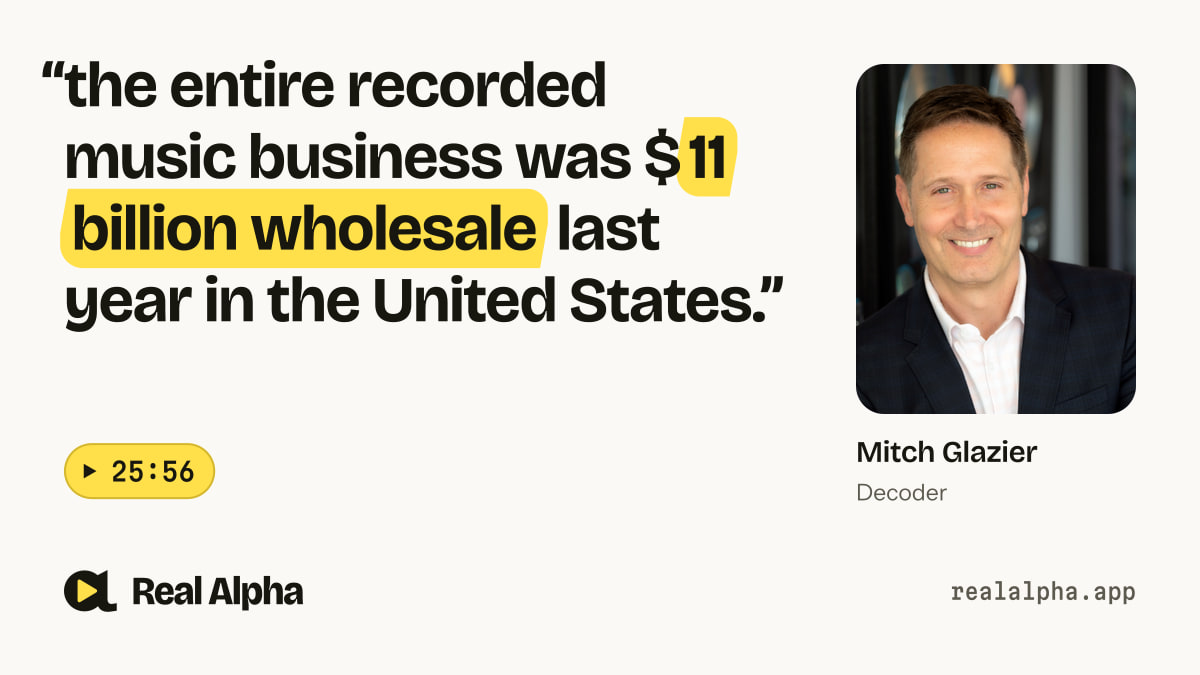
“the entire recorded music business was $11 billion wholesale last year in the United States.”
 Mitch Glazierat 25:56 · Decoder
Takeaways
- The RIAA began as a technical standards association.
- Its 46 staff cover policy, legal work, research and content protection.
- Glazier contrasts $11B in U.S. wholesale music with a $2T AI-company valuation.
About this segment
Mitch Glazier describes the RIAA's standards, research, lobbying and around-the-clock content-protection work. Its 46-person team represents a $11B U.S. industry while facing AI firms with far larger valuations.

Mitch Glazier is chairman and CEO of the Recording Industry Association of America.
Built legal and policy foundations for digital music streaming and leads the RIAA’s work on generative AI.

Nilay Patel, Host · Editor-in-chief, The Verge
Helped start The Verge in 2011 and has hosted Decoder since 2020.
From “The man who fought Napster is now fighting AI | Decoder”, Nov 9, 2026. Watch the full episode
Thanks. We'll look at and fix what's off.
Transcript
Transcribed by machine (Whisper) from the episode’s audio, so a word may be off here and there.
- 22:05
Tell people what the RIAA is, how big it is, and how it's structured. We're based in Washington, D.C., because that's where the federal government is. We used to be based in New York. RIAA actually started as a tech standards association. They created the RIAA curve, the equalization curve that allowed both the recording and the playback of vinyl records on a way that would work on every single record player.
- 22:29
So it didn't really start out as a lobbying organization or a litigation organization. That's how we became famous or infamous, depending on where you sit. But we started out as a tech standards organization, and we still do that. We still participate in international standard-setting organizations right now to try and set the fields, for example, for the metadata that people will use, whether it's AI or any other technological format or in labeling, for example.
- 22:54
But we also run the Golden Platinum program, which we're probably best known for with the general public. So we're like those nerdy auditors that actually certify the Golden Platinum records, like the lawyers, like the PricewaterhouseCoopers lawyers that walk out on the Oscars or whatever. But that's great because it allows us to sort of interact directly with artists and celebrate their success, which is very cool.
- 23:20
we also um like put together all the revenue from the entire recorded part of the music business and we're released that twice a year and that helps inform people about the markets uh and it helps to sort of on the business side give people the sort of benchmarks that they need industry wide everybody knows what their company is doing uh what their management company is doing but to know what the whole industry is doing and whether or not you're on par or you know less or more is quite helpful. We are the spokesperson when the industry is aligned. We're out there sort of talking on behalf of the industry. We technically represent the major labels, but we forge coalitions because whether you're major or indie, whether you're an artist or a publisher or a songwriter, most of the time, our interests are aligned. Every once in a while, we fight each
- 24:13
other. But where we are aligned, which I would say is 90% of the time, the RAAA is sort of the driving force in building coalitions so that we can all speak together. So we do a lot of stuff. We don't just sue people and lobby the government, although those are big parts of what we do. And then we also take on the content protection force for the industry. So we have our content protection department uh operates 365 days a year 24 hours a day we work with sister organizations in london and new zealand so it doesn't matter what time of the day it is we have people coordinated and working around the clock and then we do all those takedown notices we get a note from a manager saying a pre-release of this artist that hasn't come out yet is up. We need your help getting it down. We do all of that. And we do it,
- 25:10
the entire organization is only 46 people. Wow. Isn't that amazing? But the most passionate music lovers you would ever imagine. It's only 46 people. Only 46 people. How is that structured? Does everyone just do everything all day long? There aren't as many redundancies as there should be. We're divided into those different departments, right? Like content protection, communications and research, public policy and industry relations, and obviously legal affairs. So we are, I would say, small and nimble, but we punch above our weight. We are high profile, but our industry, if you think about it, compared to the folks that we are sort of up against, if you want to view it that way, it's really small. I mean, the entire recorded music business was $11 billion wholesale last year in the United States. The market cap of just one AI company is $2 trillion. So
- 26:18
when we're out there lobbying and we've got like, you know, our three-person lobbying team at the RAAA, trying to make a point to policymakers, and you're dealing with, you know, super PAC money that equals $250 million in a midterm cycle, we don't have that kind of revenue. But what we do have is music. And we have artists who everybody loves and who are culture makers and who are messengers that people trust and listen to. So I think we do pretty well for our tininess. The other question i ask every ceo comes on the show is about decisions you have a lot of decisions to