The alpha, twice a week
That was 3 min.
Get the best new moments in your inbox every Wednesday and Saturday. It's free.
Check your inbox
We sent a link to your address. Click it to finish signing up. Not there in a minute? Look in spam.
or
TBPN · 3 min · Nov 19, 2026
The Zynga deal passed strategic, financial and cultural tests
 Strauss Zelnick
's acquisition screen asks whether a deal fits strategically, adds shareholder value and matches company culture.
In this episode
Full analysis- 8:57Creative freedom works best with financial guardrailsPro pick 3 min
- 32:10AI will become a tool, not an entertainment moat3 min
- 42:55Zelnick explains why he passed on VR and missed mobile4 min
- 3:50GTA Online became a business beyond its original plan3 min
- 12:09Recurring spending accounts for 80% of Take-Two's net bookings2 min
- 15:41The Zynga deal passed strategic, financial and cultural tests3 min
- 27:39Take-Two links more than a billion records for marketing2 min
- 47:45Streaming could expand the market for console and PC games3 min
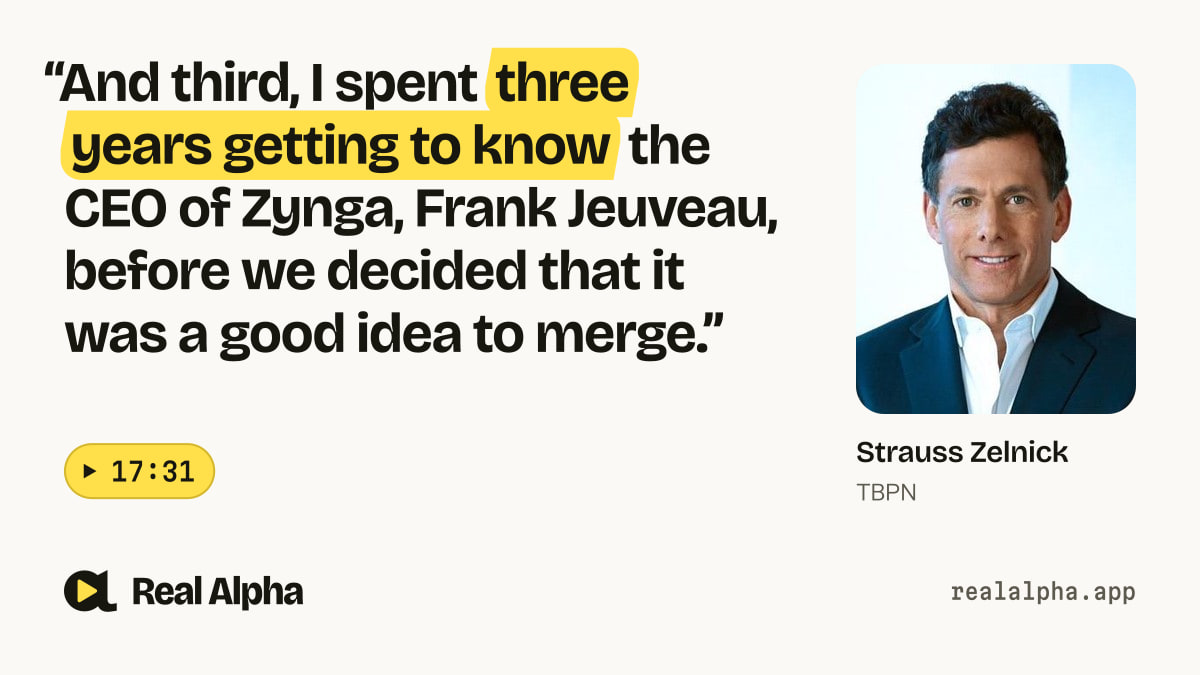
“And third, I spent three years getting to know the CEO of Zynga, Frank Jeuveau, before we decided that it was a good idea to merge.”
 Strauss Zelnickat 17:31 · TBPN
Takeaways
- An acquisition needs a clear strategic fit.
- Take-Two checks that the deal will be financially accretive.
- Zelnick spent three years building a relationship with Zynga's CEO.
About this segment
Strauss Zelnick's acquisition screen asks whether a deal fits strategically, adds shareholder value and matches company culture. Before buying Zynga, he spent three years getting to know its CEO.

Strauss Zelnick is CEO of Take-Two Interactive.
Led Take-Two’s growth by backing creative talent behind Grand Theft Auto, NBA 2K and other global entertainment franchises.

John Coogan, Host · Co-host, TBPN
Co-founded Soylent and Lucy; OpenAI bought his show TBPN in April 2026.

Jordi Hays, Host · Co-host, TBPN
Founded Branded Native; co-founded fintech Capital, which Rho bought.
From “The CEO Behind GTA VI on Building the Biggest Game in History”, Nov 19, 2026. Watch the full episode
Thanks. We'll look at and fix what's off.
Transcript
From the transcript TBPN publishes with the episode.
- 15:44
Yeah. How do you think about post merger integration, just integration across the different teams? You've made some acquisitions. How much value is there in co locating teams? I know the company is extremely distributed. But is there value of someone from the NBA team spending time with the GTA six team and vice versa? Or do... Does everyone just kind of want to be able to focus on their own goals?
- 16:08
Well, look, season three of NBA two k '27 is is GTA six themed. Sure. And last night, there was a live basketball game in Miami Yeah. You know, where where the heat played as Vice City. I I mean, they... We actually... And I'm really proud of this. Our teams are true to themselves and their properties and can collaborate. Now going to the broader question about mergers, you know, mergers succeed or fail based on a couple of key metrics. The first is, is there a strict...
- 16:39
True strategic fit? Like, do these companies belong together? The second is, do the numbers make sense? In our case, we wanna know is deal accretive? Are our shareholders gonna do better for having done this deal than for not having done the deal? Amazingly enough, many people don't think about an accretion dilution analysis Yeah. Before they do a transaction. And then the third metric is, is there a cultural fit? So in the case of our acquisition of Zynga in mid twenty two, we knew there was a sound strategic benefit to being in the mobile business. We'd already bought a couple of smaller mobile companies.
- 17:09
We knew mobile was the fastest growing part of the interactive entertainment business. We felt pretty strongly that would continue to be the case. We knew that mobile served an audience that we didn't primarily serve, which is to say an audience skewing someone older, an audience skewing someone more female. Mhmm. So we knew we wanted to be in mobile. Okay. Strategic fit. Secondly, we made sure that the economics made sense, that the deal would be immediately accretive financially, which which it was in the fullness of time. And third, I spent three years getting to know the CEO of Zynga, Frank Jeuveau, before we decided that it was a good idea to merge. And at that point, we understood, you know, where our culture's aligned and where they might not align as much.
- 17:48
It's also the truth that we we have enormous respect for divisional autonomy as long as everyone understands they're part of a a federation with with a common mission. Yeah. Make the best entertainment on earth. Be the number one entertainment company on earth. By the way, trying on number one. Number two, we're not there yet. Not even close, but but that's our aspiration. Yeah. You know, common strategy, be the most creative. Really mean it, really try to do it, be the most innovative, and be the most efficient. And we we fall short. We try.
- 18:19
And then we have a common culture. Seek excellence in everything we do. Act as a team. Be kind. Mhmm. And we fall short there as well, but it's not for want of trying. And every one of my colleagues across all of my divisions would and can tell you exactly what I just said because we're all pulling in that same direction. And because we're able to tick that third box, like, we're we're on on the same page with the same culture, you know, for those reasons, our acquisitions have all succeeded, which is unusual for a big corporation, actually.
- 18:51
Very. What is... How how do you and the team at Rockstar think about controversy? Like, if somebody is on the team and they wanna do something Mhmm. In the storyline and they're...