Free with a sign-in.
The best 11 min of 53
The CEO Behind GTA VI on Building the Biggest Game in History
Strauss Zelnick says Take-Two’s financial discipline gives its creative teams room to take long-term risks.
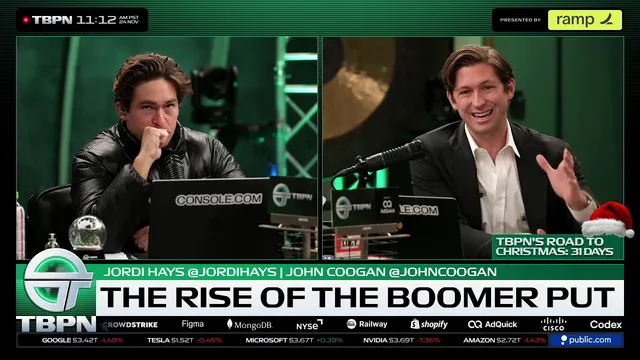
 TBPN · John Coogan & Jordi Hays
- Strauss Zelnick is CEO of Take-Two Interactive.
The best minutes
- 8:57Creative freedom works best with financial guardrailsPro pick 3 min
- 32:10AI will become a tool, not an entertainment moat3 min
- 42:55Zelnick explains why he passed on VR and missed mobile4 min
Every moment plays free. PRO marks a write-up that's in Pro.
Also worth watching
- 3:50GTA Online became a business beyond its original plan3 min
- 12:09Recurring spending accounts for 80% of Take-Two's net bookings2 min
- 15:41The Zynga deal passed strategic, financial and cultural tests3 min
- 27:39Take-Two links more than a billion records for marketing2 min
- 47:45Streaming could expand the market for console and PC games3 min
Skip the opening Take-Two history, the controversy, humor and ratings discussion, the AI-cloning and GTA VII detours, and the closing launch recap.
Full analysis · 6 min read
Real Alpha · Nov 19
Strauss Zelnick says recurring spending is about 80% of bookings
- Recurring consumer spending is about 80% of Take-Two’s net bookings, Zelnick said.
- Quarterly reviews bound creative budgets, but project returns and failure rates remain undisclosed.
- Founders should measure engagement and risk limits, not assume franchise hits repeat.
Free with an account
Read the rest of the analysis
7 sections, the 5 other voices it tests Zelnick against, and what it means for you. Every episode we cut gets one.
Check your inbox
We sent a link to your address. Click it to finish signing up. Not there in a minute? Look in spam.
or
Signed up before? The same buttons sign you in. The episode, its moments and the transcript stay free.
Quarterly reviews bound the creative risk
Zelnick described an operating rule rather than a blank check. Creators bring plans to the business team in quarterly product reviews. The company budgets the work, assesses possible returns, and stays on top of risks.
Zelnick described the target as creatively risk-forward and financially risk-averse. He said Take-Two arrived in 2007 with financial and compliance trouble, but strong creative teams. The job, in his account, was to clear obstacles without weakening creative judgment.
He also said Take-Two can be liberal with budgets when it expects extraordinary creative properties. But he disclosed no return thresholds, project budgets, or failure rates. Readers cannot see how often reviews alter scope, or what makes a risk acceptable.
For founders, the distinction is between approving a risk and managing it. Set financial boundaries before work starts, then name who can adjust scope as evidence changes.
Our read
This is bounded autonomy, not unlimited creative freedom. The process is clear, but its outcomes are hard to assess without project-level evidence.
GTA Online became a business beyond its launch plan
Rockstar launched GTA Online weeks after GTA V. Zelnick said Take-Two initially viewed it as added value for buyers. Downloadable content for GTA IV had begun the company’s recurring consumer spending model, he said.
Then GTA Online became a standalone business that Take-Two had not initially expected. Its eventual business role exceeded the company’s original framing of the service.
Zelnick said GTA V sold over 235 million units across three console generations, a result that surprised them. That is evidence of durability, not proof each launch will repeat its performance.
Take-Two’s catalog and continuing engagement can support ambitious bets, but neither guarantees the next hit. The operating model can make room for risk without removing uncertainty about what players will embrace.
Our read
The service’s evolution shows that a product can become more than its original plan. That supports risk-taking, but does not make hit creation predictable.
Recurring revenue could soften blockbuster dependence
Recurring consumer spending represents about 80% of Take-Two’s net bookings, Zelnick said. That makes year-round engagement a financial structure, not merely a product feature.
NBA 2K illustrates the shift. Zelnick said it once played mainly as a three-month experience. Now its online mode keeps consumers engaged year-round.
He expects more franchises to become ongoing experiences, easing pressure on major releases. But 80% is company-wide, not a measure for each game or future launch.
Joost van Drunen, on Prof G Markets in November 2026, sees gaming’s next era becoming more multimedia. His examples include films, parks, and user-created content, a broader thesis than Take-Two’s focus on ongoing game engagement.
Neither direction proves which format will produce returns. For operators, test whether between-release activity sustains players without making the product feel like maintenance.

Our read
Recurring engagement can make a release schedule less financially lumpy. The company-wide figure does not show which franchises can sustain it.
AI can ease chores without making hits easy
Zelnick expects AI to become ubiquitous, while making and marketing hits remain difficult. He said Take-Two is spending on tokens and seeing some efficiencies, not rapidly cutting headcount.
Take the pie chart. Zelnick said it is quicker to produce now, freeing staff from work he considers low-value. But the episode gives no measure of time saved or AI costs.
Stefano Corazza leads AI research at Canva. On MTS in November 2026, he said saved labor can leave room for more stories. Ari Emanuel told Inside Blackstone in November 2026 that taste, culture, and creative thinking remain human strengths.
Those views align with Zelnick’s distinction between faster production and creative judgment. Yet if competitors use the same tools, efficiency alone may not differentiate a studio.
Zelnick agreed that steady team sizes could raise creative ambition, but gave no production benchmark. Teams should track task-level time savings against token costs, then see whether time shifts to creative work.
- SCStefano Corazza · MTS · Nov 13AI gives creators more time to make stories
 Ari Emanuel · Inside Blackstone · Nov 10AI raises the value of human taste and creative judgment
Our read
AI looks like an input to creative work, not a replacement for the judgment that makes work resonate. Its business value needs measurement at the task level.
VR and mobile expose the cost of misreading users
Zelnick says Take-Two invested basically zero in VR, while doing paid projects to build expertise. His objections were uncomfortable headsets, a solitary experience, and nausea within 20 minutes. Those concerns explain his entertainment call, but not every possible use of VR.
He said VR may suit medical, training, and simulation uses. But he also said he misread mobile games as a flash in the pan. He later saw that some players wanted light play several times a day.
For example, they might play while waiting for a bus or winding down. Take-Two had to catch up through acquisitions, he said.
Pim de Witte is CEO of General Intuition. On Newcomer Pod in August 2026, he said his first mobile game had the right mechanics but too little variation. His example also included insufficient player liquidity.
That points to a product test beyond Zelnick’s category-level lesson. Together, the accounts distinguish compelling technology from a durable play pattern. Measure whether players return, vary sessions, and want the experience before committing at scale.

Our read
Zelnick’s VR call and mobile miss show why executive intuition needs consumer evidence. Test behavior, not how compelling a new platform sounds.
A billion records may lower targeting costs
Zelnick says Take-Two cross-references more than a billion customer records across its labels. He said the data supports more effective marketing at virtually no incremental cost, under local rules.
The company tracks sales and player activity, including when a release falls short of expectations. That is a claim about campaign efficiency, not evidence that the database creates demand.
Chris Degnan is Cognition’s chief revenue officer. On Grit in November 2026, he said new-customer acquisition is the hardest part for Cognition. That is a different business, but cheap targeting does not make acquisition cheap.
Measure whether campaigns change returns or sales, not just database size. The transcript offers no lift, conversion rate, or acquisition-cost comparison.
Our read
The database may improve campaign efficiency, but the episode offers no evidence of incremental sales. Treat reach and conversion as separate measures.
Zelnick expects streaming to widen distribution
Zelnick expects effective game streaming within two or three years as latency improves. He says it could let people play console- and PC-quality games without buying consoles.
That is a forecast, not a demonstrated channel in this episode. Connectivity and an outboard controller would still matter, so streaming will not remove every access barrier.
He also named India, Africa, other parts of Asia, and Latin America as underrepresented markets. Distribution only matters if people can reliably reach the games and sustain play.
Companies planning around the forecast should measure latency, connection quality, and actual play behavior. Wider availability matters only if it translates into sustained engagement.
Our read
Streaming could expand access, but Zelnick’s timing and market impact remain predictions. Watch usable performance and sustained play, not availability alone.
What it means for you
- Set a risk envelope. Record each project’s budget, expected returns, and risks. Revisit them quarterly and document any scope changes.
- Measure repeat engagement. Track whether players return between major releases and whether that engagement contributes bookings. Do not assume the company-wide 80% applies to each title.
- Test actual play patterns. Measure session variation and repeat use in new mobile experiences. Ask players what they want from the moments your product targets.
- Audit AI time savings. Compare token costs with time saved on specific tasks. Then check whether the recovered time reaches creative work or higher-value operations.
What to watch
- Whether Take-Two’s recurring spending stays around 80% and reaches more franchises.
- Whether streaming improves enough within Zelnick’s two or three year forecast.
- Whether AI efficiencies produce measurable time savings beyond routine tasks.
Send this to the CFO and product leaders funding long-cycle creative work.
Watch the minute where Zelnick gives the 80% figure.
Written by Real Alpha from the episode's transcript and the other moments it links, then checked against the transcript. Quotes are the speaker's exact words.
Minute by minute
A Pro write-up, open to you here. Try Pro free for 7 days
A Pro write-up. The minute by minute is in Real Alpha Pro; the episode, its moments and the transcript stay free.
Read it with Pro, 7 days free- 1:01Zelnick moved from film to games
Zelnick says he left television and motion pictures for games in the early 1990s, becoming the pre-revenue CEO of Crystal Dynamics before working at BMG Interactive. After BMG’s parent company required it to divest the business, Take-Two bought it. Zelnick founded ZMC in 2001 and led Take-Two’s takeover in 2007.
- 3:57GTA Online became a lasting business
Zelnick says Rockstar’s downloadable content for GTA IV helped establish Take-Two’s recurring consumer spending model. Rockstar launched GTA Online weeks after GTA V; he says GTA V sold over 235,000,000 units across three console generations and expects its online service to keep serving players alongside GTA VI.
- 7:37Take-Two budgets risk, then steps back
Zelnick says Take-Two was in financial and compliance trouble when he took over, but had strong creative teams. He wanted a company that was creatively risk-forward and financially risk-averse: quarterly reviews set budgets and expected returns, then teams get creative latitude within the agreed plan. He credits Rockstar’s work for GTA VI’s 99 Metacritic score and 120 perfect reviews.
- 12:06Live services ease release pressure
Zelnick says recurring consumer spending represents about 80% of Take-Two’s net bookings. NBA 2K’s online mode keeps players engaged year-round, rather than just for a seasonal three-month stretch. He expects more franchises to become ongoing enterprises, shifting some engagement away from major release spikes.
- 14:13Teams, not genre gaps, guide the portfolio
Zelnick says Take-Two does not fill a checklist of genres; it backs teams’ ideas and aims to make what it considers the best entertainment. He says Zynga offered strategic fit because mobile reached audiences Take-Two did not primarily serve, and the deal had to make financial sense. He also spent three years getting to know Zynga’s CEO before deciding the cultures aligned.
- 19:01Creative freedom has clear limits
Zelnick says Take-Two aims to make art and gives teams latitude to take creative risks, while discussing material that feels close to the edge. He says Rockstar’s humor has evolved with the world and that the company works with the ESRB and markets carefully. He advises that GTA VI is rated M and intended for players 17 and older.
- 26:11Audience controls shape marketing
Zelnick says Take-Two rates its marketing materials and works to keep them with their intended audiences. He tracks sales and player telemetry to guide decisions, and says a legally compliant database cross-references more than a billion customer records to help target marketing.
- 29:33AI is easing low-value work
Zelnick says AI adoption remains early and has not led to overnight headcount cuts at Take-Two. He says it can make work less mundane and improve productivity, citing faster pie charts as a small efficiency, while the company also tracks token costs. He argues that new technology tends to raise productivity and employment rather than simply eliminate jobs.
- 34:00AI will not make hits easy
Zelnick argues that AI may lower some barriers, but making, financing and marketing hits—and employing creative talent—will remain difficult. He says technology has long made game assets easier to create, and expects better tools to help teams produce more. He sees little appeal in AI-made clones, comparing them with exact replicas of paintings.
- 38:03Interactive entertainment has room to evolve
Zelnick says hard creative work will remain hard even if AI improves efficiency, and that greater efficiency may expand teams’ ambitions. He argues that interactive entertainment has not reached its creative ceiling and expects the form and types of games to keep evolving.
- 42:01VR faces barriers as entertainment
Zelnick says VR headsets are uncomfortable, the experience is solitary and it can cause nausea within 20 minutes, so he saw it as a poor fit for entertainment. Take-Two invested basically zero in the medium while taking paid projects to build expertise. He acknowledges he wrongly dismissed mobile as a flash in the pan, underestimating demand for lighter games played during idle moments.
- 47:45Streaming could broaden game access
Zelnick says Take-Two has roughly 13,000 colleagues and is selectively hiring, with WWE 2K, PGA Tour 2K, BioShock, Judas and other titles planned. He sees growth in markets such as India and Africa, and expects effective streaming within two or three years to expand access to console and PC games. He says GTA VI preorders far exceeded expectations and Take-Two may consider acquisitions that fit strategically, financially and culturally.
Published Nov 19, 2026.
Transcript · 43 min read
TBPN, hosted by John Coogan and Jordi Hays, with Strauss Zelnick.
From the transcript TBPN publishes with the episode.
I believe he's here, so let's bring in Strauss Zelnick, CEO of K2. Strauss, how are you doing? Welcome to the show.
I'm doing great. It's great to see you both. Thank you so much. To see you for coming on. Thanks for the kind words.
First question. Just... I'm shocked that you have the time to do this Yeah. On on a day like today. It's different than it's different than like a CNBC hit or a Bloomberg hit where you pop on for a few minutes. Yeah. So we appreciate the time and and we just wanted to say congratulations to the Congratulations. Entire team.
Read the whole transcript
Everything. I played a little bit last night. The reviews are incredible. The sales numbers that are rumored are incredible. Everything about this, it's a royal flush. So congratulations.
Thanks. We feel really really, really good about it. And I feel really grateful to the team at Rockstar Games and the entire team at Take Two Yeah. Who pulled this off Yeah. So so far. It's early.
So the first question everyone's asking, when do we get GTA seven? I'm, of course, kidding. Take us back in time. Once you get through several hundred hours of the most incredible fun you've ever heard, ask the question again.
No. I mean, I imagine you were getting sick of when do we get GTA VI. But take me back even before that. I want everyone to be at least familiar with your journey to Take Two. That's a fascinating story. And then I want to hear a little bit about the road to GTA V before we go into GTA VI. So can you you give a little bit of the backstory, since it is the first time on the show, and, and how you how you wound up running this incredible company, for so many years?
Well, I I started the video games since long ago. I was in the Yeah. Television business and the motion picture business. Yeah. And I left the motion picture business to to get into the video game business, not really in the ground floor. It was in the early nineties. So the electronic cards already existed. Yeah. Activision had already been founded. Bobby Kotick was already running it. Oh, that's right. Microsoft was not in the business yet. Sony had just gotten into the business. Yeah. And and the the leaders were Sega and Nintendo. Yeah. So it's a very different time. That's right. But I I did have the feeling that the next big entertainment business would be the video game business. Yeah.
So I went to a small company, tiny company called Crystal Dynamics. As the pre revenue CEO and and began to learn about technology and and how it applied to entertainment. Then I actually went and did a stint in the recorded music business at BMG That's right. Where we started BMG Interactive. And the CEO of Burtlesman, the parent company, forced us to divest that business, which we did to a tiny little fledgling public company called Take Two Interactive in the late nineties. And then in o one, I started ZMC. And in o seven, we took over Take Two Interactive, which at that time was an exceedingly troubled company with one franchise, which was the Grand Theft Auto franchise.
Yeah. And really nothing else. Sort of a very small property in NBA two k, which was far and away number two in a two player market.
Yeah. So coming in to take two at that time, you know that there's sort of... Are you thinking about GTA as a franchise as the golden goose? What are you changing? Because it does feel like there were... There's GTA three, then Vice City, then GTA four. There were a variety of games. Was there a focusing effort to put more wood behind GTA five, take that product take and make it go even longer because the numbers of just sales for GTA V, I think it's greater than the cumulative sales of the entire franchise before it. And then you add on online and you add on everything around it. Was that was that your first goal?
I mean, know you were working with all the... Getting through all the troubles, but from a product stand... Strategy perspective, what were you thinking?
“We did not think of it as an additional standalone business, which is what it became.”
Yeah. So how much of the the the GTA recurring revenue sets you up for success with GTA six? It it it... Does it allow you as a CEO to support the artists and the and the and the teams that want to take extra time to get everything absolutely perfect? Does it allow you more breathing room? Or is there are there any other knock on effects of that because it's pulling people to continuing managing that ongoing service? How how have the last few years been sort of managing both of those projects simultaneously?
Well, remember, we have a lot of other things going on Yeah. As well. We have the two ks label and the Zynga label. Yeah. We're one of the largest mobile publishers with Zynga. Yeah. We have NDHK.
By you the handled that question. I forget the name of the the journalist that asked you. That's basically was implying you're a one hit wonder. You just rattled out. You had the most 40 titles. Kind answer to that question that I could imagine given given the circumstances. But why don't you why don't you fill people in if anyone didn't didn't get to catch that and they've been living under a data center?
I mean, John, I think it's a really great question, which is, you know, how can we do what we do? And when we took over the company, it was it was in terrible trouble in so many ways, Trouble from a compliance point of view Mhmm. And certainly in trouble from a financial point of view, but it was not in trouble from a creative point of view. There were a lot of great creative people at take two. Yeah. And it was my job to sort of clear out all the underbrush and give them the opportunity to shine. And what I what I said then is that I hope to build a company that would be creatively risk forward and financially risk averse. A company that would make money year in, year out with our... Without regard to its frontline release schedule. A company that had a very powerful catalog.
And it turns out live services came along, which we discussed briefly earlier, which has made catalogs even more valuable. And all of those things have have come to fruition. And, yes, you're right. The success that we've had for which we're incredibly grateful does give us the opportunity to make these very, very big bets. But bets, I think, really no one else in the industry is willing to to make Yeah. Because we have the sound financial underpinnings, which will support and protect us in the event something doesn't go exactly according to plan. And by the way, things don't always go according to plan. We... And we've had things that have not gone according to plan.
“within the rubric of the agreed upon budget and approach, we then get out of the way creatively.”
Well, we think the business constantly evolves. Mean Okay.
“We have an online mode, and our consumers are engaged year round in NBA two k and all things NBA two k.”
How do you think about product or portfolio development? It... It's it's it's interesting that within Rockstar, you have a a modern open world third person game in the GTA series. And then you have a Western, a historical. There's no sci fi that's obviously in the portfolio. Like, if I were to just draw a map of different axes, I might be able to find some holes. Are you do you have a do you think that way? Do you have a strategy for build versus buy when you see different pieces of IP come up for sale? How do you think about building out the overall world of everything that Take Two is doing?
You know, look, we're we're an entertainment company. We're not a grocery store. I I I I don't need to sell, like, meat, potatoes, like, milk, eggs, yogurt. Like, we just need to make the best entertainment on earth. Yeah. And we... We've never thought about, you know, should we have, like... I mean, once upon a time, there were, like, music oriented video games. Like, Guitar Hero. Was a really big deal. Think... I I was asked at that time, by the way, in similar settings. Don't you have a music game? It's like Yeah. Look, if our creators had a great idea for a game that involved that much music or music performance, I I have no doubt we'd pursue it.
But right now, that's that's not the case. So we don't really sort of sort of go to consumer genre game. We go with team, creativity, passion Yeah. Game, consumer, hopefully,
“And third, I spent three years getting to know the CEO of Zynga, Frank Jeuveau, before we decided that it was a good idea to merge.”
And and you guys are talking internally and they're like, hey, I think this is the right decision, but I know there's gonna be a certain reaction around this. Like, how do those conversations go and when when does it make sense? Because I think in entertainment, it's not like if... People don't really know what they always want. Right? Mhmm. And it's like the customer isn't... Not every customer is right. Some customers might be right. Yeah.
But it's like an interesting kind of like thing to wrestle with as like, you know, everybody... It seems like everybody I'd... Everybody I know has been made an effort last night to start playing this game and everybody has such a wide range of opinions. Sure. But to me, I look at it and I was like, this is a perf... Like absolutely perfect launch. So you're not just talking about the fact that GTA six is live. You're talking about like minute details in the in the storyline and then people are debating over like, you know Yeah. The different kind of stages of the game. So controversy, how do you think about it?
We aim not just to make popular entertainment properties. We aim to make art. Mhmm. And and we really mean that. And that means that our teams have enormous latitude to create art. And we all understand intuitively the difference between art and, for example, exploitation. And within the sort of the the lens of is this art, the question is okay, and is is this something we're all comfortable with? And we have... We've worked together for so long. We've been at this for twenty years that I think we have an intuitive understanding of what feels appropriate and what does not. And if something's on the edge, we all talk about it and decide. I would say if anything, I I push the teams to take more rather than less creative risk. And then, of course, we're we're rigorous about, working with the ESRB to make sure that all of our titles have the appropriate rating, and we're incredibly diligent about marketing to the appropriate audiences. Mhmm.
So for example, I've... I... This happened just last week. I've had a number of friends say, hey. Kid can't wait to play the game, and I will immediately say, well, how old is your kid? And they'll say, well, I don't 12 years old. And I'll say, hey, listen. You're a parent. You can make your own choices for your for your child. To be clear, this is an M rated game. This is meant for 17 and above, and I do not advocate this title if if the consumer is not 17 or above. Mhmm. So the way we protect our creative teams is to encourage them to make great art and to support their vision, And in my case, encourage them to seek out the edge. Really go for it. And and, no, don't go over the edge.
Seek it out. Now if you think you might be at or near the edge, let's let's talk about it. Yeah. But they know very well that my my approach is gonna be, is this... Does this fit with what you're trying to achieve? Is this is this consistent with the art that is here? And, you know, if we if we didn't see this as art, like, we could all go sell bonds for a living. I don't know. Like, why do this? If if you're not interested in making art, why do this?
No. And great great art makes you feel something. Yeah. And and to be honest, as I see people online that are like complaining about like fixing the sink, you know. It's like Oh, yeah. This is like this This is art. Every... I know. I've I've been there. I've felt that. Yeah. Like, being in that situation where you're trying to do something else, like, you think you're you think you're like the the greatest gangster that's ever lived, and then you're like, I gotta... My wife's making me fix the sink. You know? It's like the most, like, real thing. And so it's like it's... It brings a level of real...
Welcome to my world, by the way. No. I know. I know. I'm last night, too you're real. Yeah.
Your wife's like, Strauss, like, can you go drop this off at at the post office on your way home? You're like, honey, I'm I'm just launching GTA six. No. But I I I think great art You actually think this is a joke, but this is not a joke. I'll be like, no. We're launching GTA six and what should I be cooking for dinner? Yeah. But that's okay. It's like But that's real life and it's reflecting on the ground. That's what good art is. It actually reflects reality and and has a commentary and emotion. And celebrates. Celebrates reality.
And and comments on reality and satirizes Yes. Reality. Yeah. Yeah. The service of service of having fun. Yeah. You gotta have fun. It's supposed to be a lot of fun. And it's also that the highs... The the... You need you need this sort of like high low. You need to have people be taken on that journey. And if you're just driving cool cars Yeah. You know, and shooting guns, it's just like... It's all, like, you know, peak Yeah. At least personally.
I know you I know you hired some literal comedians for voice acting. But is there, like, a comedy step of the interview process? Because I feel like there's some designers who might be three d modeling, but they still have some humorous chops because you'll see all these little Easter eggs and details, and it feels like the chain of command cannot be there's someone at the top who says make it funny and then it goes through seven levels of approvals to have someone actually instantiate humor into the world somewhere. It feels like everyone on the team has some level of frivolity around them. But what what is that like?
And how diffused is the is the comedic chops within this organization? Well, I mean, we have a lot of writers, a rock And there's no doubt that this this property has always been known for its sense of humor. Yeah. And and so I think if if your question is, is there a sort of culture of humor within Grand Theft Auto, the franchise? Undoubtedly. Sure. And actually one of the challenges has been for that to evolve over Totally. And I think Rockstar's done a really great job with that. Yeah. And and, you know, if it's... We've we've made titles. There's... We had a title at two k called Duke Nukem.
I don't remember that. I remember Duke Nukem. Yeah. When Duke Nukem was first launched, like the humor was considered really cutting edge, really bold Yep. Really dirty. Yep. And and people loved it. And then the last Duke Nukem we made, and this is my fault, of course. You know, it had it hadn't aged well. And and we were... We're still engaging in the same kind of humor and, the moment it passed. Yeah. And I think one of the great things about Rockstar is as as the world has changed Yeah. Despite the long development cycles, the team has been able to tune the property. So it's still it's still achieves the same thing, but achieves the same thing in a different way. If you were doing the same thing in the same way that it was doing in '19... Late nineteen nineties, like, it won't work. And the the reason that this title continues to work is that it remain...
Remains so incredibly fresh. And Mhmm. So I think you... I think you're right. Like, that's that's cultural, but it's also it's also the way that that that the senior creative team at Rockstar Games thinks about the property, and then it's a reflection of the extraordinary communication that that threads through thousands of people as they develop as they develop the title.
Yeah. You mentioned something earlier about age gating marketing, targeting adults, targeting people who are 17 and over because it's an m rated game. Is that getting easier in the age of targeted marketing online? Or is it getting harder because GTA anything you put out will go massively viral everywhere? I think the launch video broke the record or the first trailer broke the record for most views on YouTube ever. And so how are you actually marshaling the efforts around targeting the marketing to a particular audience?
No. It's a big part of what ESRB is concerned about. And we... Our marketing materials are rated as well, and we're incredibly careful. Mhmm. We want we want our creative material in the right hands and in no other hands. Mhmm. I can't I can't sufficiently stress Yeah. How important that is to us. And I think our industry in general does a very good job. Mhmm. As a matter of fact. Like Yeah. The the SRB has had for years the equivalent of mystery shoppers, and we much more rigorously comply with ratings than any other entertainment business.
Yeah. Are are are you... Do I remember this right? Are you involved with the ESRB directly?
At the ESA. I'm the chairman of the ESA. That's right. That's right. Fantastic. It's sort of a... It's a rotating chairmanship. Got it. Yeah. Makes sense. It's my it's my turn in the seat.
“We also have a consumer database across all of our labels that's cross referenced with more than a billion customer records.”
You do. Of course. Design and It's it's required. It's required. I'm interested in in maybe the more anodyne application of AI. Are you seeing value in using AI to analyze data, look at those dashboards? I'm just thinking about even if you said we're not going to generate any textures with Gen AI or something, that's completely separate from if this invoice needs to get paid, let's have an AI look over it. So operationally, what role is AI playing in the back office of Take Two, in the finance, legal, in the marketing, in the different organizations?
What have you learned from the adoption over the last couple of years? It's early still. Yeah. I mean, we haven't... One of the things that we've learned is for those who think you're gonna, you know, vastly reduce your headcount overnight, that clearly is not happening. Yeah. What what does appear to be happening is that people are using this new technology to make their work less mundane Mhmm. More interesting Yeah. More value added Yeah. And to be more productive. But, you know, we have not... I... I've been saying quite publicly, you know, new technology doesn't tend to reduce employment. It tends to increase productivity, which increases GDP, which actually increases employment.
As you know, The US employment rate has been stable for the past three years despite the explosion in all things AI. Yeah. So we too, like other corporations, aren't seeing, you know, an opportunity to vastly reduce our our our back office head count or anything of the sort. And we are spending money on tokens, which is, you know, something we have to think about. Yeah. But we're beginning to see some meaningful efficiencies in areas of work that no one's ever gonna miss. Yeah. So for example, it's quicker to make a pie chart than it used to be. Pie charts don't create any value whatsoever. They're nice they're nice to look at, but they just don't create any value. So if we could have our people spend a lot less time on pie charts, I'd be thrilled.
Yeah. Of course. Yeah. Do you... On on the AI in the in the unemployment picture, do you chop that up to game theory? Like, if there was one company that had access to AI and the rest didn't, would they be laying people off and running things super smoothly? And it's just because everyone has access, everyone's more efficient, so let's get the humans doing more creative, more valuable things, and then that allows us to create better products and compete in the market?
“And if technology makes parts of it easier, why wouldn't we avail ourselves of that technology?”
Can... But but here's the most important question. Can you use an AI agent to book a restaurant reservation in GTA six? Or do you just have to go to open table I'll let you figure or call that out. The restaurant. That's gonna be the Easter egg we're looking for. But does it does... Like, does it the the people on the team that are excited about AI, does it does it... Do you think it raises their ambition? We saw we saw someone, earlier this week recreated the, one... The world one to one in Minecraft. And it was a one person, you know, and I'm I'm sure it's buggy, and I'm sure there's issues and things like that. But I think that... But but if you're getting a productivity increase and you keep the same number, you know, if you keep the team, the same size, you should be able to, you know, expand your ambitions dramatically and that that should ultimately be great for consumers and...
No question. And by the way, I don't understand why people think that AI's ability to clone something is so astonishing. You know, before generative AI, before three years ago, people could clone exactly what we're doing with technology. It just might take a little longer and cost a little more. But who wants a clone of Minecraft? Like, go to Minecraft. Yeah. Why do you want a... What is so exciting about it? I mean, how long have we found good painters who could paint an exact replica of a Picasso? Like, that's been around for a really long time. Like, how many of those do you have on your wall?
Literally And has that... And by the way, has that reduced the value of a Picasso? No. Not at all. Not a bit. Not at So I... I'm not compelled when people say, look, technology is gonna make asset creation more efficient. It's like, well, that's what technology has been doing for the video game business since its inception. Mhmm. You know, what we could do when I got to Crystal Dynamics in in the nineties, you know, was rudimentary and very rudimentary. And today, NBA two k 27 looks photorealistic in spots. And and Grand Theft Auto six doesn't aim to look photorealistic per se because it's a stylized world, but it looks amazing. It looks amazing. It looks really, really amazing.
Remarkable. And and and tools help us create beautiful images. Yeah. And better tools will help us create more beautiful images. Yeah. That's that's that's sort of the way technology works. Yeah. But the fact that you could... Like, I can steal someone else's someone else's images, like, I I could do that before. Yeah. Yeah. You can take a picture of it. I I I guess going back to my original question, I was like... And theoretically, GTA seven could just be a live version of the entire of the entire world. Right? But would that be more fun? I'm not saying I'm not I'm not saying mean, I I can't help myself. Like, we we had take two, just went live with GTA six November 19. Wait. Let me check my watch. Oh.
So it's still November 19. And you're asking a question about GTA seven. No. We're always... We we have goalposts. We have goalposts. We have goalposts. We're gonna move them for you. I don't know. Yeah. What what do think My father-in-law my father-in-law had a line of it whenever he he had many great business achievements and a lot of admirers. And if he ever said anything nice, he'd say, oh, those are yesterday's headlines. But it's not even yesterday. It's today. It's today. Hey. Good night today. Hey. Didn't you? We had access at 9PM. That's true. That's true. Early access. Yeah. How do you think about Hofstadter's law in the age of AI?
This idea, Douglas Hofstadter said, it always takes longer than you expect even when you take into account Hofstadter's law, this idea that the first 90% of the code accounts for the first 90% of development time. The last 10% is another 90% of work. It feels like AI is maybe not changing that. You you one shot something and then you realize that there's so much more to actually take something across the finish line, ship something. But how how...
Also feels like as you get closer to the game, like, you need... Like, what I think you guys have done so well is making the game feel like so culturally relevant in the moment despite that a lot of like the work that you're experiencing was Yeah. Years ago. Taking place years ago. And so it's like bringing that sort of making it feel like extremely current on launch day even though it's been an eleven year process.
I don't know that... I don't know whether certain technological advances could could address Hofstadter's law Mhmm. As as you put it. I think it's possible. Mhmm. But I think what will remain the same is that really, really hard things remain really, really hard. Yeah. And there... You know, the things that are really worth doing tend to be very hard. Mhmm. And if they weren't hard, everyone would do them. Mhmm. I also think that as technology enables us to be more efficient and to do better work, yeah, our ambitions will grow. They will grow, and they should grow. And and every entertainment business reaches sort of a creative asymptote at certain point at a certain point, but we're not there yet in interactive entertainment.
We're not even close. So the creative asymptote, in my opinion, was reached in motion pictures, I don't know, certainly thirty years ago. We had special effects. I think they weren't anywhere near as vivid or realistic or spectacular as they are today, but you had digital special effects thirty years ago. Actually, more than thirty years ago. And you have a three act structure, and it's in color, and it's two dimensional because three d didn't really do anything. That's what a movie is. And we know what a TV show is. It's sort of half an hour, an hour early, twenty two minutes or forty four minutes depending on the format. And we know what pop music is.
It's three minutes per song and and their album still. We don't have the creative asymptote for interactive entertainment. You know, we have the the mobile free to play form factor, and then we have the PC and console, long form, big screen form factor for which you typically pay almost always. Mhmm. And, you know, the mobile experience is seven to nine minutes, seven to nine times a day, and the PC and console experience is eight hours to unlimited hours, maybe once a day or or fewer times than that, actually. But I still think we're gonna see an evolution, if not a revolution in the form factor and the type of entertainment that interactive entertainment brings to consumers. And that's really exciting. The technology will will help us get there. That's what we call take to the unknown unknown. You know?
And if I didn't know what it is, I wouldn't tell you. But Well, how do you that's what our teams are really working on. That really excites us, the notion that we can be part of that.
Yeah. Well, I mean, with that framework, how do you assess the level of product market fit or level of industry maturity around a new paradigm? Clearly, you watched mobile. You got to know the Zynga CEO. You made the acquisition at a perfect time. You considered value and the fact that, that had seriously broken through. You understood the consumer and the market very well. How would you apply that to assessing the progress of virtual reality? I follow the technology, and there's a lot every year, I'm like, it's this is the time. It's the best it's ever been. And yet when I check the actual revenues of game companies that are operating in the space, it's it's pretty minimal. So what what are you waiting for to see... Like, what what does success look like in a new paradigm like virtual reality?
“We invested basically zero. We got paid for everything that we we tried.”
Yeah. It's almost like you need to give more credit to the human brain and what your processing can do on the fly with taking a two d image and it feels three d. I I I feel the same way with AI sometimes where someone will send me something that was generated from a prompt and I'm like, you can just send me the prompt because I can hydrate that and imagine what that chart looks like or imagine what what it looks like as a 20 page slide deck. Give me the takeaway that you put into the prompt anyway. It it happens all too often.
“I think within two or three years, we ought to have effective streaming that will massively expand our TAM”
You know, we had a big step function forward when we acquired Zynga. Yeah. And we're we're gonna have a very strong balance sheet by the end of this fiscal year. We will once again be a net cash company. And given that we took on some debt to buy Zynga just a few years ago, that's pretty amazing actually. It was, you know, nearly a $10,000,000,000 deal. Yeah. And that once again puts us on the position of considering inorganic growth as long as it fits strategically, is accretive, and fits culturally. So, you know, we feel like this is kind of day one Yeah. For our company. You know, this is a massive step forward. There's a massive creative achievement on the part of Rockstar, and third parties agree with that. We haven't talked much about what happened economically except to say that preorders were far in excess of expectations, and we'll be able to tell you more about how we're doing relatively soon.
Yeah. What's your... What's, like, historically... Yeah. Historically, you guys have shared numb... Some numbers. So even though you don't have earnings until February, people will have a great idea of of the initial performance, like, in the next week or event. We're certainly gonna let let everyone know how how it's rolling out. And and as I said, you know, last information we gave is that preorders far exceeded our expectations. It gives you a sense. Yeah. And and undoubtedly, as you know, as wonderful as we expected the title to be, to have a 120 perfect review scores, to have a 99 Metacritic score.
I mean, the the Rockstar Games team just outdid themselves. I think we gotta hit the gong for the Rockstar.
We're hitting the gong. We're hitting the gong. I'll take that. Incredible an incredible achievement.
I'm glad I'm not there in person. Yeah. It is definitely something. It is it is something, but but you guys are really something. And I don't... Like, think about how many people that you know that have worked on something for over a decade. Yeah. Like a single product for over Yeah. A It's almost almost no one. It's like you guys are in a really unique, such a unique business and it's such a unique challenge to try to actually... Everyone says, oh, think in decades, realistically, they're like, how do we win this month and this quarter?... Out of this thing.
And we, you know, we actually we actually do think in decades. I'd take two. We do. We couldn't do this if we didn't. We we simply wouldn't be in this position if we didn't. Yeah. We wouldn't have developed the company this way. We wouldn't have developed the hits we've developed this way. We wouldn't have the breadth of intellectual properties that we have. We wouldn't have 15 massive franchises. We have to think long term. We always have. We've always told the market that, you know, we report quarterly, but we think long term.
I love it. Well, thank you so much for taking the time on such a huge... Yeah. We're honored to be able to spend some time with you on this day and congratulations to the entire Yeah. To the entire team. It's really... Thanks thanks for having me. I really enjoyed it.
Yeah. Thank you so much.... Seeing Strauss.... Again, Strauss. Cheers. Goodbye.