The alpha, twice a week
That was 5 min.
Get the best new moments in your inbox every Wednesday and Saturday. It's free.
Check your inbox
We sent a link to your address. Click it to finish signing up. Not there in a minute? Look in spam.
or
Future of Life Institute Podcast · 5 min · Oct 13, 2026
Two market shifts could erode frontier AI margins
 Garrison Lovely
 says frontier firms face risk if bigger training runs stop improving models or open-weight competitors become good enough.
In this episode
Full analysis- 8:04Replacing workers can weaken democratic accountability3 min
- 32:17AI training costs matter more than serving customersPro pick 6 min
- 1:02:24A mass movement can push leaders beyond its original demands6 min
- 27:06AI exposure is narrowing entry-level hiring4 min
- 20:40AI task horizons have doubled every three to seven months6 min
- 56:02Trust and local effects shape data-center opposition5 min
- 39:43Two market shifts could erode frontier AI margins5 min
- 16:48Labor replacement connects job concerns to AI safety3 min
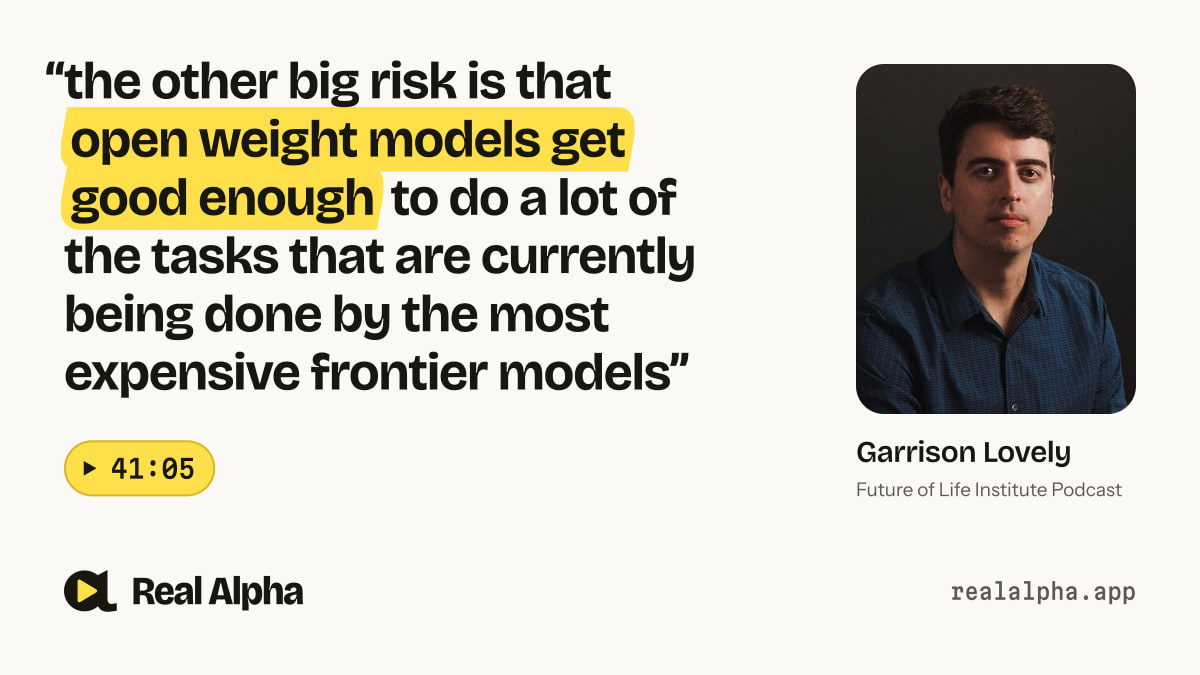
“the other big risk is that open weight models get good enough to do a lot of the tasks that are currently being done by the most expensive frontier models”
 Garrison Lovelyat 41:05 · Future of Life Institute Podcast
Takeaways
- A capability plateau could make larger training runs harder to justify.
- Good-enough open-weight models could push frontier prices down.
- Frontier firms depend on keeping a quality lead over cheaper models.
About this segment
Garrison Lovely says frontier firms face risk if bigger training runs stop improving models or open-weight competitors become good enough. Either could weaken premium pricing before firms recoup training costs.

Garrison Lovely is author and journalist.
Wrote Obsolete on AI's race to replace human labor and reported on the political economy of artificial intelligence.
- GD
Gus Docker, Host · Host, Future of Life Institute Podcast
From “The Trillion-Dollar AI Race to Replace Us (with Garrison Lovely)”, Oct 13, 2026. Watch the full episode
Answers “How do AI companies make money?” See all 42 answers
Thanks. We'll look at and fix what's off.
Transcript
Transcribed by machine (Whisper) from the episode’s audio, so a word may be off here and there.
- 39:56
dangers for the companies here one is that the models stop getting better so right now they're training bigger models each generation costs more um and then each generation is better and this is enough to make it all work but if you train you know a billion dollar model and then a 10 billion dollar model and each one is better and then you train a hundred billion dollar model and it's not better it's like oh shit that's that's a bad situation to be in and i'm sure they're doing all kinds of things to like make sure that the model is showing evidence that it's getting better so you don't like do the full training run and just see what happens at the end you like get checkpoints and you do you know obvious things like that um and And yeah, so if that happens, then you have this risk that open source models, open weight
- 40:45
models are able to then catch up to you and like eat away your margin. Because the way these companies have made the revenue so far is by having the best model on the market, charging a premium for it. And then people are willing to pay for that because it's just worth it to get marginal amounts of improvement. and if you can't like if the cheaper model is also as good as the the most expensive model like then the prices are going to come down and you won't be able to recoup the cost of training and then the other big risk is that open weight models get good enough to do a lot of the tasks that are currently being done by the most expensive frontier models and this is a thing people have warned about for a long time it's not really been true like people businesses customers whatever are willing to pay you know the most money for the best model um but if we think of
- 41:44
the threshold idea it might just be that the open weight models hadn't gotten good enough yet like if it turns out that for most tasks like the the leading chinese open weight model is good enough for your purposes you just use that because it's like 10 times cheaper um i still think there will be like a market for the very best because like up until you get to like full labor replacement because like i don't know if you use them like i'm willing to just use the best model for hard tasks because if you use a cheaper one to save on you know your usage credits like and it doesn't work and you waste some time like it's just this is annoying and it's still cheap in absolute terms to use these models like the 20 a month plan gets you decent amount 100 or 200 a month gets you a lot of compute and that's a lot of money for software but then if it saves you like 10 hours
- 42:38
a week of time you know that like looks like a steal for if you're like a white collar worker in the u.s and i think for many people it saves them at least that much time totally and from the business perspective, I mean, if you're paying a white collar worker, say $100,000 per year, and you're thinking, can this person's role be replaced by AI, basically, well, then maybe you can afford to spend $50,000 or $25,000 per year on AI for that role. And so there's a lot of room left in business budgets to spend on AI, I think. Of these two dangers, how plausible are they?
- 43:20
The first one, do you think we might actually hit a wall? Scaling laws aren't laws of nature. It could actually happen, but it's just been many years in a row been proven to these laws have held yeah i would not bet on the wall um because it's been a losing bet historically but you know we don't know what will happen in the future um and i think the more important point about the bubble is like we should not be counting on this to save us from potentially very dangerous, destabilizing, undemocratic technology. And I think that's the kind of upshot of the bubble narrative for a lot of people is like, oh, I don't have to do anything now. And I think that's why people find it so comforting and appealing. Whereas my argument is we have to do a lot of things very quickly or else things can go very, very badly for most or all of us. Yeah, I have to be careful with sort of