The alpha, twice a week
That was 8 min.
Get the best new moments in your inbox every Wednesday and Saturday. It's free.
Check your inbox
We sent a link to your address. Click it to finish signing up. Not there in a minute? Look in spam.
or
Bloomberg Businessweek · 8 min · Oct 23, 2026
Untaxed gains, not just step-up in basis, drive estate tax gaps
 Ray Madoff
 says gains often never have to be recognized, while estate-planning tools can shrink assets before transfer.
In this episode
Full analysis- 1:39Chip financing grew from one deal to a trillion-dollar market5 min
- 18:12The wealthy can avoid income tax without selling stock6 min
- 11:20Hiding applications and using zero trust can limit cyberattacks3 min
- 6:52Trading firms invest in AI for fractions-of-a-second gains3 min
- 23:52Untaxed gains, not just step-up in basis, drive estate tax gaps8 min
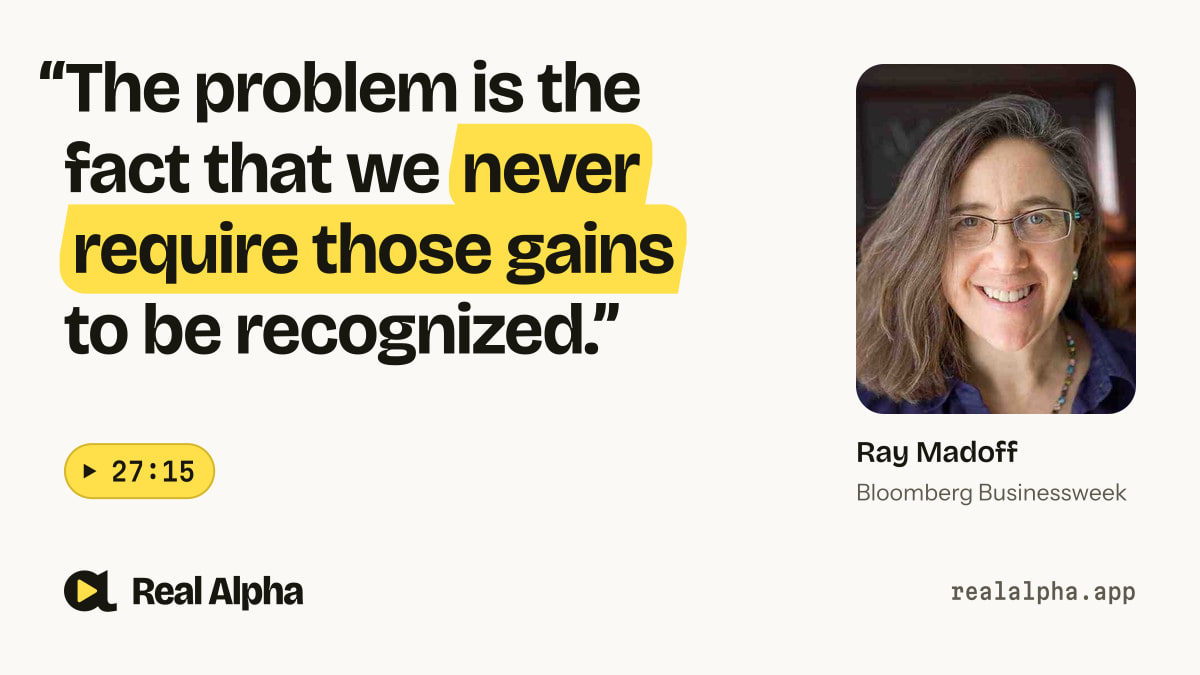
“The problem is the fact that we never require those gains to be recognized.”
 Ray Madoffat 27:15 · Bloomberg Businessweek
Takeaways
- Madoff says unrecognized gains are a bigger issue than step-up in basis.
- Estate-planning tools can reduce assets’ taxable value before transfer.
- She proposes taxing gains on transfer and treating inheritances as income.
About this segment
Ray Madoff says gains often never have to be recognized, while estate-planning tools can shrink assets before transfer. She outlines taxing gains on transfer and treating inheritances as income.

Professor of law, Boston College
Authored The Second Estate, arguing the tax code entrenches wealth and creates an American aristocracy.
From “Bloomberg Businessweek Daily: Blackstone Chips Bet (Podcast)”, Oct 23, 2026. Watch the full episode
Thanks. We'll look at and fix what's off.
Transcript
From the transcript Bloomberg Businessweek publishes with the episode.
- 24:03
All right, so go on the other side. Like, what's the debate? Like, I mean, I'm waiting to kind of get the hate mail. And people, like, will, like. Is it unfair? It's legal. Is which unfair? In terms of the tax policy. Oh, yeah. You know, you've had Republicans, Democrats, everybody weighing in. Like, I'm just waiting for someone to be like, oh, stop it. Like, you know, they do pay taxes. So you're going to hear they do pay taxes. Or they contribute in other ways to society.
- 24:33
Right. Which is important, and I don't want to rule that out. Right. But first of all, I think I want to raise this other issue, which is the issue of the estate tax. Yeah. Right? So a lot of people say... Look, there is a, which there is, a 40% tax on all transfers in excess of. $ 15 million, right? So people are going to end up paying the tax. And what people don't realize. They don't. $ 30 million for married couples.
- 24:58
For everyone listening on radio, Tim and I are shaking our heads. No, they don't.
- 25:02
And the issue, and then people say, well, is the exemptions too high or the rates are too low? No, the problem is that the wealthy are able to avoid the estate tax altogether. because they have tools, tools that I teach my students, because that's the subject I teach, about how they take property that's worth a lot, how they shrink it down to be hardly anything while they slip it through to their heirs, and then have it pop up in full value on the other side.
- 25:26
The thing that blows my mind is the idea of what they can do with sharing stocks, right? Passing off stocks, I think you said, like investments, and that they can, I guess, through certain vehicles, and that their heirs can get it And at the current value. Oh, yeah. And don't pay any tax, they could sell it right away. Yes. And there's no capital gain. Sorry, I'm not.
- 25:50
Explaining it well. Yes, you're talking about step up in basis. Thank you, step up.
- 25:53
And step up in basis is an issue, but it's much less of an. Issue than people think. Yes. Okay. Step up in basis is this idea of like, let's say, I'm sure you invested in NVIDIA and you've got $ 10 million worth, that's obvious. Totally, yeah. $ 20 million, actually. So if you were to give it away to somebody, if you were to sell it, you'd pay taxes on it, right? You'd pay $ 2 million in taxes. If you were to give it to someone, they'd pay $ 2 million in taxes.
- 26:20
But if you were to pass it on at death, then... that basis is, and the person could sell it for $ 10 million and have no taxable income because they're treated as if they had bought it for $ 10 million. At that price. At that price. So this is this thing called step-up in basis. People love to say the problem is step-up in basis. Is it not?
- 26:41
No, it's not the problem. It is an aspect of the problem. But the bigger problem is the fact that we never require the tallying of the gains. And this is unlike Canada. Canada says that whenever you either give away the property or you die and you pass on the property or you sell the property, that person should pay the gains. Because even if you didn't have step-up in basis, let's say you gave your $ 500 million of assets, which I assume everybody has, to somebody and they had carryover basis, right?
- 27:15
If you could avoid estate and gift taxes. You don't have to pay income taxes during your life because you borrow. They don't have to pay income taxes either because they borrow. The problem is the fact that we never require those gains to be recognized.
- 27:31
It just keeps going and going and going. And the reason the estate tax is not doing its job is because... basically, the estate tax was, if I say estate tax, I bet you would be able to tell me the phrase from 1990, which is still in. The air today. Death tax. Death tax. You've got it. Marketing. Immoral double tax that hurts family farms and businesses, right? Okay. This campaign was so successful, funded by 18 of the country's richest families, that 36 years later, Congress has failed to close a single loophole in the estate tax because of this issue where the public has mixed feelings about it and believes it's a double tax. And as a result, it's like Swiss cheese and raises no money at all.
- 28:18
So then what's the right solution here? Here we are in the midst of an election season where the cost of living is dominating headlines everywhere. We've been talking about the K-shaped economy for five years at this point and rising inequality. What's the solution?
- 28:35
The solution is we need to bring investments and inheritances into the tax system. For the investments, we can do what I talked about, adopt the Canadian rule, tax the gains whenever transferred. For inheritances, the problem with the estate tax is that Because it was imposed on the dead person, right? For some people, it really was a double tax. They paid a lot of taxes during the life, and then we hit them with taxes. And what people didn't focus on was the recipients. And what we need to do is we need to get rid of the estate tax.
- 29:06
And bring inheritances and gifts and life insurance into our income tax system. Decide that people should be able to inherit however much we think sounds fair.
- 29:16
It's a preference for inheritance if we want to give it. And tax it as income? And then everything else should be taxed as income. Absolutely. Okay.
- 29:23
Just the same way that money found on the street or lottery winnings or prize money or a car that you win on a game show, everything is income. And the only reason these things aren't income is because they've been written out of the system on the assumption that the estate tax. Was going to do a good job. And we know the estate. Tax is doing nothing because in 2025, when Trump had the power to have a full tax bill that he wanted, they kept the estate tax.
- 29:49
The other thing is, though— Isn't part of also thinking about this is like, how do you value wealth? And how do you put, like, obviously if there's real estate or stocks, but then there's art and so on and so forth, like, how do we.
- 30:02
Fully get that picture? But we have a system that does it, right? Our estate tax has years and years of having rules specifically about valuation. So it's there. Because we've been doing it, yes, since 1916. So that is not a problem. I think it is too much of a problem. On the wealth tax area, one of the reasons, I think, is that if you were to have an annual tax, it's very different taxing things one time in a person's life than taxing them, than valuing each year. That really can be quite complicated to do.
- 30:31
Is there a political appetite for that? I think definitely. Why? Because we have a couple of reasons. First of all, one of the values of the California thing and of the ProPublica leak, which showed how all these rich people don't pay taxes— is that no longer does anybody say with a straight face, rich people are paying a lot of taxes. A lot of people know that they're not paying taxes. They might not know how, but they know that that's the case. And the other thing that we have is we have working class people are struggling. Somebody who earned $ 60, 000 as an Uber driver has to pay $ 13, 000 in taxes. That is a huge burden for someone trying to get by. And on top of that, we have this enormous, we had a deficit of $ 2 trillion.
- 31:12
Every year we're running these deficits of $ 2 trillion because we take in seven, we spend, we take in five, we spend seven. Do you know how much the richest 1% had when we couldn't cover this $ 2 trillion? $ 50 trillion. $ 50 trillion. And I'd say that it makes sense to say that, you know what, it matters if these people pay taxes.