The alpha, twice a week
That was 3 min.
Get the best new moments in your inbox every Wednesday and Saturday. It's free.
Check your inbox
We sent a link to your address. Click it to finish signing up. Not there in a minute? Look in spam.
or
How I Invest · 3 min · Nov 6, 2026
Vertical AI needs trust as well as strong technology
 Joseph Coyne
 says vertical AI teams need technical speed, industry knowledge and a go-to-market motion suited to their contract size.
In this episode
Full analysis- 6:26Proprietary enterprise data can create durable AI advantagesPro pick 7 min
- 27:21AI makes seed-stage investing more attractive than later roundsPro pick 3 min
- 34:53Underwrite Anthropic by its market share and future competition4 min
- 1:24Enterprise AI pilots depend on data readiness3 min
- 22:14AI pricing will move beyond SaaS gradually3 min
- 38:56Vertical AI needs trust as well as strong technology3 min
- 17:25Evercoast’s motion-capture data could help train robots3 min
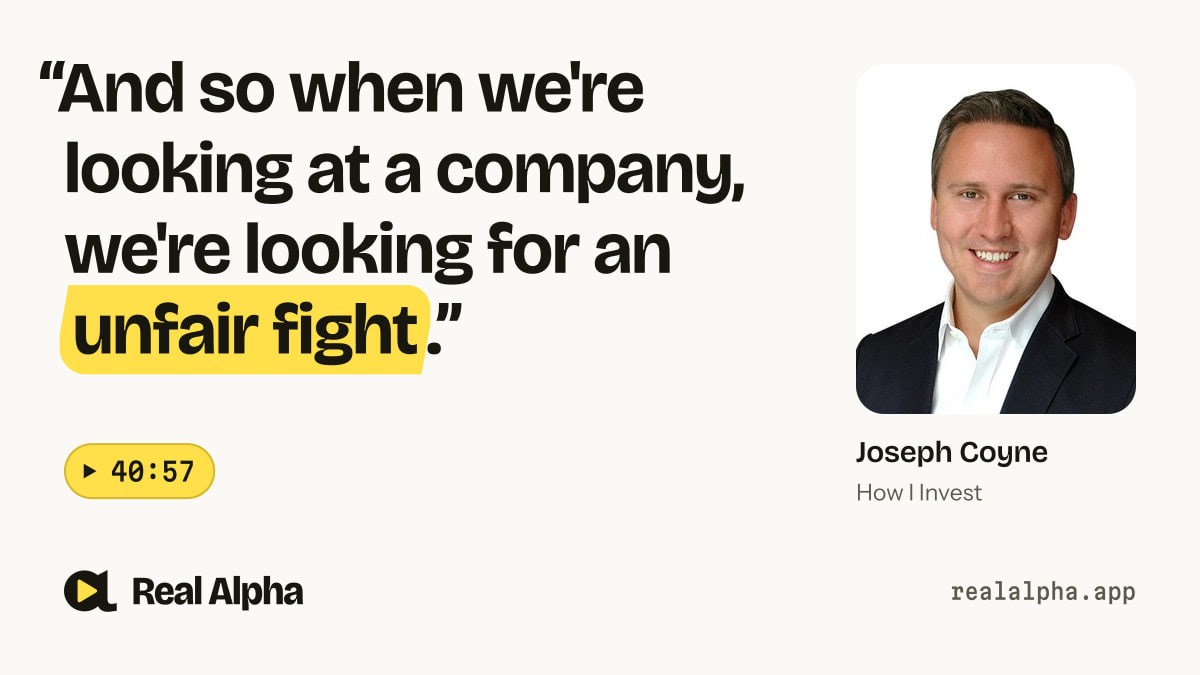
“And so when we're looking at a company, we're looking for an unfair fight.”
 Joseph Coyneat 40:57 · How I Invest
Takeaways
- Industry trust can help a vertical AI company win early customers.
- Teams need both technical skill and subject-matter expertise.
- A go-to-market plan should fit the company's contract size.
About this segment
Joseph Coyne says vertical AI teams need technical speed, industry knowledge and a go-to-market motion suited to their contract size. Domain expertise and industry access can give them an edge beyond the product itself.

Joseph Coyne is cofounder and managing partner of Studio VC.
Invested in and advised startups at Samsung Next and Bain Capital Ventures before co-founding Studio VC.

David Weisburd, Host
From “Why 95% of AI Projects Fail, Anthropic still at $2T?, and Why AI Is Still in the First Inning”, Nov 6, 2026. Watch the full episode
Thanks. We'll look at and fix what's off.
Transcript
From the transcript How I Invest publishes with the episode.
- 39:08
It'll be fascinating to watch, but I don't think you can lose coming in where you came in. Also, investor in vertical AI solutions like Legora. How do you think about horizontal versus vertical? Are there gonna be different areas where vertical wins versus horizontal wins? And what's your framework for that? When we think about horizontal, we think about more utilities that are foundational to AI.
- 39:32
So it could be a company like Monitor, where it's helping any vertical or any one enterprise manage their own models. It could be the data loss prevention example I gave with with sort of like, where is my data flowing in and outside my enterprise? That, again, would be a horizontal solution to avert potentially a vertical problem. And then when I think about verticals that will win, you know, I think selling into any one of these verticals requires trust.
- 39:58
And especially in the early days, building that trust within an air... Within an industry as esoteric as airlines or insurance underwriting or banking underwriting lending, that requires trust, understand the customer process, the legacy process, understand the data, the KPIs, etcetera, can give you an early lead to start building that data flywheel within legacy industries. And so when we think about vertical AI, I think it's, you know, companies that have domain expertise plus the ability to build product very, very fast.
- 40:29
So engineering led teams that have AI native workflows that also have deep understanding of what we call subject matter experts on the team that can earn the trust because they have some sort of asymmetric advantage to penetrate a market. And so we're oftentimes like underwriting teams in that way, which is technical prowess, what have they built today, how fast can they build their future roadmap, but then also, what does the go to market motion look like?
- 40:57
Is it appropriate for their ACV, for example? So are they being rational about how they scale? But then the next thing is, you know, we don't wanna fight in a fair fight. Right? There's lots of players. People can build companies faster than ever. And so when we're looking at a company, we're looking for an unfair fight. Bringing a gun to a knife fight. Right? It's who knows this industry better? Who's better connected to this industry?
- 41:20
Who has the license to win in this industry? That can often... In addition to having the best technology, you have to have base case very strong, if not the best technology. But having that other tipping point can really tip the scales in your favor in terms of how fast you can penetrate an esoteric market like airlines. I think your answer will be very disappointing to engineers. I think since 2008 when I started in the startup world, engineers have been trying to replace salespeople.