The alpha, twice a week
That was 3 min.
Get the best new moments in your inbox every Wednesday and Saturday. It's free.
Check your inbox
We sent a link to your address. Click it to finish signing up. Not there in a minute? Look in spam.
or
TBPN · 3 min · Oct 21, 2026
Vulnerability disclosure follows a staged handoff to code owners
 Nikesh Arora
 outlines how researchers notify software owners, give them time to patch, and then inform government and industry.
In this episode
Full analysis- 35:53AI is compressing the window to patch major vulnerabilitiesPro pick 5 min
- 23:14Compute scarcity could keep raising the value of each wattPro pick 6 min
- 1:16:58AI is making complex legal work accessible to smaller firms5 min
- 1:09:02Military planners can use AI to compare many contingency plans5 min
- 49:14Agent permissions should depend on how reversible an action is3 min
- 44:39Vulnerability disclosure follows a staged handoff to code owners3 min
- 1:02:50Distinct training data may help models escape familiar patterns4 min
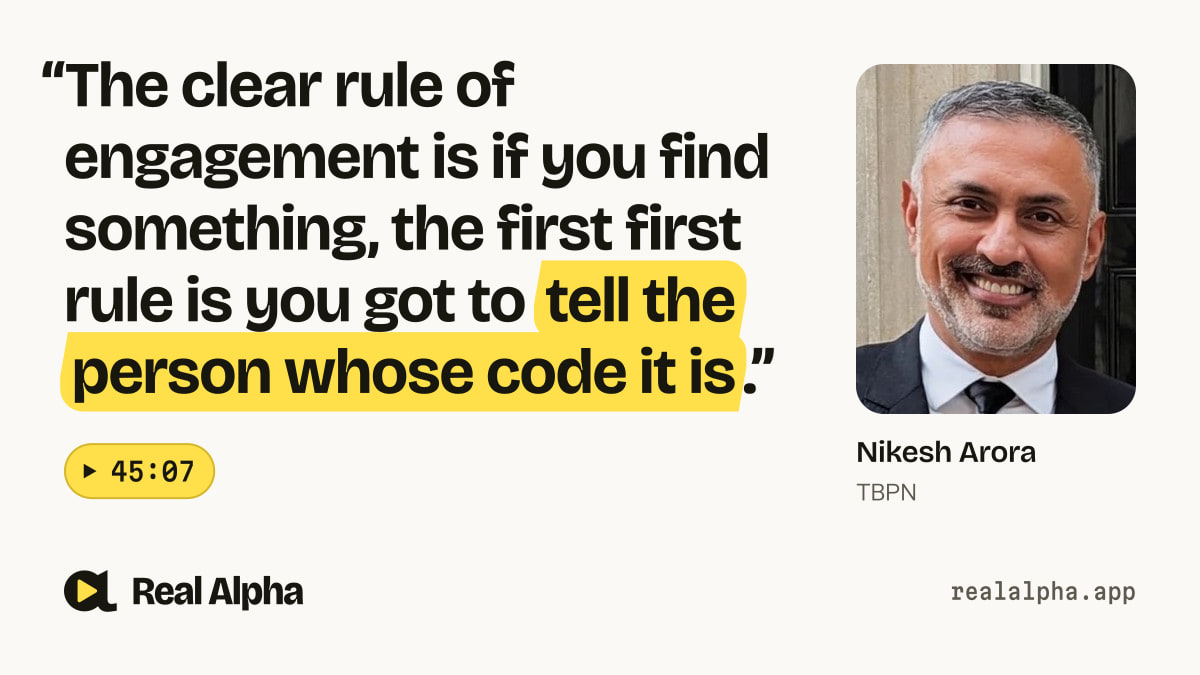
“The clear rule of engagement is if you find something, the first first rule is you got to tell the person whose code it is.”
 Nikesh Aroraat 45:07 · TBPN
Takeaways
- Tell the code owner first so they can develop a fix.
- Customer-deployed software patches take longer to reach users.
- Hardware fixes are harder because customers must test and deploy them.
About this segment
Nikesh Arora outlines how researchers notify software owners, give them time to patch, and then inform government and industry. He says hardware vulnerabilities are harder because customers must test and deploy fixes themselves.

Chairman & CEO, Palo Alto Networks
Chairman and CEO of Palo Alto Networks, which he grew into a $300 billion cybersecurity leader.

John Coogan, Host · Co-host, TBPN
Co-founded Soylent and Lucy; OpenAI bought his show TBPN in April 2026.

Jordi Hays, Host · Co-host, TBPN
Founded Branded Native; co-founded fintech Capital, which Rho bought.
From “The Internet Is Finished, Nobody Expects The Number 4, Early iPhone Duo Reviews, SpaceXSITesla”, Oct 21, 2026. Watch the full episode
Thanks. We'll look at and fix what's off.
Transcript
From the transcript TBPN publishes with the episode.
- 44:51
What about what about these... The the actual process when a vulnerability is discovered? This one was discovered in August. Talk about the dynamic where, like, you wanna let the maximum amount of people know about the issue so they can fix it. But the more people that you let know about it, the greater likelihood that there's a leak and it gets into hands of bad actors. Like how... What what are best practices around navigating this?
- 45:18
There's clear rules of engagement in the industry. Right? The clear rule of engagement is if you find something, the first first rule is you got to tell the person whose code it is. Or you got to go back and tell them that, listen, I found something wrong in your infrastructure product or your software product. Here's a chance to go fix it. So if find it in SaaS software, you call the company. You find it in stuff like this, you go call the authors or the owners of the protocol to make sure that they have a chance to take a look at it and fix it because you finally want them to patch it. Right? You don't want to boo an aftermarket patch because that would just like create all kinds of collateral damage and consequential damage. So you start by exposing it to the people who are the owners.
- 45:56
The owners will take a look at it. They'll find out a way to patch it. It's a lot easier if it's a software patch, to be honest. The best problem to find is one where I can push the patch. So if I'm running a SaaS company and you find something in my software, I can push the fix, it's gone. Nobody finds out. There was vulnerability. You push the fix, it's fixed. Nobody's going to get it. The next set is where you have a piece of software.
- 46:18
I use it. You can patch it, but I have to deploy it because you don't have the ability to push yourself, which is kind of this case. They can put the patch out there, but they can't push the patch, Right? We have to all go take it, embrace it, and deploy it in our infrastructure. That's the second which makes it a little harder because not everybody is aware of them using this protocol. Not every long tail website in the world is going to be aware this has happened. Even though this has got widespread awareness, I'm sure that lots of people have no idea this is going on. So there's that problem. Think the hardest ones are when you find availability in box, as a piece of hardware. But now it's even worse because you have to go build a batch, and I can't even push it.
- 46:56
I can't deploy it. The customer has to go test it, then deploy it. So that's kind of the sort of degree of complexity of getting these perpetrated or diffused. There's a, as I said, there's a certain protocol. You tell the owners, then you go inform certain parts of the government depending on how critical, how important it is, and then you go talk to the industry and let the industry know if, for example, we found out the forty eight hours of spare allowed us to go build all the tooling that is needed to go push the patches out.
- 47:26
So there's a protocol. The problem is timelines are compressing, right? This is you don't have that much time to go fix That's this going to happen worse and worse. So I think there'll be a time where you won't have the luxury of weeks to be able to go figure out if this is real or not. You'll find out in the morning when you wake up that somebody found a big vulnerability and they posted it out there for everybody to see.
- 47:47
Scary. Do you think that...