The alpha, twice a week
That was 5 min.
Get the best new moments in your inbox every Wednesday and Saturday. It's free.
Check your inbox
We sent a link to your address. Click it to finish signing up. Not there in a minute? Look in spam.
or
TRIGGERnometry · 5 min · Nov 21, 2026
Why Eisman says AI spending is changing hyperscalers
 Steve Eisman
 says hyperscalers will spend $850 billion on AI data centers this year and over $1 trillion next year.
In this episode
Full analysis- 39:03Why Eisman sees concentration risk across the AI supply chain8 min
- 57:35Why Eisman says U.S. debt is easier to carry than France’s5 min
- 1:13:27Why Eisman thinks U.S. banks are safer after Dodd-Frank3 min
- 10:55Why Eisman says AI spending is changing hyperscalers5 min
- 15:34Why Eisman thinks AI warnings may help the leading labs3 min
- 1:09:41Why Eisman says mortgage lending rewarded volume over quality2 min
- 1:03:25Why Eisman says Europe's aging and tech mix constrain growth3 min
- 20:13Why Eisman thinks AI may change jobs more than erase them3 min
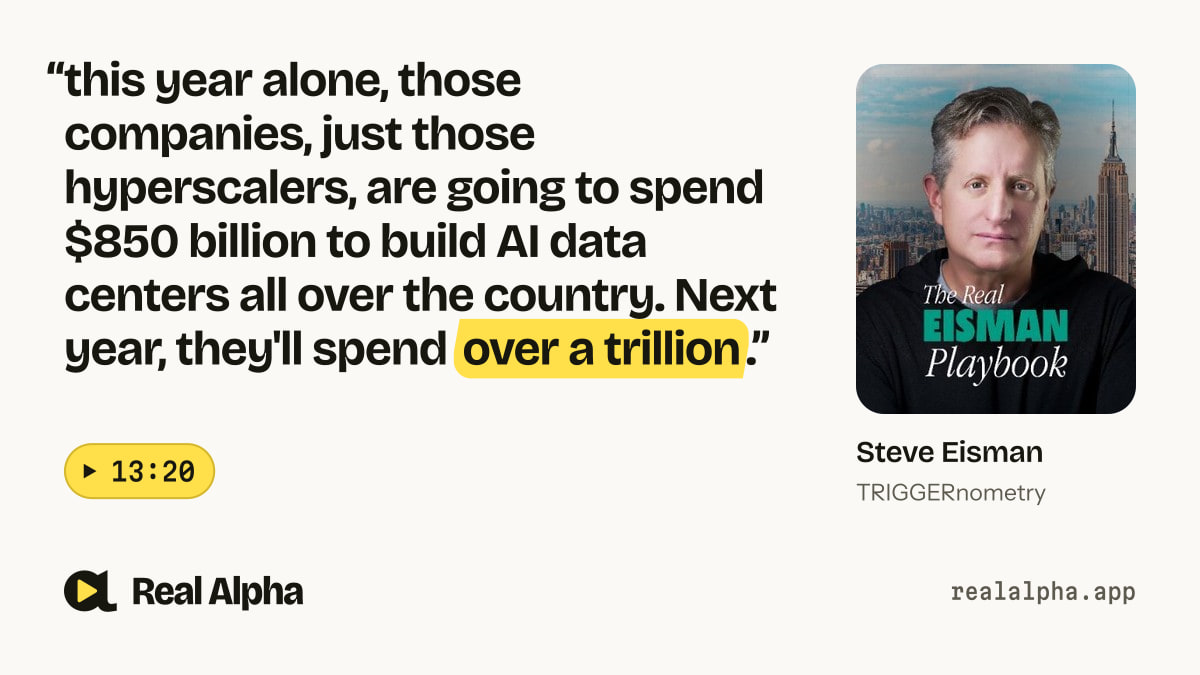
“this year alone, those companies, just those hyperscalers, are going to spend $850 billion to build AI data centers all over the country. Next year, they'll spend over a trillion.”
 Steve Eismanat 13:20 · TRIGGERnometry
Takeaways
- Eisman says each hyperscaler data center costs at least $30 billion.
- He says AI capex turns former cash generators into capital-intensive businesses.
- He expects hyperscalers' spending to top $1 trillion next year.
About this segment
Steve Eisman says hyperscalers will spend $850 billion on AI data centers this year and over $1 trillion next year. He says that shifts them from capital-light cash generators to capital-intensive businesses.

Steve Eisman is an investor known for The Big Short.

Konstantin Kisin, Host · TRIGGERnometry

Francis Foster, Host · TRIGGERnometry
From “Big Short Investor: Is the AI Bubble About to Burst? - Steve Eisman”, Nov 21, 2026. Watch the full episode
Answers “What will AI look like in the next few years?” See all 395 answers
Thanks. We'll look at and fix what's off.
Transcript
Transcribed by machine (Whisper) from the episode’s audio, so a word may be off here and there.
- 10:59
let's take a step back a lot of companies involved here yeah so if you i mean i would divide them up into kind of four groups there would be the equipment providers oh yeah they'll be profitable they're profitable so and think of it as like a gold rush the most profitable people in the gold rush is the guy who provides the picks and shovels not the people who dug for the gold. Right. Because they quickly had to pay.
- 11:31
It was so much. Back in the gold rush in California, what happened was it was so expensive to live in the area that you got the gold, then you had to pay for lunch. And by the time you finished paying for lunch, your gold was gone. But the guy who sold you the picks and shovels, he made a lot of money. So you have all the people who sell the chips, like NVIDIA, which is the king, because they sell a chip called a GPU, which is the chip needed to do these type of computations.
- 11:58
Then you have all the other types of equipment makers, Arista, Cisco, who provide all the connections, etc. That's one group. Then you have what's called the hyperscalers. And to make this all work, we've always had data centers, not always, we've had data centers for a very, very long time. But because the computation needs of this are so huge, the current data centers aren't strong enough to provide the services needed for AI.
- 12:33
So what's happening is that we are building all over the country huge, I mean, data centers that are five times bigger than all data centers to provide the computation power as a very, very expensive enterprise. literally every one of these data centers costs at least 30 billion dollars every single one in some cases more so the companies that are building most of the data centers are what are called the hyperscalers and that would be Amazon Google Microsoft and I'd include Oracle in there as well big big big wealthy tech companies and what has happened to them because they are now involved in building these very, very expensive data centers.
- 13:24
So, for example, this year alone, those companies, just those hyperscalers, are going to spend $850 billion to build AI data centers all over the country. Next year, they'll spend over a trillion. those companies used to be capital light models that generated tremendous amounts of cash flow but because of all the money that they're now spending they're now capital intense models and they're basically not generating any cash flow um that's a big change so that's group two group three which is probably the most controversial right now are the companies called the neocloud companies so the neocloud companies are basically trying to do the same thing as the hyperscalers build ai data centers they're just much newer and much smaller they don't have the same type of balance sheets this would be a company like
- 14:26
core weave and a company like nebius to build the data centers they have to raise tremendous amounts of debt and the market is starting to lose confidence in them right now and so for example core weave which six months ago raised debt at nine percent which is expensive that debt is currently priced at 15 which is prohibitive so that's the neoclouds that's what's making the market very very nervous right now and then you have all the LLM providers so you have Anthropic and OpenAI, which I'm sure your viewers have heard their names.
- 15:03
Now, some of the hyperscalers are also LLM creators, like Google, Microsoft, Meta, which is not a hyperscaler, but is a creator of LLMs and agentic AI. And then you have the Chinese, what's called open weight models, which are also LLM models, but are much, much cheaper. They're not as good, but they're much, much cheaper than the expensive American models. And those are the players. And, Steve, there's a lot of people who are listening to this