Free with a sign-in.
The best 18 min of 47
How Jensen Huang’s Ties to Alice Huang Fueled $7B+ in China Chip Sales
Jing Yang says Jensen Huang’s ties to Alice Huang helped facilitate at least $7.5 billion in Nvidia chip shipments through Chinese companies.
TTThe Information's TITV · Rocket Drew with Jing Yang, Gil Luria, Alix Coutures, Ileana Pirozzi and Amy Dockser Marcus
The best minutes
- 2:57Jensen Huang’s ties to Alice Huang predated the chip networkPro pick 8 min
- 21:06AI search makes it harder for Google to place adsPro pick 7 min
- 31:36Surgical catheters fuse partial signals to infer hidden anatomy4 min
Every moment plays free. PRO marks a write-up that's in Pro.
Also worth watching
- 10:49Luria sees China sales exposure as Nvidia’s bigger risk6 min
- 41:41Kurzweil’s AI double can keep developing without him2 min
Skip the opening Anthropic valuation update, the Google ad-format overview before its monetization discussion, and the basic catheter walkthrough.
Full analysis · 6 min read
Real Alpha · Nov 21
Jing Yang says Alice Huang’s network moved $7 billion-plus in chips
- Yang reported more than $7 billion in Nvidia chip imports through Alice Huang’s network.
- Her reporting traces a route and relationship, but leaves Nvidia’s knowledge unresolved.
- Regulatory exposure and board succession planning are the decisions to watch.
Free with an account
Read the rest of the analysis
6 sections, the 4 other voices it tests Yang against, and what it means for you. Every episode we cut gets one.
Check your inbox
We sent a link to your address. Click it to finish signing up. Not there in a minute? Look in spam.
or
Signed up before? The same buttons sign you in. The episode, its moments and the transcript stay free.
The reported scale is large, but knowledge remains unresolved
Jing Yang, The Information’s Asia bureau chief, reported more than $7 billion in Nvidia chip imports through Century Litong since 2023. She placed the Shanghai company at the center of a network built by Alice Huang, her sister and her husband.
Yang said Century Litong began in early 2023, procured AI chips, placed some in data-center space, and sold others. Her reporting also counted roughly 240,000 chips, mostly Nvidia’s A and H generations.
That is a large reported flow through a young company, not a complete accounting of every destination. The distinction matters because the total measures imports attributed to a network, while the record leaves endpoint details open.
Yang said the reporting could not determine how much Jensen knew or what Nvidia as a company understood. The figure supports scrutiny of the route, but does not establish corporate knowledge or intent.
Our read
The report supports a serious inquiry into the network’s transactions. It does not establish that Nvidia knew where every chip would end up.
Their relationship predates the AI chip network
Yang traced part of the backstory to Alice Huang’s husband and Kuan Wei, a Shanghai private-equity investor. She said the men acquired Chinese gaming companies during the 2010s, when Nvidia’s GPUs mainly served gaming.
Her account then says the two got to know each other, but the transcript does not make the referent fully clear. That supports an earlier business context, not a definitive reconstruction of Jensen Huang’s exact relationship with each person.
The host stressed that Jensen and Alice were not related, despite sharing a surname. Yang said Alice’s closeness to Jensen featured in her pitch to associates and customers.
She reported that Alice showed photographs of them together and described birthday dinners or gifts from him. Those details explain how personal proximity could be used as commercial credibility, but do not verify the underlying sales.
Our read
The association was not simply a connection that appeared after the chip business formed. But longstanding ties alone do not show what Jensen or Nvidia knew about specific sales.
Fast partner status leaves diligence unanswered
Century Litong got preferred Nvidia cloud partner status only months after its early-2023 launch, Yang said. She said the status gave companies preferential access to Nvidia chips.
The credential required training and a revenue threshold, but Yang said her reporting could not explain how Century Litong qualified so quickly. That gap raises a diligence question before it establishes anything about the shipments.
Yang said the status could function like a hotline to Nvidia. For example, she described how a preferred partner could locate chips already sitting in distributed warehouses and manage their sale.
At the time, U.S. export controls had widened, and demand for AI chips was high. Yang did not establish that every chip Century Litong procured was prohibited or sold unlawfully.
Nor does the transcript identify the internal review or individual approvals behind partner status. Without those details, the speed of approval is a question to investigate, not evidence of wrongdoing.
Our read
The credential links the reported sales network to Nvidia’s partner system. The episode raises a diligence question, while leaving the answer unresolved.
Regulatory exposure could reach beyond China
Gil Luria, D.A. Davidson’s technology research head, said investigations could lead to restrictions on Nvidia sales to companies serving Chinese customers. He pointed to Singapore and Taiwan connections, warning that restrictions might spread across wider parts of Asia.
The exposure therefore depends not only on direct shipments to China, but also on customers’ use of compute. Mike Shepard, on Bloomberg Businessweek in November, said Southeast Asian data-center sales had helped Chinese firms retain remote chip access.
That describes a regional route in a separate report, not a proven link to Century Litong. Ed Elson, on Prof G Markets in November, cited a short seller’s estimate of diverted China sales.
The estimate put those sales at up to 20% of Nvidia revenue. Elson also cited $80 billion in chip imports across three Southeast Asian markets.
Those are estimates and reporting, not regulatory findings or transaction-level proof. They show why enforcement could matter beyond the importer Yang covered, while leaving the size of any restriction uncertain.
 Mike Shepard · Bloomberg Businessweek · Nov 17Southeast Asia sales helped keep the cloud-access loophole open
 Ed Elson · Prof G Markets · Nov 16Nvidia's Southeast Asian revenue may carry China diversion risk
Our read
The risk is not confined to one Chinese importer if controls reach regional resellers. Other episodes add context and estimates, not proof about Century Litong’s transactions.
Sales risk and Jensen risk remain separate
Luria said China-related findings could restrict Nvidia’s business, while Jensen’s departure posed a separate risk. He said the business risk mattered more than a CEO exit, since an exit alone might be less damaging.
Luria also said Nvidia had lost more than half a trillion dollars in value over the previous days. He called the reaction appropriate, while describing a no-wrongdoing finding and Jensen remaining CEO as the baseline scenario.
On Prof G Markets in November, Luria said diverted chip sales could represent as much as 20% of revenue. He added that the figure could be much less.
He also said Nvidia expected 75% growth and compute demand could absorb lost China sales. But that later demand-based counterweight does not answer whether enforcement will block regional sales.
The reported 240,000 chips describe Century Litong’s purchases, while the 20% estimate concerns a possible broader revenue impact. Neither figure establishes what regulators will find.
Our read
A falling share price can reflect uncertainty about both restrictions and leadership. It cannot tell investors which scenario investigators will establish.
The board needs options before a forced handoff
Luria urged Nvidia’s board to vet internal and external successors quickly, before any forced handoff. He said an interim CEO would not be enough, and a permanent successor should carry the company forward.
His suggestion of Intel CEO Lip-Bu Tan was explicitly his own choice, not a report about board deliberations. The episode offers no evidence that the board has selected or approached anyone.
Emily Chang, on Bloomberg Businessweek in November, described Nvidia’s flat structure, 60 direct reports, and no clear successor. Ed Elson, on Prof G Markets in November, likewise pointed to no board chair, COO, or succession plan.
Those later discussions reinforce a governance concern raised here, but do not establish what Nvidia’s board is doing now. For example, a contingency plan can identify who takes over and what customers and suppliers need to hear.
That continuity matters because Luria described Jensen as an orchestrator of the AI ecosystem. Preparing a successor is a separate task from resolving the chip-sales investigation.
 Emily Chang · Bloomberg Businessweek · Nov 12Huang’s departure exposes Nvidia’s succession risk
- Ed Elson · Prof G Markets · Nov 17Huang’s structure left little room for internal challenge
Our read
Succession planning is an actionable board issue even if Jensen remains in place. The episode offers no evidence that a departure is imminent or a successor has been chosen.
What it means for you
- Map regional end use. List the distributors, countries, customers, and end uses connected to chip sales. The episode shows why a regional route can matter even when the direct buyer is outside China.
- Review partner qualification. Ask what evidence supported Century Litong’s preferred-partner status and what checks followed. Yang’s reporting leaves the qualification path unclear.
- Model enforcement scenarios. Model what restrictions on Singapore, Taiwan, or other Asian channels would mean for the business. Luria said limits could reach beyond direct China sales, but gave no episode-specific revenue total.
- Set succession triggers. Ask the board to define who could step in and what a permanent handoff requires. Luria’s case rests on having options ready, not on knowing Jensen’s future.
What to watch
- Whether Nvidia’s board investigation clarifies what Jensen or the company knew about Century Litong.
- Whether regulators restrict Nvidia sales through Asian resellers beyond China.
- Whether Nvidia discloses a succession process or identifies possible successors.
Send this to board directors and finance leaders responsible for export controls and succession planning.
Watch Jing trace the reported $7 billion-plus chip shipments
Written by Real Alpha from the episode's transcript and the other moments it links, then checked against the transcript. Quotes are the speaker's exact words.
Minute by minute
A Pro write-up, open to you here. Try Pro free for 7 days
A Pro write-up. The minute by minute is in Real Alpha Pro; the episode, its moments and the transcript stay free.
Read it with Pro, 7 days free- 2:33Yang traces a chip-sales network
Jing Yang says The Information traced Jensen Huang and Alice Huang’s relationship back several years before social-media footage of them together in Taipei in 2024 and 2025. Yang says Alice Huang’s network, built with her sister and husband, included Shanghai-based Century Litong, which facilitated at least $7.5 billion in Nvidia chip imports since 2023. She says the Huangs are not related.
- 5:58Partner status could ease chip access
Yang says Century Litong became an Nvidia preferred cloud partner within months of its 2023 founding. Partners had to demonstrate training and meet a revenue threshold, but Yang says it is unclear how Century Litong qualified so quickly; the status could provide preferential access to chips, including inventory in distributed warehouses. Her reporting counted roughly 240,000 A- and H-generation Nvidia chips procured by Century Litong since 2023.
- 10:25Luria sees regulatory and leadership risk
Gil Luria says the controversy puts Nvidia’s business and Jensen Huang’s ability to remain CEO at risk. He is more concerned about what investigations find than the scrutiny itself: findings of improper sales to companies serving China could lead to restrictions on resellers in Singapore and Taiwan and limit broader Asian sales. Luria says Nvidia had lost more than half a trillion dollars in value, reflecting the downside scenarios.
- 15:07Luria urges Nvidia succession planning
Luria argues that a CEO departure without regulatory wrongdoing would be less damaging than business restrictions, but says Nvidia’s board should quickly identify internal and external successors. He floated Intel’s CEO as a possible external candidate, citing his understanding of the ecosystem and connections in Asia. Luria says Nvidia’s ties to customers and suppliers should continue if the handoff is clean.
- 18:17AI searches complicate ad targeting
Alix Coutures reports that Google’s ad revenue growth fell from 17% in the second quarter to 12% in the third, with the company partly attributing the slowdown to lower ad revenue from AI Mode. She explains that AI Overviews summarize searches while AI Mode supports conversational follow-ups. Broader queries can make it harder for Google to decide where to place ads and measure purchases that happen later.
- 23:24Google is scaling ads cautiously
Coutures says Google is gradually adding ad formats and increasing ad volume to avoid losing users, and expects ad growth to pick up in coming quarters. She says Google has looked for creative startups that could help develop AI-aligned ad formats. Advertisers are shifting from clicks toward impressions and giving ad tools more context about their companies and landing pages.
- 27:32Mosaic maps anatomy for catheter guidance
Ileana Pirozzi says Mosaic, which raised $47 million, is building perception-enabled surgical systems, with a staged path toward semi-autonomous catheters and safety as the priority. In endovascular procedures, surgeons guide catheters through blood vessels using tactile feedback, preoperative scans and intermittent 2D X-rays. Mosaic aims to combine signals and map anatomy to give surgeons more awareness of what is happening.
- 34:09Simulation supplies scale and ground truth
Pirozzi says clinical data is limited and collecting it from patients can be infeasible or unethical. Mosaic combines simulation, benchtop, animal and human data: simulation offers scale, varied cases and ground truth, while other sources add realism. She says Mosaic is working with the FDA on evidence requirements and evaluates safety as a system involving both the technology and the physician.
- 37:03Kurzweil’s AI double still feels artificial
Amy Dockser Marcus says Ray Kurzweil’s AI double looks and sounds like him, but its pauses and lack of facial cues made the interaction feel artificial. The system uses a Google large language model trained on Kurzweil’s books, interviews and other work, alongside voice and personality-cloning technology.
- 41:41Digital doubles raise grief concerns
Marcus says Kurzweil’s digital double is designed to continue without him updating it: it can remember conversations and access a curated part of the internet. Kurzweil sees it as a way to preserve his legacy, though Marcus says his children preferred engaging with him in person. She expects more people to use digital twins, while noting concerns that chatbots of the dead could complicate mourning.
Published Nov 10, 2026.
Transcript · 33 min read
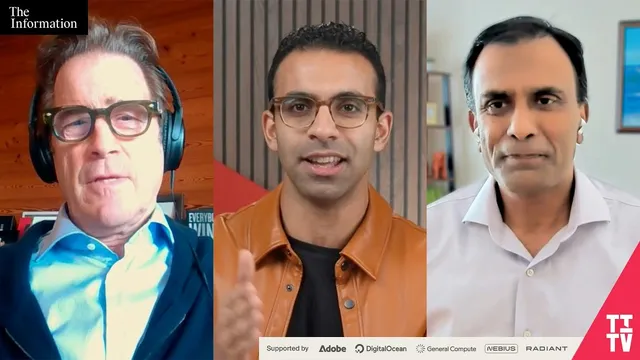
The Information's TITV, hosted by Rocket Drew, with Jing Yang, Gil Luria, Alix Coutures, Ileana Pirozzi and Amy Dockser Marcus.
Transcribed by machine (Whisper) from the episode’s audio, so a word may be off here and there.
Welcome, everyone, to the Informations TI TV. My name is Rocket Drew. I'm in for Akash Pasricha. It is Tuesday, November 10th. Before we get into the show, Anthropic just set a lower-than-expected, tentative valuation for its IPO, between $1.26 to $1.4 trillion according to an updated SEC filing. Just last month, Anthropic was expected to go public at a valuation of $1.5 trillion. They could start trading as early as November 19th, offering 825 million shares. We will keep you updated as the hotly anticipated debut nears. First up on the show today, the information has exclusive reporting about how NVIDIA CEO Jensen Huang's ties to a woman that was reportedly identified by the US government as a Chinese intelligence asset helped facilitate at least $7.5 billion in NVIDIA chip shipments through Chinese companies. We'll also get into the risks to NVIDIA, its investors, and Jensen himself with a tech analyst. We'll then shift gears to some new reporting about Google's search advertising business, we'll also talk about a new robotics startup creating autonomous catheters for surgery, and we'll wrap up with a great profile from our health and science reporter about the famous futurist Ray Kurzweil. It's going to be a great show,
so let's get right on into it. New exclusive reporting from The Information reveals how NVIDIA CEO Jensen Huang's relationship with Alice Huang, a woman reportedly identified by the U.S. government as a Chinese intelligence asset, helped facilitate at least $7.5 billion in NVIDIA chip shipments through Chinese companies. Jing Yang, our Asia Bureau chief, joins me now to share what we learned. Welcome on the show, Jing. Hi, hi Rocket.
“the two of them had done a series of acquisitions of gaming companies in China.”
Read the whole transcript
NVIDIA shares continued to fall Tuesday morning amid the news of an investigation from NVIDIA's board probing whether CEO Jensen Huang may have been targeted by a foreign intelligence operation. Joining us to discuss the potential risks for NVIDIA and its investors is Gil Luria, Managing Director and Head of Technology Research at DA Davidson. Welcome on the show, Gil. Thank you.
“this is the time to think about succession and do so quickly”
give me a call. I would love to know. So more broadly, do you have any other thoughts on how this will affect NVIDIA's relationships with its major customers, with hyperscalers, with the U.S. government? It should. Even if there are findings about selling into China, then we just need to stop doing that. NVIDIA is a remarkable American company that has fantastic relationships with all of its customers. You don't hear, I mean, Microsoft, Amazon, and Google, they complain about how much they have to pay for the GPUs, but they're also very grateful to NVIDIA and have been relying on NVIDIA in growing their business, which in turn has served Anthropik and OpenAI.
It's made TSMC's business bigger, ASML's business bigger, the whole semi-cap supply chain. NVIDIA has been, again, it has led the AI ecosystem. It's very much respected and appreciated by its customers and suppliers. And that should continue, and that should transcend Jensen Wang. But again, there would need to be a clean handoff for there not to be a disruption here. Great. Well, thanks very much for coming on the show, Gil, and giving us your perspective on this. Thank you. Google's search advertising business is showing signs of slowing down. Ad revenue growth fell from 17% in the second quarter to 12% in the third.
The company partly attributes this to making less money from ads in AI mode, its ChatGPT-like search tool. Our digital advertising reporter, Alix Koutouris, has been looking into how AI is disrupting Google's ad business. She joins us now to discuss. Welcome on the show, Alix. Hi, Raquel. Great to be here. Great to have you. So your story opens with an anecdote from the CEO of this business in LA. He noticed something was amiss with his ad budget. What happened? So yeah, it's a sales company. And basically, he allocated a budget to Google, as he always does. And a few months ago, he started noticing that the money was going unspent.
And so the money kept returning to him, which means that Google wasn't using that budget. And so that's because people were not clicking on his ads and not seeing his ads. And something was wrong with Google's advertising business because he wanted to spend on Google, but the money was just unspent. So that's when he started thinking, okay, what am I going to do with that money? And not necessarily him, but some advertisers have been reallocating the budget to other platforms, such as Meta. Wow. He's literally like, take my money. And there's just, there aren't ads to make it happen. Can you explain to us how Google is structuring its search business right now?
Because there's still traditional search, but now there's AI mode, but that's different from AI summaries. Yes. So basically this traditional search where you search keywords and then you get a result. And then in 24 and 25, it started rolling out AI Overviews and then AI Mode. So AI Overviews is basically a summary at the top of the page of your query. So whatever you ask, Google is going to summarize it. That's AI Overviews. It's going to use AI to do that. And then AI Mode is powered by Gemini uh which we all know and it's basically um follow-up questions that you have and you can have a conversation with um Google in AI mode just like you would have in Gemini or on TechGPT so those are the two um AI powered features and so at the beginning Google did not roll out any ads on in AI Overviews in AI Mode, it did it progressively, and it did it a few months after launching AI Overviews in AI Mode. All of that to avoid disrupting user's experience.
“it's difficult for Google to basically figure out where they're going to show these ads.”
Robots have been helping surgeons perform operations for a long time, but a new generation of robotics companies is taking advantage of all the latest AI technology to make surgical robots more autonomous than ever. One such company is Mosaic Intelligence Labs, which raised $47 million for the semi-autonomous catheters it's developing. Co-founder and CEO Ileana Pirozzi joins us to tell us about it. All right, welcome on the show, Ileana. Hi, Rocket. Thanks for having me. Yeah, of course. So tell us about what it is that you're building. What's the ultimate goal here?
Yeah, so at Mosaic, we build perception-enabled machines to make what today is extraordinary surgery far more ordinary. So what makes surgery really hard today is that it's fundamentally unobservable. So the surgeons are taking all this different information and they're putting it together in their head in this sort of mental model that they have of what's going on inside the anatomy uh and what we do is we build robotic systems that are fundamentally aware so they have the ability to perceive the anatomy they have the spatial reasoning to understand what's going on and they extend that understanding and that awareness to their human collaborators which turns out is pretty useful when you're navigating roads but also when you're navigating human anatomy sure so it's like it's like self-driving like a self driving catheter that can kind of do a bit of steering during the operation.
Yes, eventually. But we have a staged roadmap and safety is, of course, our most important priority. Sure. So along that roadmap, short of getting to this semi-autonomous catheter, what are the kinds of tools you plan to offer surgeons? Yeah, so the at the foundation of, you know, this physical spatial intelligence is really this concept of awareness And awareness comes with perception, and it's an active form of perception. So the machines need to understand where they are and what's around them, very much like the car on the road. But it turns out that that type of spatial awareness is also important for the surgeon to have. So today the surgeons are navigating mostly blind, and they're doing a lot of inference to try to understand what they think is going on. We just make that a lot more explicit. So we build these maps of the anatomy from the inside so that we can restore perception and go sort of beyond the limits of what humans can detect. Sure. It's like when you're in a Waymo, you can see the nice little map. Exactly. Everything around you. Yes. So you have to build that map before, you know, the robot can figure out where it is and where to go next.
So for those of us who aren't in medicine, what is the kind of surgery that you're working on? and why did you choose to work on that? Yeah, great question. So robots in surgery are actually not new, right? So what we do is we build for what we think is the next generation of surgery. So we all know surgery has been getting less and less invasive. Incisions have been getting smaller. But, you know, today already for millions of Americans, surgery means actually no incisions at all. We can make these needle punctures in access points like the leg or the arm. And that gives us access to the body's existing transport network, the blood vessels. So the blood vessels are already connecting all of our organs. And today, there are these really skilled surgeons that can use these tools called catheters. So they're like flexible, sort of long, thin noodles that can be threaded through this needle puncture. And they can kind of navigate these pathways and get anywhere they need to get, so to nearly any organ. And so So this type of surgery we call endovascular surgery.
So surgery done through the vascular system. And we can navigate these catheters, get to a destination, and then deliver the therapy at the destination precisely. So someday those catheters will be able to work semi-autonomously, they'll steer along the way. Until then, you aim to give surgeons a better map of where they are as they're going down
“we build over time this understanding of what actually is going on and where the procedure might go wrong.”
It's not one that I expected to see, but I think is also a sign of the ways, the many ways that simulation can be useful. Last question for you, Ileana, are there sort of regulatory hurdles that you have to be able to clear before bringing something like this to market?
What does that look like? Yeah, absolutely. We're working closely with the FDA to define what that looks like, especially for these systems that, you know, are not static. They change over time. Traditionally, the evidence generation is collected before something is submitted to the FDA for clearance, but this is starting to evolve because we know that we have to continue to monitor these systems over time. So yes, Mosaic is undergoing regulatory processes for both our reception product as well as our robotic systems, and they have different levels of evidence that we have to collect. But the really important thing to remember is that we evaluate these systems not just as the technology, but as the role that technology has with the physician. So when we evaluate safety, we're evaluating the safety of the system intended as the technology and the physician. So that's how we sort of think about the path ahead. Got it.
Well, thanks for coming on the show, Ileana, and breaking down what you're working on. I feel like this was like a magic school bus kind of trip through the body's circulatory system. We hear that all the time. Oh, do you? That's great. Well, yeah, thanks very much for coming on the show. AI futurist Ray Kurzweil thinks he can cheat death. He's uploaded his life's work to an AI bot designed to look, sound, and think like him. Let's bring in our colleague Amy Doxermarcus, who got the chance to sit down with both Ray and his AI double. Welcome on the show, Amy. I rock it. I am so excited to hear about what you experienced. What was it like sitting down talking to Ray and his AI double? I have to say it was a little strange at first because they were side by side for a little bit. And, you know, the AI double really does look like him and sound like him. Hmm. Wow. You know, I have to break this to you, Amy, I'm an AI double right now, and the real rocket is still asleep at home.
That's great. I'm happy to talk to whichever rocket you are today. Was it different talking to the double versus to Ray himself? You know, it's such an interesting question. I think one of the things that I noticed that felt a little bit still artificial is that our AI, which is the digital twin of Ray, he he collects his thoughts before he says anything and he doesn't really give you any kind of like facial cues or movements that give you any sense of what he's thinking until he opens his mouth so there was always this sort of like gap when i was waiting for him to say something but the ceo of the company that made it said they're working on that and by the end of the year they're hoping to improve that as well that's a really good point that's really insightful so sort of like that like there's a uncanny delay yeah i mean like you know when when you and i are talking face to face i'm like looking at you and i'm waiting for you to like indicate that you're gonna pause and you know you get a lot of visual and physical cues from someone you're interacting with and i didn't really get as many of those from ray the double ray the double r-a-i yes so Do we know why Ray, the human, decided to make this clone?
You know, he's been interested in doing this for a really long time, but never felt like the technology was good enough to do it to the level that he wanted to do it. He has long, you know, argued that we're going to merge with AI and with technology, you know, in the near future. So this feels like something he would want to do. But I think really the technology has gotten to a place where he felt like, oh, I can make a really good Ray. Let's do it now. It is definitely on brand, given everything that I know about him. So what is that technology? Do we know what models he used or how he developed them?
Yeah. I mean, he used to work at Google. And so he wanted to do a Google large language model. But there's a lot of, and they trained it on Ray's vast corpus of work. He's an extremely prolific writer. I mean, it's like 11 books and thousands and thousands of video interviews and podcasts. And, you know, just he has a very, very large archive. And then there was other technology for, you know, cloning his voice. They did interviews with him to, like, find out what kind of personality type he has so they could try to replicate his personality in it as well. It's like a combination of different technologies.
Yeah, he certainly has a large body of work. he has his classic the singularity is near where he made some sweeping predictions about the progress of ai and then a couple years later he comes out with his his victory lap the singularity is nearer where he revisits his predictions and says i was right that is Correct. He also has a new book coming out next year. He wrote an autobiography slash memoir, which I was able to read ahead of time before the interview. And, you know, I found that very moving. He talks a lot about his past. Oh, interesting. Were there any takeaways for you from that book? Anything that we should look forward to when it comes out?
I think it just gave me more of a sense of like how much he thinks about death in some ways. I guess maybe for some people that have followed his career and his interest in, you know, escaping death, maybe that's not a surprise. But he wrote a lot about his family history. And he wrote about, you know, his father died from a heart condition at a relatively young age. And that really impacted his life and his choices and his pursuit of longevity in his own life. So making this AI double, is that part of the strategy for him? Does he see it as a way to
“It's going to have its own life experiences, essentially. It remembers conversations that it has with people.”
technology here? Do you expect more people to do this in the future? Does that seem good, bad? Are there risks there? Yeah, I do expect more people to do this.
There are a number of companies that are selling these types of digital twins. Some people use them in a sort of narrower way, maybe like an author who wants to make himself available to answer questions to a reader about the book. Other people maybe want to impart their wisdom to their children or their founders of a company and, you know, they want people to know the legacy of the company. There's different ways of using it. Or someone might want to host a TV show while they get to stay asleep at home. No, no, Rocket. We want you. But, yeah, I do think, you know, some people I spoke with did raise some concerns for chatbots of the dead or grief bots with people that have died. Some people have raised concerns that it might stop the mourning process, make it more challenging to move on. It might feel strange that, you know, someone's dead and you're continuing to have some sort of strange, false, artificial exchange with them, you know, some discomfort. But I do think that there are going to be more people who feel comfortable with this technology and want to use it. Yeah, that's super interesting. The implications of that would be huge. It kind of suspends the brevity of grief, maybe, in the
future. Well, Amy, would you ever create an AI clone of yourself? That is such a great question. I did give it some thought while I was engaging with Ray and Ray. For me, I think Ray, since he's such a famous for his technology, it makes a lot of sense that someone who's a technologist and known for that would want to be preserved in such a way and have his legacy be remembered as engaging with, you know, the bleeding edge of technology. I consider myself a storyteller, so I think I wouldn't do it. I think I'd prefer to have people remember me by telling stories about me. Wow. That's a big reflection. Thanks for sharing that with us, Amy, and thanks for telling us about what you learned from this experience. Thanks. That does it for today's show. A reminder, we're on this stream Monday through Friday at 10 a.m. Pacific, 1 p.m. Eastern. If you can't make it then, episodes are available on theinformation.com, our YouTube channel, or wherever you get your podcasts. Make sure to follow us on social media on X, Instagram, TikTok, LinkedIn, we've got it all. Akash is back tomorrow with a special show from Adobe Max.
Have a great rest of your Tuesday and goodbye for now.