Free with a sign-in.
The best 16 min of 50
Microsoft Offers Buyouts to 60,000 Employees, DoorDash Nears Deal to Buy Instacart for $17B
Gil Luria and Dakin Campbell say AI debt deals can fund the biggest players, but SPVs do not erase the risks of speculative data-center spending.
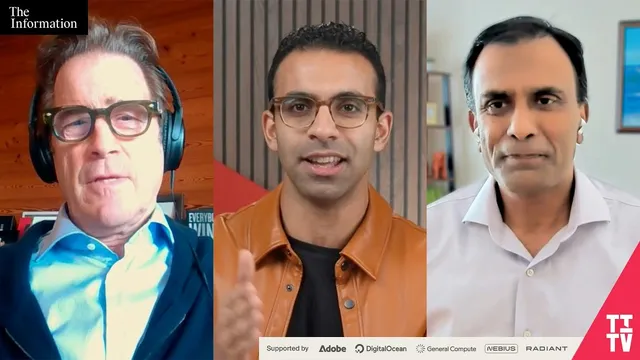
 The Information's TITV · Akash Pasricha with Gil Luria, Dakin Campbell, Valida Pau, Charlie Gottdiener, Aaron Holmes and Jason Goodison
The best minutes
- 2:59Debt-funded data center growth creates systemic risk7 min
- 22:26Enterprise forecasts need deterministic calculations6 min
- 40:55Inference speed can justify a much higher price per tokenPro pick 4 min
Also worth watching
- 32:09Microsoft expects fewer than 20,000 employees to take buyouts4 min
- 16:09DoorDash and Instacart may get another shot at a deal4 min
- 36:01Microsoft has not ruled out selling or spinning off Xbox2 min
- 29:42Anaplan customers now run hundreds of planning scenarios daily2 min
- 45:28General Compute is targeting chip niches hyperscalers have not scaled2 min
Full analysis · 6 min read
Real Alpha · Nov 22
Gil Luria warns on speculative debt as Broadcom lines up $63 billion
- Broadcom lined up $63 billion in financing, while SpaceX leased $40 billion in chips through an Apollo-linked entity.
- Luria says SPVs shift borrowing off debt lines, but leave lease commitments and speculative-demand risk.
- Boards should track guarantees, syndication and utilization before treating capacity as funded growth.
Free with an account
Read the rest of the analysis
6 sections, the 4 other voices it tests Luria against, and what it means for you. Every episode we cut gets one.
Check your inbox
We sent a link to your address. Click it to finish signing up. Not there in a minute? Look in spam.
or
Signed up before? The same buttons sign you in. The episode, its moments and the transcript stay free.
SPVs move debt off the line, not obligations
The host said Broadcom lined up $63 billion from banks and Blackstone. The host also described SpaceX leasing $40 billion in chips through an Apollo-linked entity.
These are not the same transaction, and Luria did not say the $63 billion was unsafe. The host’s framing put both deals beside each other, but that does not make his warning deal-specific.
Luria explained that an SPV can move borrowing away from a company’s debt line. Lease obligations and financial commitments still appear on the balance sheet, he said.
His Enron reference was an analogy, not an allegation of illegal conduct. Luria explicitly distinguished SPVs by saying they are legal.
That accounting distinction can make headline leverage look lighter without erasing payment obligations. Credit analysis has to follow guarantees, leases and exposure across entities.
For example, lenders may lend to an SPV backed by a large company’s guarantee, as Luria described. The borrower’s name alone may not show who bears the cost if use disappoints.
Our read
Treat the structure as a change in presentation, not a disappearance of risk. Trace guarantees and lease commitments across entities before comparing debt ratios.
Credit still reaches the largest borrowers first
Dakin Campbell’s contrast was access, not open credit for everyone. He said the strongest global balance sheets still secured financing, while smaller neocloud deals often failed or took different forms.
That divide matters to operators budgeting against a market that may not lend on equal terms. It also means large-company financing does not prove smaller providers can fund similar capacity.
Luria was not bearish on the largest borrowers. He said they could likely keep raising capital if markets allowed, and linked Broadcom’s prospects to compute access for Anthropic and OpenAI.
He pointed to Microsoft, Amazon and Google’s accelerating growth and stable-to-increasing margins as evidence of returns. Those company-wide results do not isolate returns on every data-center investment.
Campbell said Broadcom’s debt would carry a higher interest rate than Anthropic might want to pay on its lease. So the deals show financing is available, not that it is cheap.
Luria’s rate example was conditional. Firms used to paying five percent might accept six or seven percent, he said, if they believed returns would reach double digits.
Our read
The episode describes a credit divide, not a general reopening. Luria sees room for large borrowers to pay more, but that view rests on returns and continuing lender appetite.
Debt magnifies uncertainty before demand is proven
Luria’s warning concerns speculative investment financed before demand is certain, not a claim that every data center will fail. The debt makes an uncertain buildout harder to unwind.
Most data centers to date had used cash or equity, he said. But he saw debt beginning to take a larger role in the buildout.
In November on Bloomberg Daybreak: US Edition, IMF managing director Kristalina Georgieva cited about $1 trillion in AI financing, with one-third equity and two-thirds debt. She said the pace of growth concerned her.
That figure is not a tally of these specific SPVs, so it cannot establish their exposure. It does reinforce the need to separate total investment from who carries repayment risk.
The practical test is what happens if demand grows more slowly than capacity. Fixed lease payments and guarantees can remain even when a facility is underused.
“we shouldn't finance speculative investments with debt”

Our read
The concern is debt layered onto uncertain demand, not borrowing in isolation. Boards should identify which obligations persist if usage or revenue misses plan.
Banks still need buyers for the debt
An announced financing is not the same as debt placed with long-term holders. Campbell said Citigroup and Bank of America still needed a wider pool of buyers for Broadcom’s deal.
He said reporting suggested the banks had concerns about syndicating the financing on terms they would accept. At the time of the interview, that placement had not happened.
That creates a second test after underwriting. If buyers step back, banks may retain exposure longer, and later borrowing could cost more or arrive in smaller amounts.
In November on The Real Eisman Playbook, Gil Luria said CoreWeave’s low returns could not cover rising borrowing costs. He contrasted that with Nebius’s lighter debt, but those are different borrowers.
That comparison is a warning about debt service, not proof Broadcom’s financing will fail. Frank Lee said in November on Bloomberg Surveillance that GPU useful lives had exceeded expectations.
A seven-year-old GPU still earning money complicates depreciation and residual-value assumptions. It does not establish resale value for every chip or settle whether lenders can syndicate this debt.
- GLGil Luria · The Real Eisman Playbook · Nov 16CoreWeave’s debt costs put equity holders at risk
- FLFrank Lee · Bloomberg Surveillance · Nov 18GPUs may remain productive beyond standard depreciation cycles
Our read
Syndication, collateral value and customer payment commitments are separate checks. A borrower’s access to financing does not ensure that banks can distribute the risk afterward.
Cash funding puts a brake on expansion
Luria’s alternative was to build with available cash. He said slightly fewer data centers than needed would be acceptable while the market tested demand.
His reasoning was that constrained supply could leave data centers and chips more valuable, while AI use could still grow. That is a case for caution, not a claim that supply is already sufficient.
In November on The Real Eisman Playbook, Dan Ives forecast capex peaking in 2027 and free cash flow rebounding in 2028. That is his forecast, not confirmation that spending will slow.
For example, Luria cited Microsoft, Amazon and Google’s growth and stable or improving margins as evidence of returns. Those company-level figures do not isolate the return on each facility.
A budget review can compare project returns with financing costs and cash generation. If borrowing raises the hurdle, management can make the planned pace of construction explicit.
“we should build data centers with the cash we have”

Our read
Cash funding does not guarantee good projects, but it makes the spending limit visible. Luria’s case holds only if management accepts a slower build when demand remains uncertain.
Specialized compute still needs utilization proof
General Compute offers a different case for adding capacity. Its CTO and cofounder, Jason Goodison, said coding agents benefit from very fast chips, while overnight agents can use slower hardware.
Goodison said customers were willing to pay anywhere from three to five times more for the same token if it arrived 20 times faster. He also described five or seven times the price as a possible sweet spot.
Those are his company’s observations, not market-wide pricing data. The distinction matters because a speed premium only supports debt if customers keep using the capacity and paying for it.
The segment was introduced as a partner segment, and Goodison was discussing his company’s $100 million Series A. He said it planned about 20 megawatts online in Q1 and had contracts with large inference clouds he could not name.
He also said alternative chips he deploys had not yet seen large-scale hyperscaler adoption. That may leave room for specialists, but it also leaves utilization and customer concentration unproven in this interview.
The discussion did not provide facility-level margins, debt terms or realized utilization. So speed, planned capacity and funding round are not substitutes for cash-flow evidence.
Our read
Different workloads may support different chip choices, but the pricing case comes from a company selling that capacity. Require realized utilization and payment evidence before treating speed as collateral.
What it means for you
- Map the recourse chain. For each project, record the SPV borrower, guarantor, lease obligations and equipment ownership if a customer exits.
- Check syndication status. Ask whether lead banks placed the Broadcom financing, at what price and how much exposure they still hold.
- Stress-test the rate. Compare five percent financing with six or seven percent, then test whether projected returns still clear the higher cost.
- Measure workload economics. Track realized utilization and token pricing for fast coding agents versus slower overnight workloads, not just peak speed.
What to watch
- Whether banks syndicate Broadcom’s financing and how much exposure they retain.
- Whether large borrowers continue expanding capacity at returns that justify higher financing costs.
- Whether General Compute brings its planned 20 megawatts online in Q1 and demonstrates sustained utilization.
Send this to the CFO and infrastructure lead reviewing AI capacity commitments.
Watch the minute where the host introduces Broadcom’s $63 billion financing
Written by Real Alpha from the episode's transcript and the other moments it links, then checked against the transcript. Quotes are the speaker's exact words.
Minute by minute
A Pro write-up, open to you here. Try Pro free for 7 days
A Pro write-up. The minute by minute is in Real Alpha Pro; the episode, its moments and the transcript stay free.
Read it with Pro, 7 days free- 2:29SPVs shift AI debt elsewhere
Broadcom lined up $63 billion in financing, while SpaceX is leasing $40 billion in chips through an Apollo-affiliated entity. Luria said SPVs move debt away from a company's debt line but leave lease commitments on its balance sheet. He warned that debt for speculative data-center spending creates risk; Campbell said the biggest companies can still borrow while smaller neoclouds struggle.
- 8:30Debt syndication remains uncertain
Campbell said Broadcom's banks still need to syndicate the debt, and whether buyers will accept the terms remains uncertain. He said the announced NVIDIA financing consortium is largely separate, with first deals hoped for before year-end. Luria said Anthropic's filing showed 85% gross margins and 45% after compute, plus GAAP profit in the second quarter and positive cash flow for the year.
- 15:49DoorDash revisits an Instacart deal
Pau reported that DoorDash was in advanced talks to buy Instacart for around $17 billion, down from a valuation of $40 billion to $50 billion discussed in 2021. She said those earlier talks fell apart over antitrust concerns, while the current companies may see a path to regulatory compromises. Pau cited potential grocery-delivery synergies and described the talks as part of broader consolidation.
- 21:27Enterprise forecasts need deterministic math
Gottdiener described Anaplan as a scenario-planning and analysis platform for financial forecasting and supply-chain planning, with half of the Fortune 50 as customers. He argued that CFO forecasts need deterministic, repeatable calculations: LLMs can make arithmetic errors at scale and cannot provide the auditability businesses require.
- 25:28Governed AI access can extend Anaplan
Gottdiener said large customers want their AI tools to access Anaplan's calculations, not replace its scenario planning with an LLM. He said the company's governed MCP controls read and write access to the platform and protects customer security and privacy. Easier access, he argued, can help customers run more scenarios.
- 27:56Anthropic's economics hinge on scale
Gottdiener said Anthropic's reported gross margins looked more attractive than he expected, but it remains unclear how large the company must become to cover its costs. He said customers run hundreds or more scenarios a day and that AI lets them examine more. Anaplan reported $1.2 billion in ARR at the end of January 2026 and was measurably above that by the interview.
- 31:46Microsoft offers a voluntary exit
Holmes said Microsoft offered buyouts to 60,000 employees, more than a quarter of its staff, as it spends heavily on data centers and AI and looks to operate with fewer people. He said Microsoft expected fewer than a third of eligible workers to accept, likely fewer than 20,000. Azure's reported 20% cost-cut exercise was not confirmed as a committed reduction.
- 36:01Holmes sees Xbox sale as possible
Holmes said Microsoft had not ruled out selling Xbox, though Xbox CEO Asha Sharma was pushing for revenue growth and commercial chief Judson Althoff had called the business an important way to reach consumers. Holmes said paid Copilot seats rose from around 15 million in January to about 30 million in July. He also said Microsoft needs enough data-center capacity to support Azure and Copilot as Google Cloud grows.
- 40:08Chip alternatives serve varied workloads
Goodison said General Compute's $100 million Series A will help bring about 20 megawatts online in Q1; the company's last valuation was $800 million. He said coding agents benefit from very fast inference, while overnight agents can use slower, higher-throughput hardware. General Compute has announced partnerships with Cerebras, SambaNova and Positron AI; for workloads running 20 times faster, customers may pay three to five times as much per token, he said.
- 44:47Small data-center sites ease power access
Goodison said General Compute works with 5-to-15-megawatt sites, often converting crypto facilities, and checks that power will be reliable for AI workloads. He said energy is not the company's bottleneck. He argued that expertise in alternative chips, financing, energy and cooling gives the company a distinct position, and said he would not rule out working with TPUs.
Published Oct 27, 2026.
Transcript · 37 min read
The Information's TITV, hosted by Akash Pasricha, with Gil Luria, Dakin Campbell, Valida Pau, Charlie Gottdiener, Aaron Holmes and Jason Goodison.
Transcribed by machine (Whisper) from the episode’s audio, so a word may be off here and there.
welcome everyone to the information's ti tv my name is akash basricha it is tuesday october 27th before we get into today's stories i've got a quick announcement for you we want to know how you are thinking about the news cycle right now and that's why we have just launched our brand new app the information polls every day the information polls gives you five quick questions on the biggest stories in tech you can cast your vote and then immediately see how people across the industry answered at the end of the day you'll get a summary of the results and key insights into what the industry really thinks about these stories it only takes a couple of minutes so make it part of your morning routine. Download the information polls and vote today. Today on the show, we are going to dig into SpaceX and Broadcom's big multi-billion dollar chip financing deals. We'll also unpack our reporting on DoorDash's talks to acquire Instacart for $17 billion.
We'll then talk to the CEO of Anaplan about his enterprise AI playbook. We'll also look at Microsoft's voluntary buyouts. And we're going to close out the show with our partner General Compute to talk about their $100 million Series A funding round. It's going to be a great show, so let's get right on into it. Broadcom and SpaceX have announced two major financing deals this week. Broadcom has lined up $63 billion from major banks and Blackstone. SpaceX is leasing $40 billion in chips from Apollo, or at least a corporate entity affiliated with Apollo. I want to bring on Gil Luria, head of technology research at DA Davidson, and Dakin Campbell, our finance reporter, for their analysis. Gentlemen, welcome to the show. It's great to have you here. Gil, I want to start with you. So these deals feel like they have similar
“we should build data centers with the cash we have that's the right way to do it”
Read the whole transcript
so gil despite all this do you think we're going to see more or less of these types of financing deals i think that it looks like we're going to still see the largest companies able to raise that capital and they have the tolerance to pay slightly higher rates than they're used to if they're used to paying five percent they may be able to justify paying six or seven percent if they believe that the return they're getting on these data centers is in the double digits, which they do. And frankly, look at their financials. It looks like they get pretty decent returns. I know that's been a source of controversy, but if you look at Microsoft, Amazon, and Google, they have accelerating growth. It's stable to increasing margins.
That means they're getting a very good return on these investments. So they're likely to continue as much as the capital markets allow them, but they will have some price tolerance. At some point, they'll slow down the build-out if the rates get too high. And Dakin, help me square this with the big $500 billion commitment that NVIDIA got from all these Wall Street giants. This was the big roundtable that Jensen did with all these private equity firm, private credit lenders, etc. on CNBC. Is the $63 billion here, is it part of that? Is it affiliated? Are these separate pools of capital? It's largely separate, but I think it will take much the same form as what we're seeing here with an off-balance sheet SPV doing a lot of the activity.
You know, when that announcement was made this summer, I talked to a lot of people in and around the rooms. And what they told me was there is still a lot of work to be done on understanding and structuring the deals. It was basically a press release without a whole lot of substance behind it. I talked to some people this week, and there is some hope that the first deals will be done before the end of the year on that, you know, in that NVIDIA partnership. I can't say what firms think they're going to be the first movers on this, but there There is some idea or some desire, certainly, to get the first deals on that consortium out this year.
One thing I just want to mention, we've talked about how these are the biggest firms in the world. There is some element of this, of them wanting to get access to capital before it all dries up. To Gil's point, we may see a point where even the biggest and the safest and the most financially secure firms can't get capital. And so it feels like, and this is my interpretation, it could very well be wrong, but it feels like there is a rush to secure capital now in mid to late October, thinking that come November or December or something. There may be a lot less appetite from investors to buy into these kinds of deals. So a lot remains to be seen, but that's an element of this as well.
Right. And Gil, I do want to ask you, I mean, this all bodes pretty well for Broadcom. I mean, you upgraded your rating on the company. And what? As long as they can get the financing, this is all great news for the chip companies. that's right uh for broadcom to live up to its expectations over the next couple years they need anthropic and open ai to be healthy and for for those companies to be healthy they need to be able to get the compute they want and ramp up demand and and ramp up the ability to serve demand and the s1 reads really well for anthropic i think there's been a lot of scare about anthropic is never going to be profitable it's inherently unprofitable destroys value with every AI query. This one tells us a very different story. Tells us about a company that had 85% gross margins, 45% after you include all the compute, including training, which is really R&D, and was GAAP profitable in the second quarter, cash flow positive for the year.
That's a company that can raise capital. That's a company that could get people excited for an IPO next month. If they can raise capital, by the way, you still have $134 billion of the money they raised they've only burnt through 7 billion to get to this sale they're exiting this quarter at more than 70 million but they got out they all these what 700 billion dollars and 800 billion dollars in commitments coming i mean i mean the money's not going to last forever here well that depends on them getting the revenue uh it looks like they're on track to getting a lot more revenue so again they've been able to ramp revenue faster than compute if that continues to be the case they may be unintentionally profitable unintentionally free cash flow positive in which case the cash could last a very very long time and all it needs to really right now is last for a couple of years for them to be able to buy those chips from anthropic and if that happens anthropic's evaluation will be far higher than it i'm sorry broadcom's chips if that happens broadcom's chips will uh broadcom will be worth far more than it is right now broadcom's trading it 16 times that's basically the market said you know what anthropic and opi will never have capital
to buy chips again and that's appears not to be the case it looks like anthropic will be able to raise capital which means open now will be able to raise capital they're both sitting yeah more than 100 billion dollars so they're going to be able to buy a lot of chips from broadcom which means broadcom should be worth a lot more than 16 times right great well i want to thank you both For coming on, that is Gil Luria from DA Davidson and David Campbell, our finance reporter here at The Information. DoorDash is in advanced talks to buy Instacart for around $17 billion, according to new reporting from The Information.
Our deals reporter, Valida Powell, was first to break that price and first to report on Friday that Instacart had been in talks to sell itself. Valida joins us now with the details. Valida, welcome back to the show. It is great to have you here.
“the talks fell apart um because of like antitrust concerns”
have lots of history together, like to try for a deal.
And I'm sure like, you know, they have lots of relationships ongoing before already. Right. Last question for you, Valida. i mean were you expecting this deal to come through i mean when this came across your desk or when when your sources told you about this uh and and you initially broke the news uh did it surprise you or was this one that that people around you were sort of expecting for a while i felt like the uber instacart or the doordash instacart rumors have always been going around it seems like it would come up every year but it seems like you know the fact that it's finally happening is like very exciting and like you know the fact that they think it will get done was also kind of like surprising to me but um well i have on my phone i have instacard right next to doordash and also next to uber so like it's fun to see like you know how that's going to change in the future do you order groceries i do i don't and i i will I will not. Even if it's part of DoorDash, I'm not ordering my groceries. Sorry to say. I like going to the store. Oh, but we could find out if it's going to happen, get announced as soon as tomorrow. So it will be exciting to see how it plays out and how investors and shareholders
react to the acquisition. Great. Okay. Well, it was a great scoop, Valita. I want to thank you for coming on. That is Valida Pau, our deals reporter here at The Information. public software companies have been very loud in their earnings calls about their pivot to ai private software companies like toma brava owned anaplan have also been adapting to the ai era i want to bring on ceo charlie gott diner for a conversation charlie welcome to the show it's great to have you here well kash thanks it's a pleasure to be here so it's uh it's a bit a while since we've talked about anaplan on the show been a while since uh investors have paid attention to Can you just remind us what the company is all about these days?
Sure. Toma Brahu took us private in 2022, so that's why it's been a while. You know, we're a scenario planning and analysis platform. We think about ourselves as serving as decision infrastructure for the world's largest companies. Half of the Fortune 50 are our customers, and they're doing financial planning, financial forecasting with us. They're running their supply chains and planning their supply chains on Anaplan. So those are the two biggest areas that we participate in. Okay. And so tell me a little bit about the AI strategy here.
“They're really good at predicting the next word, not doing arithmetic at scale.”
Given that you are in the business of scenario planning, so I do want to get your take on the Anthropic prospectus. I don't know if you had a chance to look at it, although it seems like everyone in Silicon Valley spent the better part of yesterday looking at it.
So look, this is the big question for Anthropic. They are scenario planning. They've got to figure out how much capacity they're going to need, how much demand there'll be, you know, a couple percentage points of growth this way or that way could very much change the state of, you know, their own business. And we saw the hundreds of billions of dollars in compute and chip commitments that they had. From your read on their prospectus, are they doing a good job or do you think they've overcommitted to capacity? Is demand looking the way they think? What do you think? Yeah, so look, I go back to their fundamental business model and everything that I've read, which was actually surprising.
is that they're delivering gross margins that are pretty attractive. And so, assuming that they can still maintain this extraordinary top-line growth, they can have a real business over time, right? I mean, they're already at a massive scale. So, the question really is going to become, how big do they really have to be to make the business model pay for all these costs and consumption? And I don't think that's answerable yet because I think it's just hard to know. But if I look at the fundamental gross margin structure that they've reported on, it's more attractive than I expect it to be. It's a real technology company, which is encouraging.
I think it's encouraging for the whole space. Right.
“they're running hundreds, in some cases more than that, scenarios a day to look at different forecasts.”
That is Charlie Gottdiener, the CEO of Anaplan, here on TITV. Microsoft is offering buyouts to 60,000 people working at the company.
That equates to more than a quarter of the company's staff. For more on that, I want to bring on Aaron Holmes, our Microsoft reporter. Aaron, welcome back to the show. It is great to have you here.
“Microsoft expects a third or probably less than that of the eligible employees to take this buyout.”
“i would not be surprised if we saw some sort of spin out or sale in the future with xbox”
scenario where the company getting a little bit smaller and focusing some of its other efforts, it might be better for the business. It's a question that I have. Hey, we've got Microsoft earnings tomorrow, other than the Azure growth, which everyone pays very close attention to. Anything that you're watching for? Yeah, you know, I'm curious to see how much their growth of Copilot will continue. And if that is going to accelerate or decelerate, you know, they doubled the number of paid Copilot seats from around 15 million in January to now about 30 million as of July. So it'll be interesting to see if that continues apace. And it's also going to be interesting to see, you know, whether their build out of their cloud infrastructure is going fast enough to allow for both Azure growth and also growth in co-pilot. You know, we know that Microsoft at one point last year kind of paused their data center build out because they were essentially nervous about, you know, how much they were allocating to OpenAI. And since then, my understanding is that the company has kind of been playing catch up to speed up its data center
build out. It definitely does not want to be overtaken by Google Cloud, which is growing at much faster rate in recent years. So it'll be interesting to see what they disclose about how the buildout is going and how much capacity they've been able to bring online. Great. Well, Aaron, I want to thank you for coming on. That is Aaron Holmes, our Microsoft reporter here at The Information. Our next segment is with our partner, General Compute. The company raised $100 million in a Series A funding round to build out its NeoCloud offering with chips that are not from NVIDIA for more on that i want to bring on jason goodison cto of the company for a conversation jason welcome to the show it's great to have you here hey great to be back thanks for having me so let's talk about the hundred million dollars what are you using the money for uh basically we're using the money to to fund our growth so uh we have about 20 megawatts that we're bringing online in q1 alone um and we have contracts with really large uh you know i can't name them here, but really large inference clouds that we're bringing capacity to. And so we're just securing as much energy as possible, funding the chips and actually rolling these things into
real data centers and setting them all up. And $100 million, what's the valuation of the company now? $800 million was the last valuation. Okay, cool. So, you know, I want to get into
“you can charge anywhere from 3 to 5x for the same token because you're able to produce it 20 times faster.”
we've announced partnerships with cerebris uh samba nova and positron ai um and there are some other companies that we're kind of in talks with right now uh there's just imagine there's just an immense amount of demand for what all these different companies are doing right now.
And they, like we talked about, dominate different parts of the kind of efficiency curve. And so, you know, we're kind of helping all of them go to market and to serve the customers. Yeah. So I want to get to sort of one of the big meaty questions that Neoclouds are facing right now. Right now, there's obviously the power concern. Can all these facilities get power? Have you had any issues getting power to your facilities? Well, we're kind of lucky in the sense we've taken a really unique approach to it. So we're working with these 5 to 15 megawatt stamps. And generally speaking, we work with operators that are converting crypto facilities into AI data centers.
So there's a lot that goes into the DD on a site before we actually execute on it because Bitcoin workloads are dramatically different than AI ones.
“With the kind of compute we're deploying, we haven't seen large scale adoption from hyperscalers yet.”
and I imagine that TPU is going to be one of the things that Sundar Pichai pushes hard. Are you considering working with any TPUs? And if not, do you see that as a competitive threat to why? Because they've got these TPU neoclouds that are popping up as well. What's your view on that i'm a big fan of tpu um you know customers that we we've already signed have come to us and asked us about tpus um i would never uh rule it out um you know i i can't say anything but i'd never rule it out uh what i will say is i think that some of these hyperscale uh backed chips like tranium tpu um and even now jalapeno uh as people think about bringing these to market in mass they're going to find that it's really difficult to find any energy uh right now and so So these 5 to 15 megawatt stamps, which work really well for enterprise clients and inference clouds, we're actually kind of the experts in plugging those into.
So, you know, if anyone in the hyperscale community is thinking of getting their chip out there more en masse like the TPU, I think that we would be an obvious choice to help with that. But, you know, right now, we're really excited about our announcements and our partnerships with Cerebris and SambaNova and Positron. Great. Well, Jason, I want to thank you for coming on. That is Jason Goodison, the CTO and co-founder of General Compute here on TITV. That does it for today's show. A reminder, we are on this stream Monday through Friday at 10 a.m. Pacific, 1 p.m. Eastern. If you can't make it then, episodes are available on theinformation.com, on our YouTube channel, or wherever you get your podcasts.
Make sure to follow us on social media, on X, on Instagram, on TikTok, and on LinkedIn. I am already excited for our next show tomorrow. Have a great rest of your Tuesday. Bye-bye for now. You