Free with a sign-in.
The best 7 min of 29
Claude Could Only Go So Far Building a Xero Killer | Xero CEO
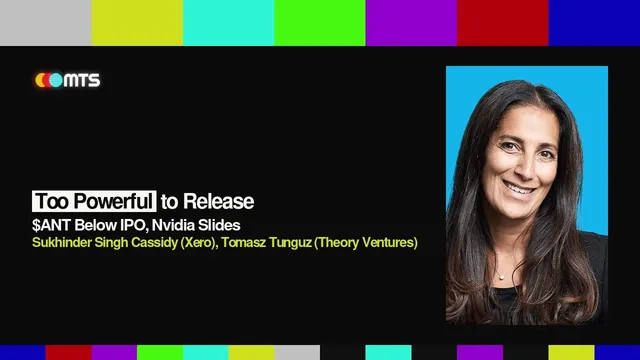
Sukhinder Singh Cassidy argues that AI favors software companies with trusted data, infrastructure and customer relationships, not thin application layers.
 MTS · Sophia Dew
- Sukhinder Singh Cassidy is CEO of Xero.
The best minutes
- 8:59Trust in financial AI means safety, accuracy, and accountabilityPro pick 4 min
- 3:32Most small businesses want AI through a trusted platformPro pick 3 min
Every moment plays free. PRO marks a write-up that's in Pro.
Also worth watching
- 12:35SaaS winners need multiple moats and sustainable AI economics2 min
- 22:11Regulation and low cloud adoption give Xero tailwinds beyond AI2 min
- 17:18Accountants play a larger role in SMB software adoption outside the US2 min
Skip the opening Xero overview and AI feature tour, the sponsor reads, and the closing career background and personal-motivation discussion.
Full analysis · 6 min read
Real Alpha · Nov 20
Sukhinder Singh Cassidy says Xero handles 60% at 96% accuracy
- Xero says it processes 60% of transactions today, at 96% accuracy on that subset.
- That is a bounded result, not evidence that financial work is fully autonomous.
- Operators should track coverage, exceptions, accountability, and model cost before budgeting substitution.
Free with an account
Read the rest of the analysis
6 sections, the 3 other voices it tests Cassidy against, and what it means for you. Every episode we cut gets one.
Check your inbox
We sent a link to your address. Click it to finish signing up. Not there in a minute? Look in spam.
or
Signed up before? The same buttons sign you in. The episode, its moments and the transcript stay free.
Xero reports 60% coverage at 96% accuracy
Xero CEO Sukhinder Singh Cassidy put two numbers on one bookkeeping task. Xero processes 60% of transactions today, she said, and reports 96% accuracy on that subset.
That is not 96% accuracy across every transaction. But it is performance on the transactions Xero processes.
If those 60% are measured against all transactions, then 100% minus 60% leaves 40% outside automation, our arithmetic. Cassidy gave no error breakdown or measurement window beyond today.
For example, she said uncertain transactions are left for a person. That can limit automatic mistakes, but leaves substantial work outside the automated share.
Cassidy called 96% better than human error, but gave no comparator or error definition in this discussion.
For a finance team, 96% can still mean frequent corrections at transaction volume. The transcript gives no transaction count, error severity, or review time, so the business impact cannot be calculated.
“If we're not sure, we won't process it.”
Our read
These figures make a bounded operational claim, not a promise of full automation. Coverage and accuracy need to be read together.
Claude's prototype exposed infrastructure beneath the interface
Cassidy's Claude attempt exposed how far an interface can get without the connections underneath. She said it first made a simple transaction categorizer, then pointed her to banking and tax links Xero already had.
That is a product demonstration, not a production comparison. It says little about the cost, time, or obligations involved in building comparable integrations.
Generating a screen is smaller than running a financial system. Xero's case rests partly on bank, payment, and regulator connections, as well as the software customers see.
MongoDB's Chirag Shah described agent backends built around agents, tools, memory, and context on MTS in November 2026. That describes a different application architecture, not proof that Xero's connections are defensible.
But the anecdote does not establish exclusive access or prove a rival could not connect the same services. Operators should test integration depth, operating obligations, and exception handling rather than count connectors alone.
The distinction matters when choosing what to build or buy. A prototype can validate a workflow. It cannot show by itself that a provider can maintain connections or accept downstream responsibility.
Our read
The example makes a case that a prompt-built screen is not a complete commercial product. It does not prove that Xero's infrastructure cannot be replicated.
SaaS winners need several defenses and sustainable economics
Cassidy separates thin feature layers from businesses combining software with data, infrastructure, trust, and customer acquisition. That is more useful than treating every SaaS company as equally exposed.
Yet Cassidy is Xero's CEO, making this an interested case for Xero's position. Her framework is useful for diligence, but not independent evidence that Xero will win.
She says software still needs margins, customer acquisition, and trust. Xero does not use a model for every feature, she said, and reserves generative AI for work where it differentiates.
Xero says over 2 million subscribers benefit from some AI feature. That reach number does not tell us how many use generative AI, pay extra, or save time.
On How I Invest in November 2026, THL Partners co-CEO Todd Abbrecht said he seeks defensible businesses with AI tailwinds. His screen resembles Cassidy's, but it does not independently confirm Xero's position.
Still, Cassidy disclosed no feature-level inference costs, labor savings, remediation costs, or retention here. Buyers need those measures to test whether trust and infrastructure also produce sustainable economics.
Our read
Her framework travels better than her self-assessment. Founders can use the categories, but need operating data before calling their position durable.
Accountants still shape small-business software adoption
Xero's adoption data points to intermediaries as well as end users. Cassidy said API calls and app-building attempts have quadrupled since January.
Most builders she sees are accountants, bookkeepers, or third-party developers serving small businesses. Direct SMB builders are a tiny minority, she said, and may include larger firms filling a specific gap.
Take the regional split. U.S. SMBs tend more toward self-service, while in Australia and the UK, the vast, vast majority look to an accountant or bookkeeper to set up accounting software.
She did not say those advisers always select the product. The adoption point is that setup routes differ, which affects onboarding, support, and sales.
For example, she said an SMB may handle invoicing but might have an accountant do bill pay. That puts roles and permissions inside the workflow, not just channel planning.
For a product team, the same feature may have two users with separate permissions and incentives. Channel economics can depend on helping the accountant without leaving the business owner less informed.
Our read
The route to adoption may run through the accountant as much as the business owner. That makes channel behavior and role-specific workflows part of the product test.
Regulation and cloud migration create demand beyond AI
AI is not Cassidy's only growth case for Xero. She pointed to uneven cloud-accounting adoption and regulatory digitization, forces that could matter even if AI adoption stays cautious.
She said cloud accounting remains at different penetration levels across markets. In the UK, she cited digital tax filing under Making Tax Digital and said Xero created filing software.
Cassidy said Xero got more than its fair share of that market. She also named e-invoicing and digital payments as tailwinds.
Xero bought Melio in the U.S., where Cassidy said paper checks remain a gigantic part of the market. These are specific demand sources, but the episode gives no adoption rates, conversion timing, or revenue shares.
A regulatory requirement may prompt adoption, but repeat use and paid conversion remain separate tests. The episode does not show whether the UK filing gain translated into retention or higher customer value.
Our read
Cassidy offers a reason not to treat AI as Xero's only growth engine. The episode does not quantify how much these other drivers contribute.
Cassidy expects cheaper software to expand work
On jobs, Cassidy expects easier, cheaper software to multiply use cases rather than shrink demand. She invokes the idea that lower costs can increase use, citing Google Maps and local advertising.
At Google, she said she helped build Maps with Brett Taylor and 10 engineers. She recalled that some expected Maps to kill local advertising, while her account is that it expanded the industry instead.
But that is an analogy, not Xero customer data. The episode gives no hiring totals, displaced accounting hours, or net productivity figures.
Eric Glyman, Ramp co-CEO, said on Lightcone in November 2026 that cheaper intelligence does not always increase usage. His account points to task needs and organizational limits, complicating a universal demand-expansion forecast.
That distinction should shape staffing assumptions too. More software output can coexist with fewer hours for a particular task, while demand may grow elsewhere. Net job effects require measurement.

Our read
This is a plausible demand thesis, not a headcount model. Forecasts need to account for both new work and work automation removes.
What it means for you
- Measure exception work. Track the share completed automatically beside accuracy on that share. Include corrections and cases handed to staff, not only successful runs.
- Cost models by task. List model and inference costs for each workflow. Compare them with measured time saved, especially where a frontier model adds no differentiation.
- Map both user roles. Interview small businesses and accountants in each target market. Xero's account suggests setup and payment responsibilities may sit with different people.
- Separate growth sources. Budget cloud migration and regulatory digitization separately from AI adoption. Track conversion and usage for each rather than combining every tailwind in one forecast.
What to watch
- Whether Xero can raise its current 60% coverage while sustaining the reported 96% accuracy.
- Whether AI feature use produces measurable time savings, paid adoption, or lower review burden.
- How cloud accounting, digital tax filing, e-invoicing, and payment digitization translate into growth.
Send this to a CFO or product lead assessing AI exposure in vertical SaaS.
Watch the minute where Cassidy gives Xero's coverage and accuracy figures
Written by Real Alpha from the episode's transcript and the other moments it links, then checked against the transcript. Quotes are the speaker's exact words.
Minute by minute
A Pro write-up, open to you here. Try Pro free for 7 days
A Pro write-up. The minute by minute is in Real Alpha Pro; the episode, its moments and the transcript stay free.
Read it with Pro, 7 days free- 0:00Claude hits infrastructure limits
Cassidy says Claude first built a simple app to categorize transactions when she asked it to replicate Xero. When she asked for a Xero competitor, it directed her to connect Plaid, a company she had cofounded and tax authorities—all infrastructure she says Xero already has.
- 1:42Full-stack data powers AI
Cassidy describes Xero as a data company connected to thousands of banks, payment rails and regulators. She says more than 2 million subscribers use an AI feature, including automatic bank reconciliation; users can turn it off, and Xero leaves uncertain transactions for them to review.
- 3:32Small businesses approach AI cautiously
Cassidy says only a small fraction of Xero customers connect to Claude, while many report fear or uncertainty about AI. Since January, API calls and attempts to build apps on Xero have risen 4x. She says most builders are accountants, bookkeepers and third-party app developers, who can also use XeroForce to create low-code or no-code workflows.
- 6:19AI puts thin wrappers at risk
Cassidy argues that SaaS companies with easily replicated application layers face more risk than full-stack platforms. She says Xero combines infrastructure, data, applications, customer trust and a go-to-market engine, while AI-native software still needs sustainable margins and customer trust.
- 8:59Defensibility goes beyond code
Cassidy says building software quickly is necessary but not sufficient: companies also need to understand why customers use them and deepen their trust and infrastructure advantages. From her Claude experiment, she says customers care about price, trust and functionality, as well as having AI bundled or unbundled to suit their needs.
- 10:26Financial AI trust has three parts
Cassidy defines trust as keeping sensitive data safe, producing accurate results and being accountable when something goes wrong. She says Xero automatically processes 60% of transactions at 96% accuracy and leaves uncertain transactions for review. She also points to Xero’s responsibility for tax filings, payment fraud and compliance.
- 12:24SaaS winners need multiple moats
Cassidy says investors wrongly treat all SaaS companies as one category. She sees risk in expensive, single-feature products without critical infrastructure, proprietary data, a scaled go-to-market engine or strong margins. She argues that winners need customer trust, several moats and sustainable economics, and should use advanced models where they add value.
- 14:28Xero brought global operating demands
Cassidy says she searched for a CEO role for about a year and a half and was drawn to Xero partly because she had used it for her startup, the Boardlist. Compared with StubHub, she says Xero is global from day one, trades on the ASX and reports twice a year, bringing different governance demands.
- 17:15AI adoption varies by market
Cassidy says U.S. small businesses tend to choose and set up software themselves, while small businesses in Australia and the U.K. more often rely on accountants and bookkeepers to set up accounting software. She says this changes whom Xero needs to serve and makes self-service adoption and trust in AI different across markets.
- 20:59Regional tech markets can grow
Cassidy points to Sweden’s renewed activity in generative AI startups and says Latin America has shown enough market potential to support large technology companies. She names MercadoLibre, Nubank and Contra Azul as examples.
- 22:11Regulation drives Xero's growth
Cassidy says she saw macro tailwinds in Xero beyond AI, including markets where small businesses have not yet adopted cloud accounting and regulatory digitization. She points to digital tax filing in the U.K., e-invoicing and the shift from paper checks to digital payments in the U.S., where she says Melio is positioned to benefit.
- 24:31Cheaper tools can expand jobs
Cassidy argues that when technology gets cheaper and easier to use, its use cases can multiply rather than disappear; she says companies are still hiring engineers to build more software. She recalls building Google Maps with Brett Taylor and 10 engineers, and says it shifted local advertising toward digital rather than killing the industry.
- 26:21Impactful work sustains Cassidy
Cassidy says she is motivated by building impactful products with great teams and sees work as part of her impact in the world. She calls this a strong time for builders and says the pace of change keeps her learning.
Published Nov 17, 2026.
Transcript · 26 min read
MTS, hosted by Sophia Dew, with Sukhinder Singh Cassidy.
Transcribed by machine (Whisper) from the episode’s audio, so a word may be off here and there.
I went to Claude, and obviously I use Claude Cowork. We use it internally at Xero. And I tried to replicate Xero. And at first it built me like a very simple app that can do not bank reconciliation, but can categorize transactions. Then I said, no, I want to build a Xero killer. And you know what Claude said? They're like, well, you should go connect to Plaid. I'm like, well, Xero's already connected to Plaid. You should go connect to Yodely, where I was the co-founder many years ago. Well, okay, we already have Yodely in the stack. No, you should go connect to like tax authorities. Yeah, that too is at Xero.
So Claude could only go so far to build a commercial application at scale. Does that make sense? And then it started directing me to all the infrastructure that Xero has. Hello, everyone, and welcome back to MTS. Today, I am joined by Sukinder Sin Cassidy, who is the CEO of Xero. Xero is one of the leading account platforms globally, with 5 million subscribers in over 180 countries and revenue over 2 billion US dollars. So today, I'm super excited for you to join me to talk about the future of SaaS business models and how AI and this whole industry is impacting SaaS. So welcome to MTS. Thank you so much for having me, Sophia.
I'm excited to be here. I'm so excited for you to be here. Right as you were starting, you're sharing some cool stats about Xero. Can you just share about what you guys do and where you guys are today? Sure, sure. So Xero today is, as we noted, about 5 million subscribers across a number of countries, but we call ourselves focused on the 3x3. So what we mean is Australia, the U.K., and the U.S. are major drivers of growth and our biggest markets. And number two, we talk about three important jobs that small businesses need to do that we offer on Xero. That's accounting, payroll, and payments. And so we know that when we do accounting, payroll, and payments, we access over $100 billion in global TAM in our markets at Xero.
Read the whole transcript
Oh, wow. And so, specifically, as someone who understands the software world a lot, can you talk about how this big platform shift has happened during this age of AI? Like, what are the big changes you've seen happen? Sure. Well, first of all, as you probably know, like, we're a data company, right? We ingest data. We process data. We put data into our own applications. We're connected. Just to give you some sense, Zero is connected to thousands of banks. We're connected to payment rails. We're connected to regulators around the world. So, that's all infrastructure underneath our application. So for us, traditional AI and machine learning have long been part of our DNA, right?
We need to produce data in a reportable and intelligent format for customers. So Gen AI for us is a boom. I mean, it is a boom. It is a builder's dream. And so people get quite confused. And I'm like, hey, guys, we are a full stack infrastructure, data, applications, GTM engine that operates across multiple jobs in multiple markets. And that gives us a lot of data in a Gen AI world. it also gives us a lot of access to TAMP. So as an example, today over 2 million of our subscribers benefit from some AI feature. And then we have a few features that are what we would call hero features. So if you're in the world of bookkeeping, which we are, like auto bank reconciliation where you log in and the job is just done for you.
Like you don't have to reconcile the transactions. They're just auto reconciled is probably one of our hero features in Gen AI because that goes from like us asking or helping you with it to just doing it on your behalf. and then you are in control as a small business or an accountant who uses a platform and you can turn off auto bank rec or if we're not sure about a transaction that we're reconciling, we leave it for you to reconcile. So that's a good example of like why, you know, the opportunity for AI is tremendous. I mean, it's like a builder's dream and for small businesses, the thing they're short on is time, cash and intelligence.
Yeah.
“We are 4x the number of API calls on the platform and people attempting to build apps since January.”
A lot of people assume now that you can just build anything you want with one prompt, there won't really be a need for a lot of these big SaaS companies or even the valuations of current SaaS companies will start to go to Xero. You even coined a term earlier called SaaSpocalypse. I love that term. What does SaaSpocalypse mean and where do you see SaaS going? Yeah, and actually I also coined a term called SAIS, software as an intelligence service, which I think is our opportunity.
But I think that it's a tale of two cities. I think people confuse, first of all, companies that are thin wrappers or application layers where you can easily replicate that thin application on a clod. Okay, so that's one kind of SaaS. Does that make sense? It's defensibility is only the application layer. And I'd say those companies we think are more at risk. How do I know that? Because I'm sitting at zero. And remember, we have 5,000 employees ourselves. So we're a big purchaser of enterprise software, right? So do you think I'm not looking at my own stack internally and thinking about what piece of software am I going to double down on?
Who can give me more AI? What am I willing to retire? Because it's a thin wrapper that's costing me around. And quite frankly, what new AI native software company might I adopt? By the way, AI native software is still software. So just so you know, it still, at scale, needs to be profitable, have margins, right, and be able to build a GTM engine and build customer trust. These things, by the way, have nothing to do with code. So what do I love about Xero? We're a full stack. platform with massive customer trust. We're a system of record, a system of action, and a system of trust. And we have critical infrastructure that SMBs and accountants and bookkeepers can use right underneath the application layer. And on top of the application layer, I mean, we spend hundreds of millions of dollars acquiring customers directly and through our account and bookkeeping channel. So I would say don't confuse us with a thin wrapper.
I want to shout out our sponsor, Lovable. You know, the app you've been meaning to build, the internal tool, side project, or product you'd otherwise lose a weekend to, with Lovable, you get software you can ship today. That includes an editable code base you can inspect and change, plus two-way GitHub sync. Lovable also handles the backend and infrastructure, including managed Postgres, auth, storage, hosting, payments, and more, so you don't have to wire it all up yourself. And through Lovable's MCP server, you can create and deploy your project directly from the agents you already use. Turn ideas into software people love with Lovable. Lovable.dev. Now, on to the episode. What would you give advice to other
“We've marked it to our customers that we will process 60% of transactions today. If we're not sure, we won't process it.”
it takes to actually build a great product? Well, first of all, I think they, to your point, they throw it all in a lot and a bucket and there are like SaaS goes this wide, right? It runs,
“if you're charging a lot for a thin slice, a thin slice wrapper or singular feature, I think it's a risky place to be.”
And then specifically, what did you think when you started, when you became the CEO, What was maybe an assumption that you had that you don't have anymore? Oh, great question. So first of all, I always say to people, I think you may or may not be aware, the company I ran before this was StubHub.
Yeah, you're the president, right? Yes, but effectively the CEO because it was a division of eBay. And I led its sale to Viagogo. And then so we consolidated the market. And then I had to lead the COVID response. So I was looking for a long time for my next CEO gig. And I remember saying to recruiters, and they kind of laughed at me because it was a high bar. I was like, the CEO job needs to be available. Yeah. It needs to be an attractive business model with macro tailwinds. It needs to have a culture I believe I can thrive in. And I need to have like empathy with the end customer. And I was looking for no joke almost a year and a half before Zero showed up. And I'm a customer of Zero because I own my own startup or I owned my own startup at the time called the board list that was on Zero.
So the minute I got the call, I said to my husband, I was like, I think this is the one. And within three months, I became CEO. So what is my assumption? I think the assumptions are probably what's held true, not what hasn't held true. I think what's held true is like it's an amazing company and business model. I love zeros. I love our opportunity. And I think the assumption that's wrong is not mine. It's the markets that zero does not intend to fully compete and be on offense with AI. Yeah. So you ran StubHub before running zero. Yes. What's the difference between the two of running the two companies? Yes.
I mean, it's vastly different. One was a U.S. headquartered company that had an international business that was like 5% of our revenues. So it was international. But like, you know, I could just go to eBay and get whatever thing I needed done. I was on eBay's management team. If I had to go lobby, I was independently running StubHub. But I could just drive to San Jose and get it done. I mean, the biggest difference for Xero is we don't trade on NASDAQ. We're unique in that. You know, Atlassian, Canva, they're a much more NASDAQ place or U.S. listed. But we trade on the ASX. And so that has its own unique governance principles.
Like we only report twice a year. You know, it's probably a heavier governance market and less growth oriented, let's say, than NASDAQ. Sort of a bit less risk takers. So probably the biggest adjustment for me is just I'm running a business whose DNA is global from day one. And I'm the oddity that I'm a Canadian immigrant here in the valley running this business from Silicon Valley, but it's global. Having said that, you know, Google, obviously early in my career, I was at Google and I was the president of APAC in Latin and I did run Google's international business without a drop of U.S. revenue from here.
I ran it for six years. I mean, I would go to Mountain View every day and lobby for everything my business needed and that became a multi-billion dollar business. So I am used to it. So you are used to it. It sounds like most of the conversations we have around AI is very much on domestic, how it affects us domestically and how it affects us here in the United States.
“In Australia and the UK specifically, the vast, vast majority look to an accountant and bookkeeper to set up their software in accounting.”
11labs, AI that communicates at human level across every channel and modality. 11labs.io.mts Scale your startup on Neon. Millions of developers and startups have already chosen Neon for their backend.
Start on the free plan or get up to $100,000 in credits for your startup at neon.com.mts Special thanks to our sponsor Kong, the AI connectivity platform. Connect APIs, LLMs, agents, and systems with serious security and governance. KongHQ.com. Finally prove what your AI investment is worth with Lairdyn. Head to Lairdyn.com today to start measuring your AI's bottom line. MongoDB, trusted to run critical applications by 75% of the Fortune 100, the intelligent data platform for the AI. era. Apply today for access to up to $15,000 in Atlas credits, dedicated technical support, and exclusive events and go-to-market opportunities. MongoDB.com.
Chargebee, billing and monetization infrastructure for the AI era. chargebee.com. ClickHouse is the real-time database built to keep up with every query your apps and agents send its way. And it now runs Postgres, observability, and AI tooling on one platform. Learn more at clickhouse.com. You should fast. So do attackers. Don't assume you're secure. Prove it. Horizon 3. Go hack yourself with AI. Visit horizon3.ai slash node zero. The key ingredient in today's M&A? SRS Aquium. Learn why their shareholder rep, payments, and escrow solutions have been used by 96% of top global PE firms and 88% of top global VCs at srsacquium.com slash MTS. That's s-r-s-a-c-q-u-i-o-m dot com slash MTS. Would you say there's any country outside of maybe the main major players that's underrated right now when it comes to how they're competing and showing up in the AI race?
Oh, you know, that's interesting. So this is less about zero because we don't compete here, But Sweden is having a resurgence, as you probably know. I mean, Sweden was the place of Spotify and Klarna. But I think that Sweden is showing up well again when it comes to generative AI startups. So that may be one that people would not expect. But of course, the Nordics do have a history of disruptive software. What about in Latin America? You know, in Latin America, I mean, look, I ran that business for Google. Zero doesn't have a big business in Latin America. But I think in Latin America, I would say between MercadoLibre and Nubank, Latin America has been able to prove to Silicon Valley investors that there's big enough TAM to hold unicorns or decacorns.
So I think the same is true in accounting software. The biggest player there is Contra Azul, and they would probably be worth in the billions. And so I think that Latin America, even though it's an emerging market, it now has big enough TAM on an absolute dollar basis to have MercadoLibre, Nubank, Contra Azul, and others be able to build unicorns and decacorns. Yeah. One thing I'm curious about,
“And you have to remember that around the world, there's still many markets where SMBs are not doing cloud accounting.”
and also with regard to even cloud accounting is still behind. Definitely. My last question for you is I want to get your opinion on the future of jobs and how technology is going to affect and specifically software is going to affect the future of jobs. I think on one end, we have new, small, medium-sized businesses. You work really closely with new businesses that get created that a lot of people say the opportunity for them is larger than ever before because it's never been easier to start a business.
And especially with tools like you guys are providing, anyone is able to with a lot less resourcing than before. On the other end, people are saying, okay, well, you're not going to need the accountant. You're not going to need that tax finance person or whatever you maybe would have had because it's now automated away. What's your stance here? Yeah, so first of all, I mean, I think you probably, you're an engineer, so I'm going to give you a phrase that you likely know, which is Javon's paradox, which is idea that like people think that when something gets cheap and easier to access that um use cases decline in fact they multiply i think this is one of the reasons that you're not seeing a collapse complete collapse in the software market right now right in the engineering market there's still engineers being hired everywhere because people see the macro opportunity to build more software faster right not to not build software um i also one of my first jobs at google was is that um the first person, business person on Google Maps. So I left my own startup and I came over to Google and I was hired to be the GM of local and maps. And I partnered with Brett Taylor, who I'm sure you know,
and Brett and 10 engineers and me as a business person, we built Google Maps. And everyone's like, oh, this is the death of the Yellow Pages industry. And look, in fact, if you want to be a successful local advertising player, you needed to shift to digital. But I think you and I would both agree that Google Maps didn't kill the local advertising industry. It multiplied it. So the value shifts, but it does explode. That's what I believe. The value shifts and it does explode as well. I love that. My last question for you, just because I am so inspired by your whole story and just your whole career trajectory, and that you continue after working on really hard problems, you want to go back to even harder problems and continue working on them again. And so I'm just curious on a personal level, what motivates you and what are the core problems you're trying to solve?
Yeah, look, I always say, if you read my LinkedIn bio, it would say, I love building, you know, products that impact with great teams. And so like, how do I find the energy? I think I find the energy because as long as I can do something impactful, build impactful products with great people, like my cup is pretty full, right? And I look at like my impact as work is part of my impact in the world. So I don't think of those two things as separate. I think like what I do at work can be impactful. And so why do I keep going? I keep going because as long as I find the work impactful and I get to work with great people, and do it well, I'll keep going.
And to your point, like if there's a day where I feel like those things aren't true, like I'm also okay to hang up the gloves. You know, I've had an amazing career. But right now, I keep saying it. Like it is the rise of the builder era. You know where I live? Silicon Valley. We're builders. At zero, we're builders. Me, I'm a builder. I've been an entrepreneur three times. So it is one of the funnest times in history. I'm worried that if I stopped working, I'd very quickly like lose the knowledge train. Does that make sense? Because things are changing so fast. So I'm learning at this ridiculous rate right now. It's one of the funnest times in history and it's never been a better time to be a builder. And so I love your story where you are choosing to be a builder right now because you want to be competing and playing in this time period.
Absolutely. I love it. It's so much fun. Well, really appreciate you for coming on MTS, sharing more about Zero's story, how you guys have grown, and also just where you think the future of AI is going. It was amazing having your perspective here. Thank you, Sophia. A huge thanks to MTS sponsors. Blitzy, autonomous software development for enterprise code bases. Ship 5x faster. Blitzy.com. AdQuick, make your brand a billboard. Out-of-home advertising as easy to scale as digital. AdQuick.com. ARENA, measuring AI performance in the real world. ARENA.AI Support for the show comes from VCX, the public ticker for private tech.
The U.S. stock market started history's greatest wave of wealth creation. From factory workers in Detroit to farmers in Omaha, anyone could own a piece of the great American companies. But today, our most innovative companies are staying private longer, which means everyday Americans are missing out. Until now. Introducing VCX, a public ticker for private tech. Visit getvcx.com for more info. That's getvcx.com. Carefully consider the investment material before investing, including objectives, risks, charges, and expenses. This and other information can be found in the Innovations Fund prospectus at getvcx.com.
This is a paid sponsorship.