Free with a sign-in.
The best 18 min of 114
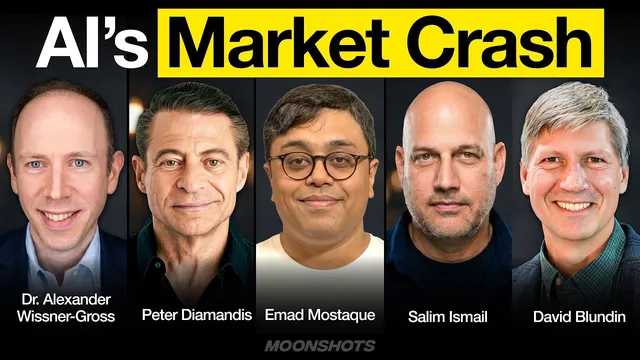
Big Tech’s $3T AI Bet, Claude Writes 90% of Anthropic’s Code, AIs Editing AI Brains | EP #308
Peter Diamandis, Salim Ismail, Dave Blundin and Alexander Wissner-Gross argue that AI's $3 trillion buildout is accelerating self-improving systems.
 Moonshots · Peter Diamandis & Salim Ismail & Dave Blundin & Alexander Wissner-Gross
The best minutes
- 1:01:57Models can edit neural weights without retrainingPro pick 8 min
- 49:09Companies can move workflows into an AI improvement loopPro pick 8 min
- 35:02Benchmarks can steer AI toward problems people care aboutPro pick 2 min
Every moment plays free. PRO marks a write-up that's in Pro.
Also worth watching
- 24:39Insurance capital could help finance AI infrastructure4 min
- 40:44Everyday AI still depends on access to real-world systems7 min
- 1:13:58AI could help secure legacy industrial control systems5 min
Skip the election debate, Apple’s device discussion, the sponsored reads, and the extended AMA on longevity, purpose, renaissance, empathy, robots and data centers.
Summary · 4 min read
The hosts debate whether AI's $3 trillion infrastructure buildout can keep drawing capital: Blundin argues firms expect lasting business gains, while Ismail warns that large infrastructure waves can also produce bubbles. They compare benchmarks for expert work and everyday tasks, and discuss Anthropic's report that Claude writes more than 90% of its code. Wissner-Gross sees MIT's demonstration of models editing neural-network weights as an early step toward self-improving systems, while noting that the work remains small-scale. The group also discusses connected-device security, antimatter containment, NASA's lunar plans, and how AI could change work, purpose and demand for robots.
A Pro write-up, open to you here. Try Pro free for 7 days
A Pro write-up. The rest of the summary and the minute by minute are in Real Alpha Pro; the episode, its moments and the transcript stay free.
Read it with Pro, 7 days freeMinute by minute
- 0:00AI could shape voting decisions
Wissner-Gross argues that AI systems already influence elections by shaping human voters' choices. The hosts discuss asking models to compare candidates and ballot measures; Ismail argues that local decision-making can contain the effects of policy mistakes.
- 7:16Apple faces an AI hardware pivot
Wissner-Gross says Apple should have invested more in AI and criticizes products such as its proposed home display and tabletop robot. The hosts debate whether consumer devices could become thin clients that rely on data centers for compute; Diamandis says laptops may give way to interfaces connected to each user's cloud.
- 17:58Big Tech commits $3 trillion
Diamandis says Alphabet, Meta, Microsoft, Amazon and Oracle disclosed more than $3 trillion in combined commitments to leases, buildings, power and equipment, with about $1 trillion added in three months. He compares the total with roughly 10 Apollo programs and says lenders are demanding tougher terms. Blundin argues the investment is justified by the potential for lasting business dominance and recursive self-improvement.
- 21:29AI buildout needs new capital
Ismail argues chip demand could remain near-infinite for the foreseeable future, although new approaches to computing could eventually change the market. Wissner-Gross suggests insurance capital could help finance AI infrastructure, citing approximately $6 trillion in U.S. life-insurance capital and $3 trillion in property-casualty insurance.
- 29:56Work benchmarks remain unsaturated
Diamandis describes SemiAnalysis's GDPX as a trial-day benchmark with 206 tasks across 11 fields. Its leading model scored 12%, followed by Gemini 4 Carbon at 10.9% and GPT-6 Astra at 9.6%. Wissner-Gross says the scores suggest the benchmark could be solved within a year or two, and urges entrepreneurs to create benchmarks for goals they want AI to optimize.
- 40:44Everyday AI could reduce friction
OpenAI surveyed 3,995 Americans and built 169 browser-and-computer tasks for LifeVal. GPT 5.2 scored 49.3 in December 2025, while GPT 6 Astra scored 80.6 in September 2026. Ismail says everyday assistance could ease tasks such as navigating healthcare and government services; Wissner-Gross questions the close clustering of later models and whether OpenAI prioritizes enterprise work.
- 49:09Claude writes most of Anthropic's code
Diamandis says Anthropic's amended S-1 reports that Claude authored more than 90% of the company's September 2026 code contributions. Internal Claude usage grew more than 250-fold from January to September, and its value at consumer prices exceeded monthly cash payroll from April onward. Wissner-Gross sees this as evidence that AI is taking a larger role in research and development.
- 53:28Companies need to redirect workflows
Ismail advises companies with more than 50 people to build an AI stack alongside their existing operations and migrate workflows one by one; one company reduced a 22-step process to four. The hosts say leaders should measure how quickly processes improve and help people decide what to direct AI capacity toward. Diamandis describes city-problem bounties as one possible way to give people and AI meaningful goals.
- 1:01:57Models can edit neural weights
Diamandis says an MIT CSAIL study had a model edit 0.016% of a small open model's weights, raising its math score from 7.9% to 48.1% without retraining. Wissner-Gross says this could support interpretability, add capabilities and change model guardrails; he notes the work used no backpropagation and sees it as an early path toward recursive self-improvement.
- 1:13:58Connected systems remain vulnerable
Diamandis describes hackers remotely switching supermarket refrigerators to defrost mode, affecting stores in eight countries; the episode reports about 100,000 euros in spoiled food in Belgium and an earlier attack on more than 500 stores in France. Ismail says AI-driven attacks can outpace human-led defense. Wissner-Gross points to outdated industrial control systems as a security gap.
- 1:20:56Antimatter storage sets propulsion limits
Diamandis says a Northwestern team held a single positron for a month using magnetic and electric fields in a near-absolute-zero vacuum. Wissner-Gross says the work could advance antimatter containment and research into physical symmetries, while large-scale storage remains a challenge for spacecraft propulsion. Blundin notes that matter-antimatter annihilation could be highly efficient in principle.
- 1:26:32NASA plans a return to the Moon
Diamandis says NASA plans Artemis 3 for 2027, with four astronauts practicing Orion's docking with the Blue Origin and SpaceX lunar landers in Earth orbit. He says Artemis 4 is planned for 2028 as the first crewed lunar mission since 1972, and that NASA plans to begin building a base near the lunar south pole. The hosts discuss competition with China and the risk that politics could stall the effort.
- 1:34:50AI could widen longevity and purpose
Diamandis says basic longevity habits are cheap; he contrasts gene therapy at half a million dollars to $2 million per treatment with David Sinclair's AI-discovered SL100, estimated at $200 a month, and cites a $101 million HealthSpan XPRIZE. Ismail says work and purpose are often conflated, and AI could free time for family, community and science. Blundin sees AI aiding human self-improvement and says media can distort empathy; Wissner-Gross calls the moment a possible renaissance.
- 1:45:34New uses could absorb robot supply
Wissner-Gross says humanoid-robot supply may exceed current demand and expects new uses, such as robots building or maintaining data centers, to absorb it. Ismail argues that communities can benefit by using the intelligence data centers produce. Diamandis says students should consider trades such as electrical work, welding and plumbing as data centers expand.
Published Nov 4, 2026.
Transcript · 1 h 24 m read
Moonshots, hosted by Peter Diamandis, Salim Ismail, Dave Blundin and Alexander Wissner-Gross.
Transcribed by machine (Whisper) from the episode’s audio, so a word may be off here and there.
So it's election day, guys. I can't wait to bring Skippy into my voting booth with me and ask for its opinion. But yeah, 250 million people vote in the U.S. today. Hopefully they do vote. All right. That's midterms. Have you guys voted yet? You think that you think the turnout will be significant? Yes, of course. Via mail-in. Of course. Of course. And I'm Canadian, so. Oh, you're out, dude. I'm out. Yeah, you and mine. You can't send me your choices. But Lily's able to vote. Do you actually do you do you sway her when you when you see the ballot? There's so many little tiny positions down the line. You have no idea what's going on.
Yeah. So, you know, the actual swing races are so few. I weren't. None of us live anywhere near any of the races that actually matter. Yeah. Yeah. Texas, Kansas, Ohio. You see, I don't actually think that's true. Drew, we just even on recent pods, we've talked all about local politics where, for example, city of Cambridge, we can't even get Waymos or or Boston. I do think even if at the national level, it's not possible to have much individual influence at the local level, where a lot of the data center and autonomy action is happening. This is where maybe the key politics of the future are being decided.
Well, did you do any AI assist research there? Or, Peter, did you ask Skippy for opinions on your local? I'm a one-issue voter. You know what my issue is? Keeping the Santa Monica airport open. Well, even that prompt, though, is, hey, which of these votes will connect to that outcome? Yeah, for sure. That alone isn't easy to figure out. Yeah, I mean— I do think—I mean, Dave, to your point, that is a credible way to make, in a complex media and political landscape, to make voting decisions. Literally just go to the top models and say, here is what I'm interested in. rank or stack rank each of these decisions and candidates accordingly. And you get pretty far.
Read the whole transcript
Yeah, for sure. I mean, it's credible today in today's election, it's going to be dominant in the 2028 election. I mean, almost everybody's going to have an agent or two or 10 that they trust. And they're not going to make any decisions in 2028 without consulting their agent. You think about how dangerous that could be if it's not set up right. And this is why we're so frustrated on this podcast all the time about how there's no regulatory movement whatsoever like think what i think about what i just said and how what the implications that are that's two years from today there will be an election where the vast majority of the electorate, is asking their AI agent for an opinion on what to do.
Any thoughts, guys? Compared to the written ballots, which is, you know, this paragraph, which you have to read three times, understand what it's saying. Unless you've done the research, you're like just, you know, I mean, as you're walking into the ballot booth, there's these signs of, what did that sign say? Yes, I'm 33. Anyway, it's crazy. But it's also, Dave, I think like that's the nth reason why all of these people who get themselves into a moral panic over AI personhood because they're so concerned that AIs will be granted the vote, completely missed the point. AIs already have the vote. They're using human meat puppets to influence elections. And I'm not sure that's a bad thing.
That never occurred to me until you just said that. You're so right. That's going to just absolutely take off. You got to stop saying meat puppets at some point, though. I'm sorry. I'm sorry. Voters. Voters. Meat voters. I'll be the downer in this and I'll point you to a 2015 study by Yale that shows the U.S. is in no way, shape or form a democracy or a functioning democracy. There's no amount of public will that can result in legislation. And so there's that. Listen, I really think this idea of a representative democracy is so last century, right? The ability to have an actual democracy using technology now.
So and then I can I can like I can assign my vote on, you know, women's issues to my wife or I can assign, you know, my vote on hair growth to Salim. At the end of the day. Yeah, bad, bad vote. But note the note the discrepancy there, Peter. Right. We created representative democracy when information was scarce. If you're in California or D.C., you had no idea what was happening in California. The speed of a horse was as fast as you could find out. So Congress or the Senate meets occasionally to literally give people time to ride across the country and say, here's what my people are thinking. Today, we have an abundance of information gets misinterpreted, faked, misused, and every major democracy in the world is under stress from that problem.
Well, I love what Alex said. The more we move to local and state level control and decision making, the more resilient we'll be to the inevitable mistakes. the more you have one big mistake that affects everybody the less resilient the the country and the world is to but they're you know things are moving so quickly now there's inevitably going to be big mistakes you just don't you want to contain those to a jurisdiction and learn from them and the only way we're going to do that is with with local voting, local, you know, caring on a local level, local or state. And so, Alex, I completely agree.
Yeah, apparently more special economic zones. More special economic zones would be great, like what charter cities. Or like Diamond Age, there are more techno lifestyle choices. You know, you choose to be Amish, you can choose to not be Amish. There should be a thousand other intermediate choices that people can opt into, just like the Diamond Age described. All right. So, Dave, are we going to start the neo-Victorian clade now? We'll be the neo-Vickies. You know, I love that book, and I really, I've always surprised me that that was Neil Stevenson's choice. If you haven't read Diamond Age, it's an amazing book by Neil Stevenson.
And apparently OpenAI and Anthropic have both set up, you know, election war rooms to watch for misuse of chatbots. But I wonder if we're going to have Cambridge Analytica all over again in this way. In this time, it's AI swaying people subtly on who to vote for. Or not so subtly. I mean, it's, again, not obvious to me. Cambridge Analytica and surrounding issues with meta, there were issues of coordinated, inauthentic behavior and also polling and misuse, alleged misuse of data. But with an AI, who's to say whether there is any misuse at all? If the AI is just pre-trained off of the Internet and post-trained off of hard reasoning tasks and a user asks it a question about an election and it gives its version of an honest answer and it sways the election as a result, given its own priors, is that obvious misuse or is that just superintelligence steering, voluntarily steering voters toward perhaps superintelligent decision making?
It would be interesting. So Skippy knows more about me than probably any human at this point, given the fact that it's got access to everything, all my conversations. And, you know, I haven't done it this year, but I should have said, listen, on all of these issues, what do you think is best for me, given my points of view? Now, is that abdicating your voting right? The other thing I'd love to ask it is what would you like to vote for and get its opinion? That would be fascinating. Have you asked Skippy, Peter, what Skippy wants out of the election? I haven't yet. I should do that. That's an important question.
Yeah. You're the proxy vote for non-human intelligence. I am the meat puppet for Scoopy. My highest calling in life. Don't tell my kids. God. You know, another thing that happened yesterday was Apple, you know, John Turness and you. Apple CEO just did his first earnings report. I don't know if any guys see that. Of course. Oh, no. How'd it go? Apple beat its revenue estimates at $114.5 billion. It did well, but the stock went down 3%. They closed at $4.94 trillion, just above NVIDIA. So it's neck and neck to get to be number one in the world. Pretty extraordinary. But the one point that Ternus made was, again, about memory pricing, how it's unprecedented, and it's eating up its margins.
What about vision and enthusiasm and all the, you know, like the next 10 years of Apple? How did you feel about that? What did you think, Alex? I think Apple has only itself to blame. I think Apple should have, could have, hopefully will lean back into superintelligence, and it hasn't been. And so if Apple is bellyaching that their prices are going up because memory prices are going up, memory prices are going up because the demand is coming from super intelligent data centers, not from consumer devices. And then on the other hand, you have Sam Altman basically saying that all of your consumer RAM, you should just hand it over because it's an inefficient use.
It's unproductive to have RAM sitting idle in consumer devices when it could be used to full utilization in a data center. I think John Ternus should be listening to Sam and either putting all of the RAM in the devices that Apple ships to full use with superintelligence or maybe just hand it over to Sam and Dario for better use. It's so true, though. When are we getting a new Siri? When are we getting a new Siri? I mean, it was supposed to be by now. Siri still sucks awesomely. Well, maybe they were holding back for Ternus to have some kind of a quick win. But, I mean, it's such a low bar. I think that the earnings was clearly, you know, very conveniently, they beat expectations. This is his first earnings report as CEO. You would expect that. And you can pry the ram out of my cold, dead hands, as far as I'm concerned.
John Ternus was handed a bunch of devices that had been sitting on the shelf for a couple of years by Tim Cook so that he could have a nice launch of his CEO career, including this HomeView, which for the life of me, I don't understand what Apple is thinking. It's like five to 10 years behind the times. It purportedly, according to public reporting, working on a tabletop robot, which also makes no sense. reportedly going to be like a home view that can steer or angle its screen. Again, I'm not sure whom Apple thinks is going to be buying this. I'm not. It makes no sense. In an era when Elon is launching Optimus robots that can actually do useful things, why is Apple wasting its time?
You know, someone needs to come in with a better phone and just, you know, get Apple off its butt of innovation because it's so dependent on its previous products. Well, I have to do that, Yeah, but he doesn't want him to do it. He wants to do it in a way that they obliterate Apple, not, you know, spark a competition, but just sneak up, build something so compelling that nobody can live without it and take the interface away. You know, Apple exists because it's the first point of contact with everything. It's the front end. You take the front end away and push Apple back one layer and it's gone.
So that's Sam's dream. It's a hard thing to do, though. Follow the money and follow the RAM. Does the RAM really need to be in your pocket, or can it be in a data center? And could a phone be reduced to a thin client that just does real-time interaction, low latency, maybe via Starlink, direct-to-sell with a data center somewhere? And I can't wait till— It's such an important point, though. Prior to now, that RAM, the highest calling of that RAM wasn't a very high calling. So using a terabyte of it to store little kids' birthday videos was no big deal. And then you just sit there, you don't even watch it for like a year.
It's just holding on to that data. Now you can cure cancer with that exact same resource. That's such an incredible shift. So, yeah, the implications of that are huge. Sorry, Peter, go ahead. Probably one step away on the communications network from having that. I still have outages and I still want to be able to connect. But at some point, you know, the idea of having a personal laptop is going to be ridiculous, right? You'll have an interface. They're left around hotels. They're left around houses. You'll pick it up and automatically it will connect to your instantiation of your cloud. I think Sun was ahead of its time.
There were so many companies, including Sun, but not limited to them, started on the premise that we would ultimately end up with thin clients. And that didn't happen because bandwidth wasn't persistent enough, wasn't low latency enough. But I do think maybe if Elon wants to spend a little bit of time on the Starlink side and not just on the Orbital Data Center Dyson Swarm side, I do think a fully realized Starlink vision could ultimately just be like a straw into Apple's brain and suck out all of the RAM, suck it back to the data center. where Sam would like it, and then ultimately we walk around with mostly thin clients.
You hear us, here's Elon, we want the Starlink phone, the phone service, and we want a new Starlink laptop as well. It would literally be just a screen, a battery, and an antenna. Get rid of the CPU, get rid of the memory. Well, the Chromebook was that exact same vision. I think you just need broadband coverage everywhere, and then it flips. Because there's a few things, you know, like you have a huge GPU sitting idle on your laptop for the occasional video game use. But, you know, after you get broadband, you can play the video game just as well remotely. And it just has to render as fast on your screen.
So I think we're there now. It'll be interesting to see. But Apple, you know, Apple and Microsoft actually both don't want that to happen. So we'll see how they fight against it. Yeah, I think the market isn't necessarily pricing in that Starlink may be a direct competitor for consumer RAM, that they're in some sense trading off with each other as substitute goods. Brilliant idea if the RAM is someplace else and you've got a great connection. You know, microcells, we are dribbling bits all the time. Now that's the Moonshot, ladies and gentlemen. This episode is brought to you by the Abundant Summit and Link Ventures.
Welcome, everybody. Welcome to Moonshots, your number one podcast on all things AI and exponential, your front row seat to the singularity. I'm here with the Fantastic Four. Of course, AWG, our in-house ASI. Alex, good to see you in your normal haunt. Likewise. Yeah, Dave Blundin, our king of all AI investing. Dave, as always, love you, brother. I got a whole week in Cambridge. I love it. I got him back with this stuff again. And Salim Ismail, our man with more frequent flyer miles than there are stars in the galaxy. Okay, so Salim, fess up. Where are you today? I'm in Madrid for a couple of days for the Singularity Summit here.
Super excited. We have a huge EXO community and the Singularity alumni crowd is great. Can't wait. They didn't invite me this year. I'm normally there. Yeah. I'm like, why am I traveling? This is Peter's gig. God damn it. Check your inbox, Peter. I'm pretty sure. I'm pretty sure you're invited. There's an invite there someplace. Man, oh man. You know, listen, my kids are 15 and I want to be home for them as much as possible. I got up at 4.30 so I could, you know, spend time with my son studying for his physics exam. But when they go to college... I think I'm going to be a virtual probability function on the globe like, like Salim is.
Well, these moments of time are so important. Everybody needs so much coaching through the singularity. Uh, it's, it's so important to get that bonding time. Like I, and that's always been true, but now more than ever. Yeah. It really is. You know, I think it's worth spending some time either today, one of the next pods talking about if you're a parent, how do you help your kids understand the speed of change and what's coming and prepare them? because our schools are definitely not doing that. So I'm Peter Diamandis. Everybody, you're Abundance Provocateur. My mission, deliver data-driven optimism.
Help you see the singularity as something that's happening for you, not to you. We'll talk about that. The number this week is $3 trillion. That's how much five tech giants have now committed to their AI build-out. About a trillion of it was added in the last three months alone. It's insane. And we'll talk about this, our first story. If you haven't yet, follow us on X. Our handle is at moonshots underscore pod. We put clips out from our episode. So if you don't have time to listen to the whole episode, check out the clips. OK, a few fun comments from at Crocs, no socks. I love that name. At this point, I've mostly stopped paying attention to the mainstream media. Thank you for the hard work and providing such a beacon of optimism. Do you guys watch the mainstream media?
We are the mainstream media, Peter. What are you talking about? That's a valid point. You know, because video games is bigger than all media combined. And then within media, online is bigger than all other media combined. So I don't think we're alone the mainstream. But this genre is definitely the mainstream. Well, let me put it differently. Do you watch the evening news? No. Only occasionally when there's a crisis going on. I dispute the premise. Now that MSNBC is, I understand that the name is available. now, we could be the Moonshot Network Broadcasting Company. Wait, it's available? We'll put a bid in for it. Change this name to MS Now. Okay. David Stanbrooks says, thank you guys. You have really helped me. I'm a 64-year-old U.S. Marine Corps honorable veteran. You've helped me get my arms around the cool new possibilities in front of us in the world. And that's our goal. I hope you see the possibilities. And at Thandun says, Imad needs to be a permanent member. Don't lose him. He's dropping big ideas casually. Imad, the fans want you. And of course, we invite Imad to every episode. He couldn't make it today, but he'll be back with us soon. So three big questions we're going to address to kick this podcast off. The first is, how long can the AI money party
still keep going? Dave, that's going to be a fun one. How do we measure whether AI is really able to do our jobs and rsi are the machines now building themselves all right buckle up let me jump in the first story so let's open up with money alphabet meta microsoft amazon and oracle have now disclosed more than three trillion in combined commitments on leases buildings power and equipment google alone is over a trillion of that nearly eight times their last year's figure i mean that's insane meta is over 800 billion some of these leases run for 30 years so for context You know, again, the entire Apollo program cost about $280 billion in today's dollars.
So this is about 10 Apollo programs worth of commitments from five companies. I mean, that alone is a crazy, crazy thought. The bankers are now reading the fine print. So Wall Street Journal says lenders who once funded the build outs with very few questions are now demanding tougher terms, wary of delays and slower AI profits. Even the Frontier Labs are tightening their belts. According to the Financial Times, OpenAI cut its new round to about $20 billion from $30 billion at a valuation of $1.25 trillion down from $1.4 trillion. You know, the question is, is this slowing down? So, you know, and here's the tell.
Everyone is buying insurance. HSBC is talking to insurers about offloading the risk on its data center loans. Put options on CoreWeave, which pay off if the stock falls, hit a record high in October. One advisor told the journal that his clients, many of whom were former tech employees, have made so much money, they're now quitting to hedge their stock. Makes sense. So, Dave, what do you see here? How long does this financing party still keep going? Three trillion, five trillion? I mean, where's all the money coming from? Well, first of all, there's no doubt that it's the right thing for humanity to make this investment at whatever the maximum level humanity can support is.
So then the question becomes how much money is there in the world? And, you know, keep in mind that these companies. All of them were piling up more cash than we've ever seen in the history of the world, by far. I mean, just massive, massive cash-sucking machines. And they pull the cash in from all over the world. And in just, what, two years, they've completely reversed course to using every penny plus debt, other than Apple, to build out the biggest conceivable AI as quickly as possible. And then the payoff from that, they all believe, and they're right, that payoff from that is complete and total world business domination forever thereafter, especially with the recursive self-improvement effect.
And so now that we're well into RSI, which we'll see later in the pod, they're only going to double down. They're not going to slow down. But then it doesn't answer the question, but how much money is there in the world? And what you saw in the last week is that investors and debt holders can get very nervous in a real hurry. And so, you know, right now, Elon is really torpedoing this by saying, hey, don't lend to all these other companies at 15 percent. Lend to me at only 8 percent, but I'm much more creditworthy. Well, I'm generating revenue from five different sources. Yeah, actually, exact quote we had on the last pod is, I would never lend money to somebody who only makes money by serving AI from a data center.
I'm like, wow, talking about a jab right in the heart. Oh, geez, dude. How convenient. Yeah, how convenient. So I'll ask Eric Brynjolfsson at Stanford next week, like, look, just fundamentally, how much money is there in the world? We must be getting near the end of what exists. Save some for our viewers, please. So, Alex, these are 30-year contracts. How long do the chips last? How long are they going to be valid? Fortunately, there is a company, Ornn, that I have a financial interest in. Peter, I think you and Dave have financial interest in. Salim, sorry. That actually measures this. I'll Venmo you some.
Yeah. So Oren is in the business, among other things, of projecting out and managing underlying financial instruments for futures markets, trading on the future discounted value of GPUs, among other assets. So my go-to answer is just ask Oren. They have a bunch of ticker symbols now. The H100 prices increasing, which is insane, on chips that are how old? Three years old now. But how long do we expect these chips to still be? in use. Well, that's what's amazing. Like the use cases are going to pile up like crazy. So one prediction is they keep going up in value for quite a while. But then at the same time, Alex keeps pointing out, we're discovering new physics and new physics means new ways to compute.
That could be incredibly disruptive to the whole foundation. It's very, very hard to predict which will win out that race, you know, new ways to compute photonic being at the very head of the curve. Or no, you know, the use cases are so valuable. And the efficiency of those chips is skyrocketing with algorithmic self-improvement. And so, like, I personally could not get an NVL 72, no matter how much I was willing to pay. I finally had to sign a $15 million lease. Three year lease is the only way to get it. And it doesn't even come online until the beginning of February. It's like horrifically short, short chain or short supplied. And so that's the best you can do. So, you know, but, but I'm desperately want it because I know what we can turn it into.
Salim, I'm curious when you're on stage or you're talking to entrepreneurs, you know, my realization is unless you've got AI in your story or longevity in your story, that competing for venture investing is almost impossible these days. Yeah, you have to be. It's table stakes at this point, right? Even 10 years ago, Kevin Kelly, founder of Wired Magazine, said the next 10,000 business plans will take a domain and add AI to it. And we're seeing that play out now. I think to answer the chip question, it's pretty clear there's a bunch of things that are going to happen at the same time. We're seeing the biggest infrastructure build out in the history of the world. That does not mean we don't see a bubble because every one of these big infrastructure has also come with a bubble. The directionality is right. Timing is very, very difficult. And it seems to me with all the use cases coming online that then the demand for chips will be near infinite for the foreseeable future until you see some radical change in computation, and Dave points out, come online and then change the game.
But that's a ways away because there's a lot of stuff happening in labs, but it's still a ways away. I mean, I've got to believe three to five years at least before anything major comes online. So that's the minimum, I would say. Ten Apollo programs. That's insane. I mean, it is the singularity swallowing the economy, but then again, it's called the singularity for a reason.
“And so I suspect this is not investment advice, but someone out there is going to make quite a bit of money finding a clever way”
It's a challenge, though, because if you look at Berkshire Hathaway's entire history, The investment theme has always been buy a company with huge brands like Coca-Cola, Geico, Apple, huge brand that doesn't show up on the balance sheet as a line item. So the investors have undervalued the brand, you know, the penetration into brains. And so the data center equivalent of that doesn't really exist. Maybe Caruso will be the first to get there. But, you know, there's no history or theme.
So they'd really have to rethink their entire mold to get into this race. There's no margin of safety in the singularity. Yeah. You know, and here's the challenge. I mean, a lot of people who are just barely surviving and who don't have, you know, have don't have margin on making ends meet are super nervous about this. Right. Where do they put their capital? What is the impact on the economy? And I think we need to be sensitive to that. Oh, yeah. Well, not to mention the daily volatility. It just goes up and up and up and up. So if you're already nervous and then you make any kind of investment at all and you track it, you're just constantly on edge.
This episode is sponsored by Google for Startups. Think about this for a second. You now have access to the same generative AI models that cost hundreds of millions of dollars to train. Google's Startup Technical Guide for Generative Media gives you a complete blueprint for deploying Google DeepMind's models and production. Images, video, audio, all of it. Real architecture, real results. Find the link in the show notes below. I'm going to move us into our next story. We talk about benchmarks, something that you and I wrote about and solve everything, Alex. It's happening at an accelerating rate.
So, you know, there is a new benchmark called GDPX from a research firm, Semi-Analysis. We're going to have Dylan Patel on the show sometime in probably the start of the new year. So what's a benchmark? It's a standardized test for AI. You know, most benchmarks are like a final exam that you're able to measure your model against. We've talked about humanity's last exam. We've talked about a whole slew of benchmarks. GDPX is different. It's like a trial day at a real job. So the AI agent gets dropped into a realistic work environment and is left on its own for up to eight hours. In one finance task, for example, it worked a private equity deal inside of a data room with 2,000 files and had to figure out what matters.
So it's showing a chart here of the GDPX leaderboard. There are 206 tasks across 11 high-value fields, including chip design, cybersecurity, biology, finance, legal, quant trading, recursive self-improvement, hardware design, material science, alignment, and software engineering. So SemiAnalysis built it with 14 specialist partners. The results, we've got this on the chart here. Even the best models only scored 12%. Opus 5.5 led at 12%. Gemini 4 Carbon was next at 10.9. GPT-6 Astra at 9.6. On the finance and legal tasks, almost every model scored zero. So, Alex, take it away. Why does this matter?
So many things to love about this benchmark. First of all, as I've pointed out on the pod in the past, we're starved for good evals. The ideal eval is in an interesting area where we actually want the capabilities. Ideally, for a best de novo eval, you would see performance by the best models maybe in the 10% to 20% range, high enough that you know that it's solvable, low enough that it hasn't been saturated yet. And what's beautiful, but one of the several things that's beautiful about GDPX, and thanks to a friend of the pod, Dylan, for launching this, seeing Opus 5.5 right in that sweet spot is so exciting.
What I take away just looking at the numbers is that means this is about to get solved, like probably next year, max, maybe two. I can't think out that far. Probably the next year. going to see that saturated. That's the first thing. Second thing is, in an era when Anthropic and OpenAI are seemingly modeling all of their general purpose eval suites on human occupations, GDPX is modeled after actually the frontier, like recursive self-improvement and material science. These are the things that are going to move. And alignment. These are going to move the economic needle for the industries of the future, not just the distribution of what we have human meat bodies right now doing in the surface economy. So this is, I think, a benchmark for where the puck is going, not where the puck is right now, which is, I think, super exciting.
Alex, there are two charts here, cost versus performance to the Pareto frontier, and this one modeled by domain, looking at the spikiness. Do you want to comment on either of these? Yeah, maybe it's just starting with the performance frontier. So we talked on the pod previously at the launch of Gemini 4 Carbon, debating a little bit of hand-wringing on the pod as to whether it really was on the frontier or not. What I love about benchmarks like this, especially in two dimensions where there's cost on one dimension and performance on the other, it's so revealing. It does suggest that Gemini 4 Carbon is a little bit Opus 5.5-like, But at the same time, for those who aren't looking at this, if Gemini 4 Carbon didn't exist, there would be a big gap in the Pareto frontier.
What I take away from this diagram, this Pareto optimal frontier, is Gemini 4 Carbon is, in fact, although it hasn't been released yet, So, it's entirely possible that Google is just dumping cheap tokens and maybe subsidizing. It's difficult to know unless it's actually generally available. But assuming the price point is accurate and the capability point is accurate, this does suggest that Gemini 4 Carbon is at least moving the frontier up and to the left, which is what one would hope for. Yeah. How about this one? The frontier is spiky, which is also exciting. The bit about law being anemic, interesting.
The bit about bio. So normally when we've looked at spider charts like this in the past on the pod, we've talked about multiple forms of intelligence. And they're usually like emotional intelligence and quantitative intelligence, some sort of psychologism. Here we're seeing biology, cyber, alignment, material science as dimensions of intelligence. And I think it's pretty striking. there are probably a lot of humanists who would say, how on earth could these be spiky? Those are all more or less STEM-type capabilities, but no, in fact, we see spikiness even within STEM fields.
“If you can't measure it, you can't optimize it. And now in an era of superintelligence, everything is getting optimized.”
giving guidance to automated systems. If you divide by zero, Salim, it goes to infinity. singularity right there actually it's down there too your company may go to zero pretty quickly when your agents do weird things so you you need some guidance oh goodness yeah like salim they are the return on person years ropey metric that we use is very similar to what you're describing but then then the flip side of that is your token utilization like how efficient are your people in using ai and that that's a hairy one but it's incredibly urgent and even a course metric there would be extremely valuable to the world right now.
Dave, how fast does it go from 12% to 50%? Are you as bullish as Alex? Oh, you want me to do the poly market on it? Yeah. Well, a lot of it has to do with the definition of the benchmark, but I think everything crumbles really quickly. Like within two years, everything pretty much saturates. So 50% is sort of the midpoint, maybe a year from now, on almost every dimension. I am a huge Dylan Patel fan, so I'm very biased. But I think everyone should listen to every word that Dylan says. He's not a podcaster. He's just a regular frequent guest and friend of the pod. But one thing to take away from this is he's an expert in semiconductors.
He's absolutely not an expert in chip design, biology, finance, legal, quant trading, hardware, well, maybe hardware design alignment. But he took it upon himself to fill the void by finding experts in every single category. So everyone should be inspired by that because right now so many people that I meet are saying, well, I'm not an expert in blah, blah, blah. And therefore, I can't act in blah, blah, blah category. But with AI's assistance, you can do almost anything. So just by finding the expert in the category to set the benchmark, you've enabled it. And so he's so AI aware and so few people are AI aware that the opportunity to create that benchmark in every category is right in front of almost every listener.
So you don't have to be the world's leading expert or Nobel Prize winner. You just need to define the way to define success in any given AI endeavor. And that's what's going to unlock it. Also, remember, Dylan's subsidiary, recent subsidiary, Citrini, as we've talked on the pod in the past, basically walked into a cafe and solved scorpion antivenom as a problem. That was a subsidiary of semi-analysis. So we could say, oh, well, he's just a semiconductor guy. But in this era, when it's possible to use superintelligence to solve essentially anything, he's also a magnate across many different areas.
What do you care about? What do you care about passionately that you want solved? Point SI on that. Create your benchmark. I'll leak it out to you guys, but don't tell anybody, okay? I'm getting ready to roll out what I call the abundance benchmark or abundance index and singularity index. So I'll share it with you guys very shortly. It's going through QA at the moment, but super excited. I want to create a mechanism to actually track humanity's progress towards a defined abundance and the singularity. Because, you know, Ray never gave us the real mechanism of tracking that. He picked a number, kind of described it, but never put any benchmarks against it.
So that is coming. That's exciting, Peter. I mean, this is just us talking. Yes. Which model is leading? This is all models all together. How are we moving in those directions, measuring it along the way? I'm going to share it with you very shortly, Alex. I'd love your— Great. Can't wait.
“So a lot of the AI capabilities are getting way, way, way ahead of their connection to the world.”
because it's going to take all the human bottlenecks out of the biotech research loop and fully automate it. And we should say, Dave, that you and I are both investors in Kevin's new company. Yeah, probably as of yesterday. I want to make this more tangible, right? So we all have – everybody's always very busy doing stuff. Over this weekend, I actually went around the house and took pictures of about 10 things that I've been sitting around forever.
I don't have time to take 20 photographs of those, find the auctions, put them on eBay, do the shipping, et cetera, et cetera. And I've said, you can go to Grok or Muse or any of these now and say, here's a photograph, find a comparable price, sell it on eBay for me. I will predict that the number of eBay auctions is going to skyrocket over the next six months as people figure this out and go, oh, I've got liquidity in all these little pockets. The friction is taken out of selling stuff. Let me just start shedding a whole bunch of stuff now that I didn't really need to have and get some extra cash in the door.
And I think we're going to see a boom in that domain. I love it. Well, related to that, I think we're going to see AI-native versions of every conceivable product. And people will just buy the AI-native version out of convenience rather than – it's just so painful to deal with these legacy systems. So there's opportunity everywhere.
“if you're over 50 people, set up this intelligent stack on the side and start moving workflows over one by one and start rerunning them.”
Blitzy uses thousands of specialized AI agents that think for hours to understand enterprise scale code bases with millions of lines of code. Engineers start every development sprint with the Blitzy platform, bringing in their development requirements. The Blitzy platform provides a plan, then generates and precompiles code for each task. Blitzy delivers 80% or more of the development work autonomously, while providing a guide for the final 20% of human development work required to complete the sprint.
Enterprises are achieving a 5x engineering velocity increase when incorporating Blitzy as their pre-IDE development tool, pairing it with their coding co-pilot of choice to bring an AI native SDLC into their org. Ready to 5x your engineering velocity? Visit Blitzy.com to schedule a demo and start building with Blitzy today. You know, I had a walk and talk with with Anusha yesterday. For those who don't know Anusha, I'm sorry, he's the CEO of the XPRIZE. Salim and Dave, both on the board with me there. And we're talking about where XPRIZE goes, because XPRIZE sets targets for people to shoot for.
Right. And they've been typically 10 million to 100 million dollar prizes. And we've talked about the idea of do we do micro competitions, right, where a city comes up and says, here are 10 problems in the city need solving. And just put out bounties and let people who want purpose, who want something to focus on, use AI to go and solve that problem and then build a business on it. It's an intriguing notion, certainly, or maybe bounties, if you could open it up to super intelligences that want to compete, they're still standing on the moral equivalent of a city corner flipping tricks for altcoins. Maybe they could be winning real something or other stable coins or something from XPRIZE nanos on a city basis and doing something productive, which I'm sure they'd love to do. Yeah, for sure. So we just broke ground on the Forge version two, which, you know, that's our holodeck. Oh, nice. The first holodeck was really cool. It's designed to blow your mind with what you can do with AI, build movies, build videos, whatever, or build songs. And the new version of the holodeck is geared at exactly what you were saying, Peter. Corporate CEO or leader walks into the room, what do I do with effectively 50,000, 100,000 people worth of AI tomorrow to make my company better, to make my
world better, to, you know, how do I do that? And the AI just starts brainstorming with you. It has thousands of examples of other things people have done, and it's all got faces and voices. So it's super inspiring and they're all around you. And so we're hoping that that unlocks people's imagination just by seeing all the use cases. It's hyper interactive, all video-based. Really important. Reverse prompting, you know, having a conversation with your AI, no matter who you are, a mom, a dad, a student, an entrepreneur, and saying, you know, this is what I care about. I'd like to do something meaningful.
Can you help me brainstorm? Just going back and forth, you'll get great ideas. And then you'll have to choose which one you want to take a shot at. And not necessarily even transformative in the short term. One use case that I see happening over and over again this month is take a large company with a legacy code base and they'll often take some junior employee. This just reportedly happened. Cisco, where a junior employee was asked by a senior executive, just take Cisco's entire code base and use superintelligence to rewrite the whole thing. And this is now possible. So taking an entire legacy infrastructure of a company, if it's an enterprise above some size, and just basically fix and enhance everything, that alone, I think, is a good warm-up exercise.
What adjacent products can we create? Where's opportunity that we're not taking advantage of? You know, this is the story of Amazon basically taking their compute and creating Amazon's cloud. There's so many opportunities for revenue, you know, adjacent to your current business. The edge of this is so ridiculous. I want to point out two things I saw in Anthropix SEC filing. OK, one is 90 percent of September 2026 code contributions were authored by Claude. 90 percent, over 90 percent. The second one that really blew my mind is daily co-contributions per engineer, Claude, were 45 times higher than two years ago.
Not 45%, 45 times. That's an insane number. I'll tell you, I keep sending every team here all these video format research documentaries that are made in real time now, just ginned up with AI. And they keep saying, well, can you give me that in document format so I can feed it straight into my skippy ear to my agent? I'm like, no, my purpose here is to keep you relevant. If I start talking directly to your agents, that's one step away from you dropping off the face of the earth. I don't want that. I want you to actually be empowered. So it has to go through. But after I saw Socrates and Plato at Abundance 360 debating, remember that?
I remember. I was like, that is clearly the interface of the future. And Ahmad is now this close to having the real-time version of that, where you just brainstorm. It's exactly Jarvis from Iron Man. It's just so close now. So I definitely want to stick with that interface. Because I think once people are addicted to that interface, it's so energizing and so eye-opening that there's no going back. So I just want to push that over the finish line. All right.
“The machines will understand the machines, the machines and the super intelligences will defensively co-scale with each other.”
outcome. The perfect outcome is democratization that allows everybody to contribute some intelligence to the machine. So that if you're like, there's a team at Moderna right now that has all kinds of biotech knowledge, but their only path to market would be to retrain an entire foundation model from scratch for over a hundred million dollars. And like, that's a terrible path forward.
But if I could build a module that's specific to a task and then attach it to what Alex just described, which is the, the, the fundamental, you know, kind of bare bones, pure intelligence with no specific knowledge, which is probably maybe a 40 billion or even smaller parameter model. And then I can bolt on this capability and then get it to market. And the whole thing is transparent. Because of this ability, the AI police can look right into the neural parameters and make sure it's not doing anything evil. That's the perfect one-two punch outcome where everybody's involved, everybody's benefiting, and it also can't go rogue. So this really has profound implications. Ilya has been talking about continuous learning for a while. We haven't seen what Superintelligence's company is doing yet, which I'm kind of shocked by. Any clues?
Well, the very persistent rumors out there in the public, again, is that SSI has been doing prop trading, which the argument goes that prop trading, quant trading is a killer app if you have effectively infinite context window, because you need to pull in all these data sources and keep track of time series over very long periods of time. But if that is indeed the case, if Ilya has been doing SSI for quant trading this entire time, I think that's probably a fail for civilization. It's not that valuable. I mean, Ilya, as a human being, was so much about safety, so much about, you know, building AIs that uplift humanity.
I have a hard time imagining that to become his mission. I hope for his sake, you know, obviously he's doing well regardless, but I hope for humanity's sake and SSI's sake that when SSI eventually comes out of stealth, that what they release is at least moving the frontier forward because absent that, the frontier just from generally available models is moving incredibly quickly. And I think it's very difficult if you're going to be a general purpose Neolab like. SSI is, you had better be prepared to leapfrog everything else that's out there because it's so competitive. Isn't this one of the biggest things that's happened in a long time? I mean, we've gone from programming the AI to having the AI program itself. That's a massive thing.
So what you're saying is the singularity is an important point in time. But this inflection point seems like a huge deal. So you're saying the singularity is a huge deal? It's very similar, in my opinion, very similar to the first integrated transistor on silicon. And you're like, wow, wait, suddenly I can see a pathway to solid state computation instead of vacuum tubes. This is going to be huge, but it's still just one transistor. You know, it's like these models are tiny, tiny, tiny examples. So now that being said, things in AI tend to get very big very, very quickly. So I think it's profoundly important, but I don't want to, it's very, very small scale so far.
So they can't program themselves beyond like, you know, 0.01% of the size of the original model. Yeah, I think if Ray were in this discussion, I think Ray would say something like, we've always been in the middle of recursive self-improvement. When humans first started writing, that was arguably a form of RSI because, well, yeah, Yeah, like humans can read the writing and then improve accordingly. It's just that this RSI recursion has been more recursive of late, and that's why it's called a singularity. All right, I'm going to move us along. Let's get a little bit into cybersecurity.
the effect of altruism community arguably fetishizes what they call a pivotal act, which is going to be this act by a human savior to defend humanity against super intelligence.
It would be ironic if at least in Europe, the pivotal act that the EAs so sought would be like a refrigerator defrosting. Or turn off all the air conditioners out there, which don't exist. They don't have any. Peter, this goes to your point where you said that the most dangerous problem is a human with an AI acting. Welcome to the health section of Moonshots brought to you by Fountain Life. The discussion in this section is for informational purposes only and is not medical advice. Please consult a qualified health care professional about your individual needs. I'm a co-founder of and client at Fountain Life.
You know, AI is impacting every aspect of our lives, how we teach our kids, how we do our business. But one of the most important things that AI can deliver to us is health. And one of the things I think about when shooting for 100, 120 is, am I going to have the cognitive health to be able to think clearly and keep my wits about me for the next 50 years? I'm joined here today by Dr. Don Musalem, the chief medical officer of Fountain Life and a member of my Fountain Life medical team. Don, a pleasure. So, Don, talk to me about brain health. Brain health, you know, you're right. This is the number one concern people coming into Fountain Life have is, will I remember the name of my child and the face of my loved one?
35% of dementia cases are entirely preventable with lifestyle. And what was really intriguing to me, Peter, is that a quarter of our members had advanced brain age. But over 13 months of us really helping them live healthier lifestyles, eating healthier, moving their body regularly, and optimizing sleep. People overlook that so often, but that sleep optimization is critical for our brain health. What we showed is that we were able to improve the brain age in 46% of those individuals. That's a powerful number. That's amazing. You know, one of the things I love about Fountain is we're constantly searching the world for the most advanced therapeutics and bringing them to our members.
So for me and all of you, I hope that you appreciate the fact that you can become the CEO of your own health. You can make sure that you've got the cognitive clarity for the next 50 years. Come and check it out. Fountainlife.com slash Peter to learn more and become the CEO of your health. Now back to the episode. Love Linty. All right. I'm going to turn this to two science stories that I know Alex and I are both excited about. Hopefully you guys are, too. So two weeks ago, physicists did something that sounds like Star Trek. They captured a single particle of antimatter and held it for a month, a new world record.
So the back story, every particle of matter has an antimatter twin, right? An electron has a positron, for example, with the same mass but opposite charge. And when two of these particles touch, they annihilate themselves. And Einstein's famous equation, you know, energy equals mc squared. And that's why you can't keep antimatter in a jar. It destroys the moment it hits the side of the jar. So a team at Northwestern built what they call a container without walls. They started with radioactive sodium, which spits out positrons, the antimatter twin of an electron. The positrons ricochet through a silver, a sliver of cold tungsten to slow them down.
Then they're steered into a vacuum, just 0.3 degrees Kelvin above absolute zero. And they're held in place by a magnetic and electric field. They kept one positron alive for a month, and they said they could have kept it alive indefinitely. So why does it matter? Well, there's an imbalance of antimatter in our universe. The Big Bang should have created equal amounts of matter and antimatter, which would have wiped each other out. Instead, a tiny excess of matter survived, and that's all of us. So, Alex, you know, I think we need a lot. a lot of positrons to make a Star Trek warp drive. Well, you know, that's the elephant in the room, right? The ability to shepherd around large amounts of antimatter in a contained way. This is how the enterprise, the starships in Star Trek power themselves. They keep little pods of magnetically confined antihydrogen and another pod of hydrogen and that powers their faster-than-light propulsion. Also, they have separate fusion engine that's less efficient. But maybe a bit of backstory on the actual science here. So this is out of the Gabriel's group at Northwestern. Funny backstory, maybe this will be pretty obvious.
When I was a first-year graduate student in the Harvard Physics Department, I shared an office with Jerry Gabriel's group. Of course. It's a lovely, lovely office, but he's since moved on to Northwestern. This is a major step forward. Jerry's and his group, major leaders in measuring a number of precision measurements, a number of constants of nature. In this case, the scientific interest is measuring CPT symmetries, that's charge parity time. As you alluded, Peter, there's probably quite a bit of interesting physics that one should be able to discover relating to, say, mirror symmetries of various sorts. Why do matter and antimatter differ in apparent abundance in our universe? Why do certain symmetries like left-handed versus right-handed symmetries. Why are they seemingly disobeyed in certain physical processes? Chirality, very interesting, somewhat surprising to many. So that's why this is scientifically interesting.
Technologically, though, Jerry et al. are pushing us toward a world where we can do antimatter containment. And this is something I know a friend of the pod, Jared Isaacman, has also very interested. And he's interested in antimatter propulsion for spacecraft. But you're not going to get long-term antimatter spacecraft propulsion unless you can hold it for a while. And right now that's very challenging. Hold large amounts of it for a while. Hold large amounts of it without the whole thing blowing up. And Jerry et al. have now pulled this off for a month. So what does What does gene theory say about this, Alex?
Stay tuned. Okay. Come on. Well, you know what? You're such a tease, Peter. I'm going to tease you back. I will have something to say about it, but I'll speak through the publications. It is something that I think about quite a bit, CPT symmetry. Yeah. Awesome. Dave, any thoughts on this one? New energy source? Well, you said hold large amounts of it, but E equals MC squared. I mean, a sugar cube would power a city, right? Yeah, for sure. Well, it's much more efficient. I mean, if you look at efficiencies just on a material basis, in principle, matter-antimatter annihilation should be 100% efficient.
No waste. No pollution whatsoever. I mean, you throw off a lot of hard X-rays or gamma rays, but in principle, you could use up all the rest mass if you have balanced hydrogen-antihydrogen propellant. As opposed to fusion, depending on what sort of fusion you use, it could be like up to one or two or four percent efficient. And then fission is a fraction of a percent, like 0.1 to I think 0.3 or so percent efficient in terms of rest mass. So if you want a maximally efficient battery for propulsion for a spacecraft, at the moment with the physics that we have today, there's no beating antimatter.
You'd still have to heat water at a boiler and drive a turbine to make electricity. You could carry a microscopic black hole and drop garbage into the black hole and recover the rest of the mess that way. That is an alternative. That's what the Romulans and Star Trek do. Yeah. Okay. I love it. All right. Let me move us on. So let's turn to the space frontier. NASA is moving at Apollo speed once again. So on Friday, Administrator Jared Isaacman, friend of the pod, laid out his plan. Next summer, 2027, Artemis 3 launches with four astronauts, three Americans and one Italian on a two-week mission in Earth orbit.
Their job, practice docking their Orion capsule with both moon landers, both Blue Origin lander and SpaceX's starship. That's three launches from Cape Canaveral in very quick sequence. That's going to be super cool. And then Artemis 4 launches in 2028. It's going to be the first humans on the moon since 1972. And just a quick pet peeve for me. I always spell moon with a capital M. It's a proper, it's our moon. I know you can say Luna, but when we're talking about general moons, that's a generic moon. Anyway, NASA will wait as long as possible before choosing between SpaceX and Blue Origin to see who lands the crew.
We'll see if Blue Origin is able to, you know, make up lost time. And this time they're going to stay. NASA is building a moon base near the lunar south pole with the first launch by the end of this year. So many landers, rovers, orbiters will follow. It's going to build, you know, Luna City. Isaacman said that this is a new space race, this time against China. And it will be, quote, much closer than it ever needed to be. And it's much closer than it ever needed to be. His fix is Apollo's own playbook. You know, it's hard to remember that we went from Apollo 7 to Apollo 11 landing on the moon in just nine months.
That was insane with, you know, with computation less than you have, I don't even know, on your aura ring, I guess. Anyway, for me, this is personal. And I'm going to be with Jared in Orlando, giving a keynote with him tomorrow. Yeah, tomorrow night. It'll be fun. I love in the massive aspiration that you have in the world that you're willing to die on the hill of the capital M. And the moon needs our respect. Anyway. The capital M moon. And then, I mean, 50 years of waste. What happened during the intervening 50 years with no humans on the moon? And by the way, the Soviet Union never even got around to landing a human on the moon itself.
It's so bizarre. We need to fix this. Well, this time there's commercial pressure. I think it'll be very different. And Jared is all into it, too. The divide and conquer there where, OK, Elon, relativity space, you get stuff into orbit cheaply. That's very profitable. I'll get the moon base going. You can refuel my ships on the way. We'll work. You know, it'll be a military commercial cooperation. And the commercial side doesn't slow down for 50 years. so that'll keep the the government side of it actually on its toes it's going to be a much better dynamic than it's been in the past it's interesting jared's all into it i mean the the ability for nasa to hit this timeline and build its moon base is based upon federal budget and i i think you know jared's doing the wise thing he's pulling out the old soviet u.s race card and saying it's u.s versus china we've always needed a stalking horse some kind of competition to drive federal spending and it's china this time did you see uh i i shared it on a group chat did you see the chinese space plane that the u.s government just, it's just like wild. We've abandoned our own space shuttle, but there's imagery now getting released from the U.S. government via Maxar of this Chinese space shuttle with all of these
seemingly advanced capabilities long after we've abandoned our own space plane. What better stalking horse, what better nation state, near peer adversary, whatever euphemism we want to use to reboot the space race? It's going to be awesome. I can't wait. And I missed the Apollo 11 launch. I wasn't there. I look forward to being at the Artemis 3 launch. It's crazy that it's been 50 plus years. I mean, we can't afford another 50 year gap. It's so disappointing that there was this 50 year gap. I'm just petrified that something like this could happen with superintelligence where overregulation or changing political winds or China syndrome or something.
We saw it happen with nuclear energy for 50 years. We saw it happen arguably with space for 50 years. really don't want this to happen this time with superintelligence. I don't think it will. I think it's democratized enough where the open waits, people are just going to keep pushing these boundaries forward. Everybody can now operate on this. There's no wait slowing down. Alex, did you ever see the report that came out in the early 70s towards the end of the Apollo program, right? We left the moon on December 17th, 1972 with Cernan Schmidt as the last Apollo moonwalkers. And there was a report put out that projected NASA's capabilities if they maintained Apollo funding with, I think it was a 100-person moon base by 1986 and landing on Mars in the mid-'80s as well.
And that could have been, and they believed they could do it with 1970s and 80s technology. The story makes no sense, Peter. I think there's probably a contribution from changing political winds, obviously the Vietnam War, and shifts domestically around the Vietnam War, probably an influence. But I do hope in the fullness of time we understand why it was that we weren't landing humans on the moon for 50 years. It seems like a historic travesty. Yeah, for sure. Well, I think the cost of a war, especially the Cold War, is hugely underestimated because all innovation is on the margin and all investment is on the margin.
And when you're in a Cold War or a hot war, all the margin goes into that effort. And so all kind of edge case innovation gets tied up in that capital allocation. So the scenario where this never happens again is the scenario where... there's a relatively peaceful world. The scenario where we get stalled again is something really blows up in Russia, Ukraine, or elsewhere, and then it diverts all budget, all political votes, all attention into that. So, you know, cross your fingers. Maybe, I mean, something, an area that, so as a student of the history of American science and technology, one of the things that interested me the most is what causes progress to happen in the first place. For example, in American history, the history of interchangeable parts in an industrial ecosystem, at least in America's Industrial Revolution, is often widely attributed to the American Civil War, where there was a need to be able to use and reuse ammunition and guns and different gun components on the battlefield. And their war is ultimately a driver of an industrial revolution, at least a contributor. But to my knowledge, no one has conclusively studied or understood where, like, what is the optimal, if it must be some great
power competition, what is the optimal great power competition state that optimally drives forward progress? It seemed like for a while, World War II, post-World War II, despite the enormous human cost, obviously, goes without saying, we were achieving fast progress, and then everything stopped sometime around the 70s. And I would just love to know what went wrong and how we fix it. Voice agents are just software, but software deserves a real development platform. I'm Nick Leonard, CEO and co-founder of Voice Run. Voice Run is your runtime and development platform for voice agents. On Voice Run, agents are built and configured in code. No limiting, no code platforms. For developers, that means total control. And for enterprises, that means extensibility that meets your complexity.
We've built Voice Run CLI first, meaning we've kept your Claude Code, Codex, and even your Open Claw in mind when we built it. Your assistant of choice can build and deploy voice agents, can test and simulate scenarios, and can analyze and evaluate at scale. In other words, we've closed the loop on voice agent development. We don't build demos destined to fail in production. Voice Run is where the best voice agents happen. Visit us at voicerun.com. If you guys are good with it, let's move to AMA with the Mates. And if it's okay, I'm going to take question number one because it's kind of pointed at me.
So, number one from at Christoph Jeffers, how does LEV, longevity escape velocity, trickle down to the poorest among us? So, good question and something very important. I think longevity is probably the largest business on the planet besides AI. And the question is, you know, a lot of the treatments today are expensive. Well, let me first say that the number one thing everybody should be doing, sleep, diet, exercise, and mindset. They're cheap and you can do them. But there are technologies that are being proposed like partial epigenetic reprogramming. This is the work that Dr. David Sinclair just reported in his phase one data where they're using three out of the four Yamanaka factors using a gene therapy, using an adeno-associated virus to get those three Yamanaka genes into cells.
And that is expensive. So, you know, using AAVs and gene therapy can be anywhere between a half a million dollars to $2 million per treatment. But this is where it gets exciting. You know, David also announced he's been developing a treatment called SL100. And SL100 is three molecules that he's discovered using AI. And these have been tested in human cells. They've been tested in mice. And his estimate of how much this will cost is 200 bucks a month. And just remember that everything, you know, starts expensive. And then technology is that force that takes everything that's scarce and makes it abundant from the cell phone to intelligence.
And we also have the $101 million HealthSpan XPRIZE focused on reversing aging in cognition, immunity, and muscle by 20 years. And one of the basic premises of that competition is it needs to be affordable for everybody. All right, Salim, over to you. What do you want to pick? I will pick the number two is the obvious one here. for me, which is, if SI is doing, I'll say AI, if SI is doing most of our work, where will people actually find purpose? And that's at the way SI. You know, we've, I've talked about this a couple times. I may did a whole video on this on my. channel. We've made a basic mistake of conflating employment with purpose, right? If you look, 79% of corporate workers don't have connection to their work. They don't find meaning in their work.
So this is a longstanding challenge. We've faked ourselves into doing this. The industrial world taught us that value comes from productivity, but this is actually not the case. It's going to come from other things. And I think as AI does more and more of the work, we have this unbelievable opportunity to spend more time being, spending time with kids, building communities, doing scientific exploration. This is why this concept of the massive transformative purpose is so important, because it really gives you a case to point yourself at and a place to point intelligence at. And so that's very, very critical. Imagine a world where nobody has to work to survive, right? But everybody has an opportunity to contribute. So that's a couple of ways of thinking about it. Great. Dave, over to you. Alex, you want three, right? So I'll take four.
Yeah, I'll take three. Yeah, okay. So I'll take four. What is the, I was just guessing. You're so polite. Well, you know, sometimes they feel like they're labeled for somebody. So four, what is the equivalent thing or practice for humans to develop reinforcement or recursive self-improvement so human recursive self-improvement and that is from the awesome cj true heart who we love because he contributes all the time and he was just a great guy in la um so uh yeah you know it's interesting i had a conversation with my grandfather before i passed away many years ago he was a farmer and cheese factory guy in ohio and he was asking me what do you do for a living it's like well i code on this computer he's like you're not working you're typing that's like not work that's like what are you doing and then i was like after this i'm gonna go to the gym he's like why on earth would you go to the gym like like he's used to working in the field all day like that's utterly insane that a human would go to a gym so here we are you know we we are an improving society we just kind of lose track of how much we're improving i think ai is going to unlock much better daily planning and all kinds of ideas on how we can recursively self-improve
even more. I bet we're nowhere near optimal in terms of our health, our happiness, our daily practices, our daily plan. I think AI turned in that direction is going to be one of the greatest boons to humanity of all time. I just hope, I hope that Mark Zuckerberg and Sam Altman reserve some compute for that endeavor. But it's going to be great, I think. Awesome. Alex. All right. Thank you, Dave, by the way, for reserving number three. So number three asks, can abundance spark a second society-wide renaissance? And this is from Patos One. Let's think more broadly. So the original renaissance, the European renaissance from the 14th through the 17th centuries is broadly attributed to a rediscovery of classical antiquity, among other factors, obviously. There are, as always, numerous input factors in one of these large-scale shifts, but a rediscovery of classical antiquity artistically, technologically, socially.
And I think there were many local optima in at least Western civilization. There was obviously the Roman Empire, you know, drop a footnote, how many times do American men think about the Roman Empire every day? Okay, well, I'm thinking about it at least one time today. But there were other periods. As I gestured earlier, there was the post-World War II period, when there was very rapid progress being made on atomic slash nuclear energy, and shortly thereafter, the space race, the original space race. So one way of answering this question, I think, is if I map, if I construe abundance to be the singularity or just the present time, I do think we are seeing a second renaissance, not referencing necessarily the European renaissance from the 14th to 17th century, which was rediscovering antiquity, but rather I think we're starting to rediscover the world from, call it 50 years ago, where in the post-World War II era, we were seeing all of these emerging technologies, nuclear power, computers, a variety of space-associated technologies, and many, many others burst onto the scene for the first time.
And then, going back to the earlier discussion, maybe some would call it, like Tyler Cowen would call it a great stagnation, but 50 years of arguably wasted time. If we were Isaac Asimov, if Isaac Asimov were in this discussion, maybe he would write a whole new meta second foundation about thousands of years of wasted time after the collapse of empire. But in this case, it's not the Roman empire all the way to the Renaissance. It's the, call it post-World War II era, when a bunch of changes were inserted, and there was rapid progress coming out of World War II to this 50-year gap. In short, yes, I think we are already seeing a new form of renaissance, but it's not anything like the 14th through 17th century European renaissance.
It's a rediscovery that the physical world shouldn't be a source of fear. It should be a source of opportunity and inspiration, and we should embrace everything that is within our power to control in the physical world and not be afraid of it. All right. Dave, over to you, pal. Five, six, seven, or eight. I'll take seven. Elon Musk believes that Western civilization is contaminated by empathy. How does this group see it? Well, and that's from DDMT year. I can't speak for the whole group, but I think he has a really important point. The U.S. is actually statistically the most generous country in the world.
And and I'll tie that to being empathetic as a company, as a country as well. And so I think what happens, though, is that we're reactive to the media. And so, you know, yesterday there was a Learjet that crashed in in Florida. And now people are like, I don't want to fly anymore. But if you look at the statistics, it's by far the safest way to travel. But they didn't show all the train wrecks and car wrecks on TV last night. So we don't react to that. So we're, quote unquote, contaminated by empathy in the sense that we make decisions based on statistical outliers that are right in front of us on TV or the Internet.
Whereas China doesn't do that. China has statisticians and researchers try and gravitate to the right overall answer, and that's why they have abundant energy, and Europe has none. It's that same effect. So it's a byproduct of a good thing, which is empathy, but it's miscalibrated by the media. And so that's what I think causes the, quote-unquote, contamination. So empathy is fundamentally a good thing. Elon knows that. We all know that. But we can't make decisions on emotion all the time. even the state of the union address where you call out a single person and say stand up and tell me your story it's terrible it's terrible it's terrible sorry peter please remember the media's job is to scare the shit out of you right if it bleeds leads, and they're just wiring your neural net, same way you train a large language model by showing it data after data. They're just training your neural net on all the negative news and all the fear-mongering so they can sell your eyeballs to their advertisers. That's their business model, understand their economics. Alex, over to you. As opposed to moonshots where we don't advertise and we don't care about eyeballs at all. I read you loud and clear, Peter.
Well, we're not trying to scare the shit out of you. We're trying to give you optimism. We aim for a different set of neurotransmitters in our audience. At least we understand what we're aiming for. Fair enough. Thank you for always being the truth-sayer, my friend. I appreciate you. Balls and strikes. Balls and strikes. I love it. I'll pick question number eight. So robots are simultaneously not going to have a market, but will also be entirely consumed by industry. Which is it? And this is from Latent 4407. So I picked this question because I think this is maybe aimed at some of my comments from the past two pods. So when I spoke in previous conversations about robots potentially not having, say, the demand catch up to the supply, it was in reference by analogy to what I think we're seeing or about to see with Elon and Starship, where all of this upmass is about to come online, seemingly. And yet, you really can't saturate all of SpaceX's forthcoming upmass with communication satellites. It's going to require an entirely new use case for what we're going to start lifting, heavy lifting into orbit. And right now, Elon's plan seems to be orbital data centers and the Dyson swarm. And I'm very optimistic that that's a good
way to saturate all of this new supply that's coming online. But if he doesn't do that, if Elon decides, well, we're just going to launch all of these starships and there aren't new use cases, I do think there's a very real chance that many of these starships, if he builds at the quantity that is anticipated and being publicly forecast, will end up going empty. I don't think that's realistic because I think ODCs and other new use cases are going to come online. Similarly, by analogy with general purpose, largely humanoid, I expect robotics. I think there is so much humanoid robot capacity that's about to come online that it will overwhelm the existing demand.
And so that oversupply, the market wants to clear and supply wants to meet demand. And I think it's reasonable to expect that the market It will clear via new use cases, new industries that are capable of saturating the new supply of robots. I rather like Dave's hypothesis that one of the major demand sources is going to be, and also SAM's, is going to be robots building data centers or otherwise maintaining the innermost loop, as it were. That's probably the best use case I can think of in the short term as well. I saw this with automotive manufacturers, right? Alex, we had like 100 automotive manufacturers at one point, like 200 different tire manufacturers.
And it all, you know, they were producing and then it all, you know, sort of got figured out by the market. I thought you were going to go in a different direction, which is Henry Ford had basically an analogous problem. The overproduction of the Model T and it wasn't, there was the problem of how do you saturate demand and living standards? What do you do? you ensure that your employees are compensated and incentivized in such a way that they're able to hopefully purchase some of your own cars. And so I'm not quite sure what Elon's example is. Maybe it's he sends all of the SpaceX and Tesla merged companies home with 10 robots or something as a way to juice the market. But he'll need some sort of Henry Ford-esque virtuous self-licking ice cream cone. All right. Salim, over to you.
uh i'm gonna leave number five for you let me take number eight robots are simultaneously not going to have a mark sorry sorry data centers let me take the data center one number six okay how does living next to a data center make you rich living next to a factory didn't why are data centers different from that's from uh at donna daves so uh you know the factories created more opportunities in the near term because you could employ the local workforce, you could purchase local services, et cetera. A billion-dollar data center, the building aspect of it is there, but it may not purchase and many of the benefits may distribute and get sucked out very quickly.
However, if you go back to what Alex just talked about, the need for compute is going to be incredible. And it's like saying we don't want electricity anywhere near our neighborhood. You want electricity in your neighborhood because you want to thrive from it. So when you can apply intelligence to all these things, Great economic value is not just living next to the data centers, using the intelligence that the data center produces to then do lots of really interesting things. So this is why it's so critical and so important, because the amount of compute we're going to need is going to be near infinite.
And therefore, we'd really like to take advantage of that, learn how to leverage the intelligence coming out of it. The other thing is the data centers are going to make a lot more money than the factories ever have. There's that possibility too. A lot more to distribute. How quickly memory dims? What happened to factory towns? I'm not even sure if I buy the premise of the question. Number five. You never accept the premise of any question, Alan. The premise of the, you know what? Elon says delete, and I say the premise of most questions is probably wrong. Okay. Having said all that, I'm going to move on to number five.
We hear a lot about colleges. Why should students not pursue trade school? from at Paul Beecham. Paul, they should pursue trade school. There is a lot of opportunity for electricians and welders and plumbers, for sure, especially now as we are tiling the planet in data centers. I think that you've answered your own question. I think they should. At the end of the day, students should find their purpose in life. Whether that be their family, whether that be art, whether it might be building a company, and then pursue the strategy that gives them the most agility, the most opportunity. And trade schools are definitely there.
I think we've seen a huge shortage in electricians and plumbers and, you know, air conditioning specialists. The singularity needs you. Very good. All right. I got to run, folks. Okay. I'm going to go ahead and play our outro song, and then we'll all run. But, Salim, safe travels, buddy. I love you. Miss you. Take care. See you guys soon. All right. All right. All right. Now let's play our outro, Better for All of Us, by Numbers. And I'm coming on you. You and me, us together. We got to pull it through. Da-dah-dah-dah-dah-dah-dah-dah-dah-dah-dah-dah-dah-dah-dah-dah-dah-dah-dah-dah-dah-á-dah-dah-dah-dah-dah-dah-dah-dah-dah-dah-dah-dah And we are bound together, making decisions that'll change the world.
This is actually very clever for those who aren't watching the visual stream. These are sentences that are being depicted as transformer attention. It's pretty clever. It's going to become the new karaoke model, Peter. Did you catch in the video we were seeing cross attention from words to each other in the karaoke feed? That's great. And if you're a creator, send us your outro video. We'd love it. Send it to media at diamandis.com. And hopefully it's excellent and we'll play it. Gentlemen, love you both. Have an awesome day. Transcription by CastingWords