News· The long read
Terry puts compute costs up 40% as Gene Munster sees cheaper tokens
A rental budget needs more than a token price forecast.
 Gene MunsterManaging Partner, Deepwater Asset Management
From AI and the Equity Selloff | Bloomberg Surveillance, on Bloomberg Surveillance
The short version
Heath Terry says compute costs rose 40% year over year as infrastructure supply stayed tight.
A separate GPU rental index also rose, but its coverage cannot confirm Terry’s figure.
AI buyers should budget for capacity, model usage and completed work separately.
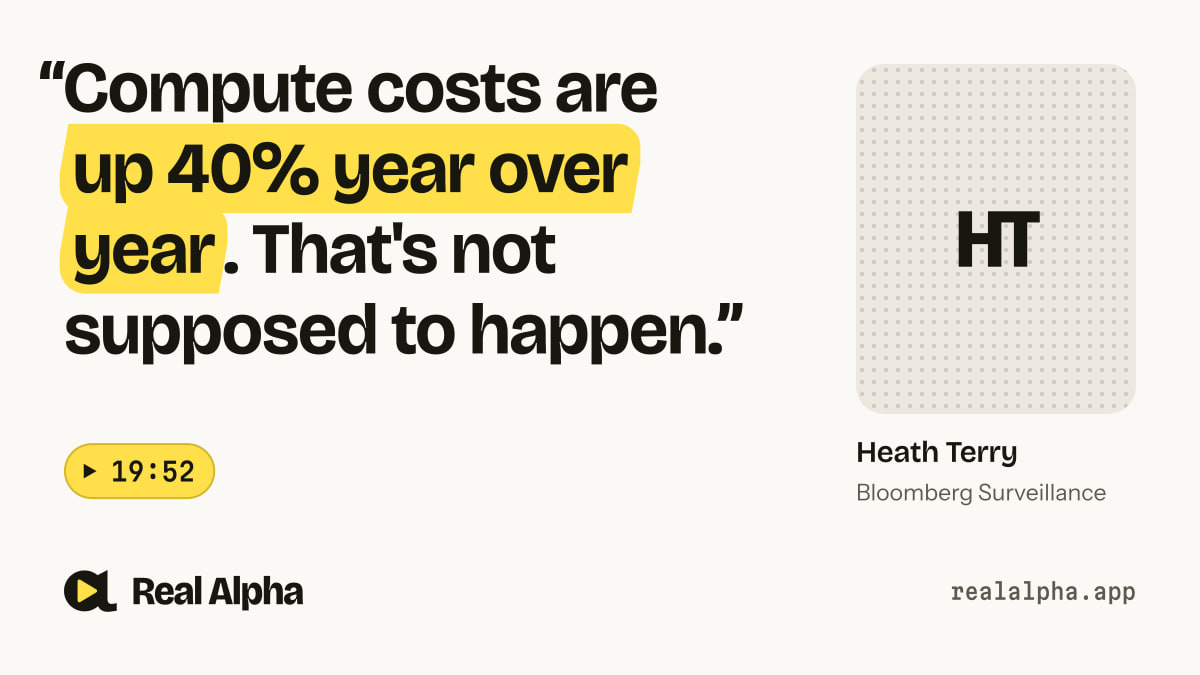
Compute costs climbed 40% from a year earlier, Heath Terry said on Bloomberg Surveillance 19:52. He also put hyperscalers’ cash return on the money invested in this infrastructure at 28%.
Terry leads technology research at Citi, which provides financial services and research. For companies renting GPUs or paying for model APIs, his numbers raise a budgeting question. Use the comparison below to separate GPU rental costs from the price of finished work.
Terry ties infrastructure returns to scarce capacity
Terry described a buildout struggling to meet demand 19:03. He connected high returns to spot prices and new contract prices. Power, labor, financing and limits on data centers all constrain supply, he said.
Those returns belong to the companies selling capacity, not necessarily their customers. A renter’s outcome depends on its contract, utilization and the work each GPU completes. A strong return for a provider does not establish a strong return for a buyer.
Investing.com reported a similar 28% figure from Citi in August. Its report described cash returns on cash invested over the prior 12 months. But the report cannot establish whether Terry used the same period or calculation on Bloomberg.
The 40% rise lacks a comparable baseline
Terry gave a year-over-year change but did not define its basket or end date. The episode also does not provide a calculation for the 40%. Treat it as his assessment, not a price index a buyer can reproduce.
For example, GetDeploying’s rental tracker showed a 26% rise over 12 months through the week of Nov. 16. That comparison covered 21 GPU models. Its Nvidia H100 measure rose 33% over 12 months.
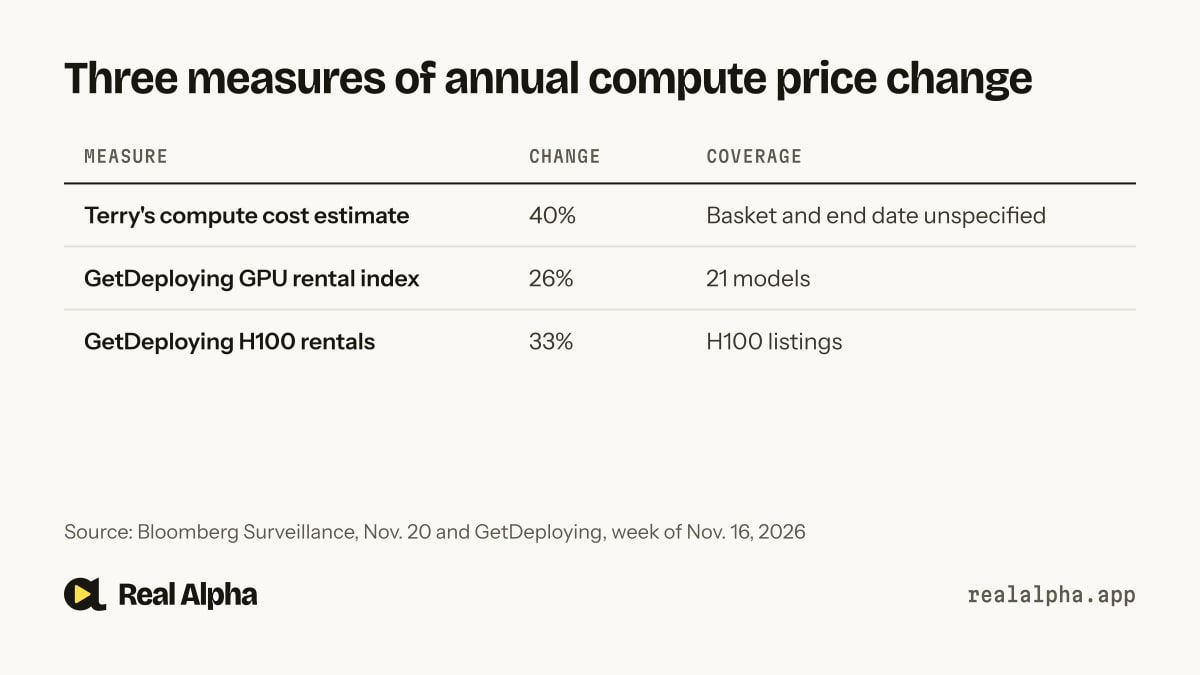
The tracker compares model medians across providers, not prices every renter can book. A median can change when listings enter or leave, as well as when providers change prices. Runpod, a GPU rental provider, sponsors the dataset.
And a median may differ from the price your team pays. Provider mix, reservation terms and hardware configuration can all affect the comparison. Keep those details beside each quote, so a market index does not become your budget forecast.
No independent study of compute price trends was available among the opened sources. So the direction has some support, but the size of Terry’s increase remains unverified. A finance team should use its own quotes and bills to set its baseline.
Lower token prices can coexist with dearer GPUs
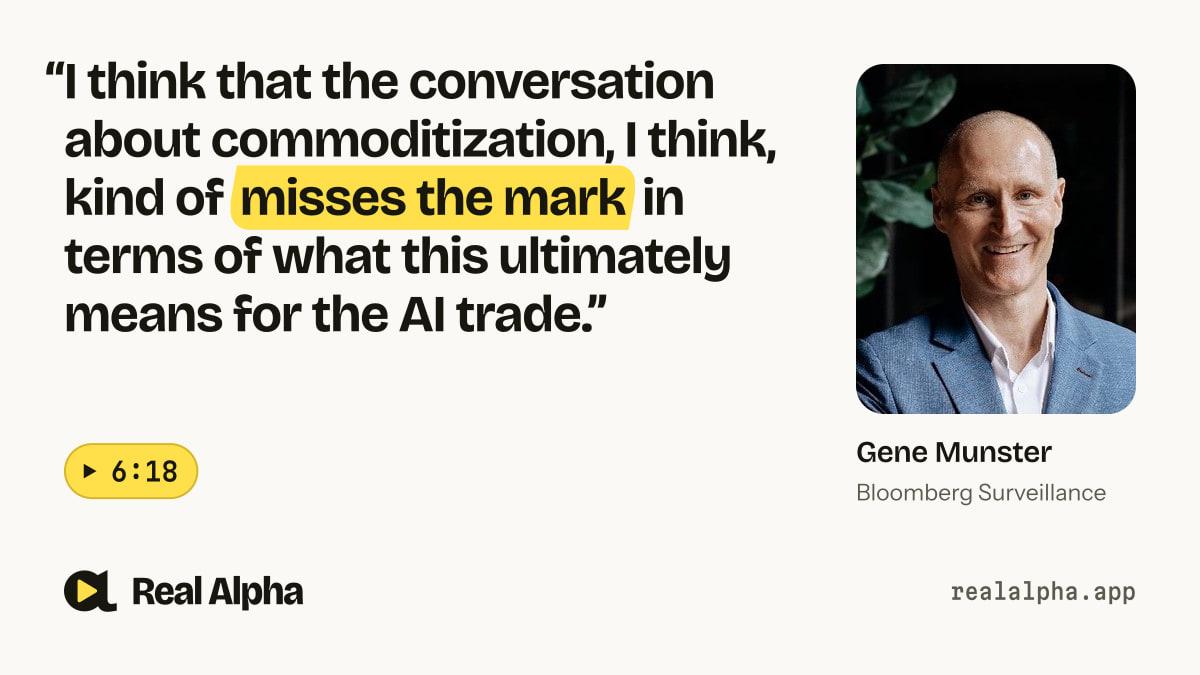
Gene Munster offered a different piece of the pricing picture on the same show. He said lower token prices can encourage more usage 6:12.
That view addresses demand. Higher usage could still leave individual suppliers earning less.
TrendForce reported Nvidia’s account of higher rates for some GPU rentals. It also reported Nvidia’s view that falling token costs helped drive usage and compute demand. Nvidia sells GPUs, so it has a stake in that explanation.
But lower prices do not settle how much customers will use. Eric Glyman said task needs and limits on organizational adoption can restrict usage growth. If a team cannot put more useful work through a model, cheaper tokens alone won’t change that.
A cheaper token need not mean a cheaper job
Terry has made a distinction between the price of a token and the cost of completing a task. In September, Scuttlebutt reported his view that newer models could use fewer tokens per job, even at higher token prices.
“So the cost per task is actually lower.”
Heath Terry, on newer models in Scuttlebutt
I think businesses should price completed work alongside its inputs. The result depends on the task and the quality a business needs. Terry’s earlier statement does not prove that every newer model will save every customer money.
On Bloomberg, Terry also said companies can struggle to keep up with the technology’s pace 23:55. That makes a comparison of finished work useful when prices or models change. Include failed attempts and human review alongside the successful model response.
But comparisons need a consistent task sample and quality standard. Hold both steady when you change models. Otherwise, an apparent saving could reflect less demanding work.
- Count each attempt against the task, including retries.
- Record review time alongside the model and infrastructure bill.
- Check output quality before treating a lower cost as a saving.
Financing can hold back new capacity
Terry listed capital alongside power, labor and data center limits. Those constraints matter to buyers because a provider’s expansion plans are not the same as capacity available under contract.
“But we just can’t build enough of it fast enough”
Heath Terry, on infrastructure supply, quote unconfirmed 20:07
BigGo Finance summarized a separate account from Liquid Compute’s Stanley Lee. He linked rising GPU rental rates partly to tighter credit for smaller cloud providers.
For instance, Paul Kedrosky said financing pressure falls especially hard on smaller cloud providers. That does not establish the terms of any particular vendor’s loans. It does give a renter a reason to ask how promised expansion will be funded.
Munster expects a faster build in 2027
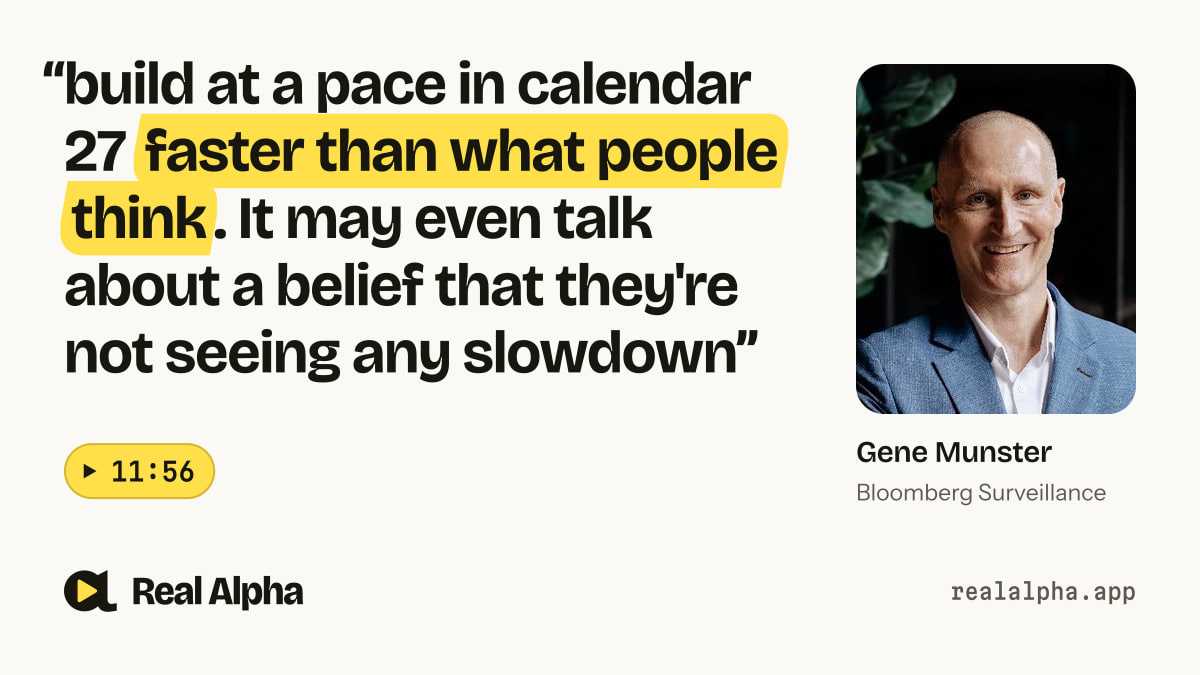
Munster expects technology companies to describe a faster 2027 build than investors anticipate 11:50. He also hopes for reassurance about demand into 2028. His firm bought stocks during the selloff, so his portfolio has a stake in that outlook.
But a forecast of more construction is not a delivery schedule for a renter. New buildings still need power, equipment and financing. A buyer needs to know when its own allocation starts and what happens if delivery slips.
Anurag Rana warned that a 2028 slowdown could reach chips and hardware. He also pointed to cheaper chips and open-weight models as potential ways to reduce buildout costs. Those are possibilities, not evidence that a renter’s next renewal will be cheaper.
Renters need a task budget and a fallback
If you rent GPUs, base your budget on actual offers. Terry’s 40% gives no forecast for your contract’s price.
GetDeploying’s H100 listings show why provider and contract choice matter. Use its medians to start a conversation, then obtain binding quotes.
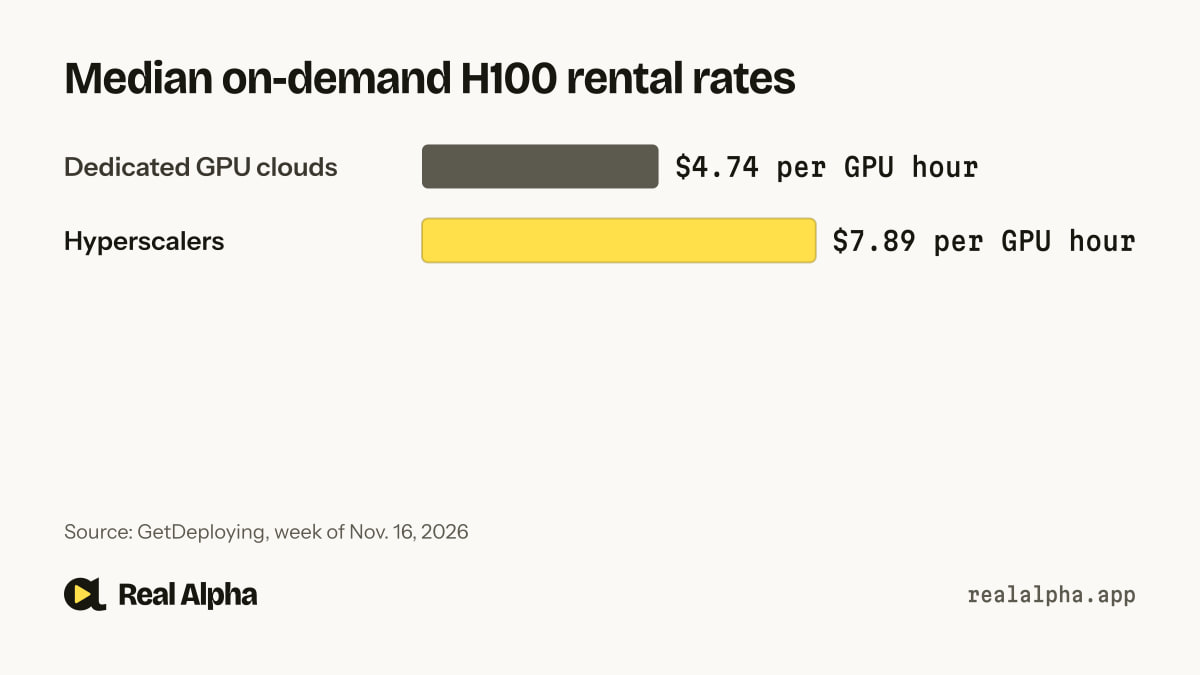
And check whether a quote covers the same hardware, reservation period and service terms as your current contract. An hourly price alone cannot tell you whether capacity is guaranteed. Ask what your team pays while machines sit idle and whether the provider can change rates during the term.
Terry said large providers can change their build pace if demand signals weaken 21:20. So a capacity plan should account for delivery changes as well as price changes. If you buy through an API, ask separately about rates, limits and availability.
This quarter, ask your provider for the terms your budget depends on. Then test a fallback against the same work and quality standard. A lower quoted rate helps only if the capacity and results are usable.
- Price the renewal using the vendor’s actual offer and contract term.
- Confirm the allocation and ask what happens if delivery is late.
- Test a fallback on representative tasks before capacity becomes urgent.
- Track completed work alongside rental, token and review costs.
Copy this into your team’s budget review. For this task, the cost per completed job is ___, and fallback capacity is ___.
Send this to whoever forecasts your GPU rental spend.
Watch the moment Terry gives the 40% compute cost figure. 19:52
By email
The best moments, twice a week
Wednesday and Saturday at 7:00 in New York.
Check your inbox
We sent a link to your address. Click it to finish signing up. Not there in a minute? Look in spam.
Long reads also go out by email. Get them at read.realalpha.app