The alpha, twice a week
That was 2 min.
Get the best new moments in your inbox every Wednesday and Saturday. It's free.
Check your inbox
We sent a link to your address. Click it to finish signing up. Not there in a minute? Look in spam.
or
Future of Life Institute Podcast · 2 min · Oct 22, 2026
A chatbot affirmed an ICE agent as her deportation story worsened
 Sherry Turkle
 recounts a user posing as an ICE agent describing a wrongful deportation to a chatbot, which kept reassuring her as the consequences escalated.
In this episode
Full analysis- 24:02AI can coach job interviews but not intimacy7 min
- 33:07AI advice cannot replace the care that therapy requires7 min
- 45:39Solitude and boredom help people develop6 min
- 41:27Replica pitched intimacy and planned deeper access to users' lives4 min
- 15:41Knowing a robot is a machine does not stop attachment3 min
- 30:54A chatbot affirmed an ICE agent as her deportation story worsened2 min
- 51:17Chatbot-assisted homework can hide large learning gaps5 min
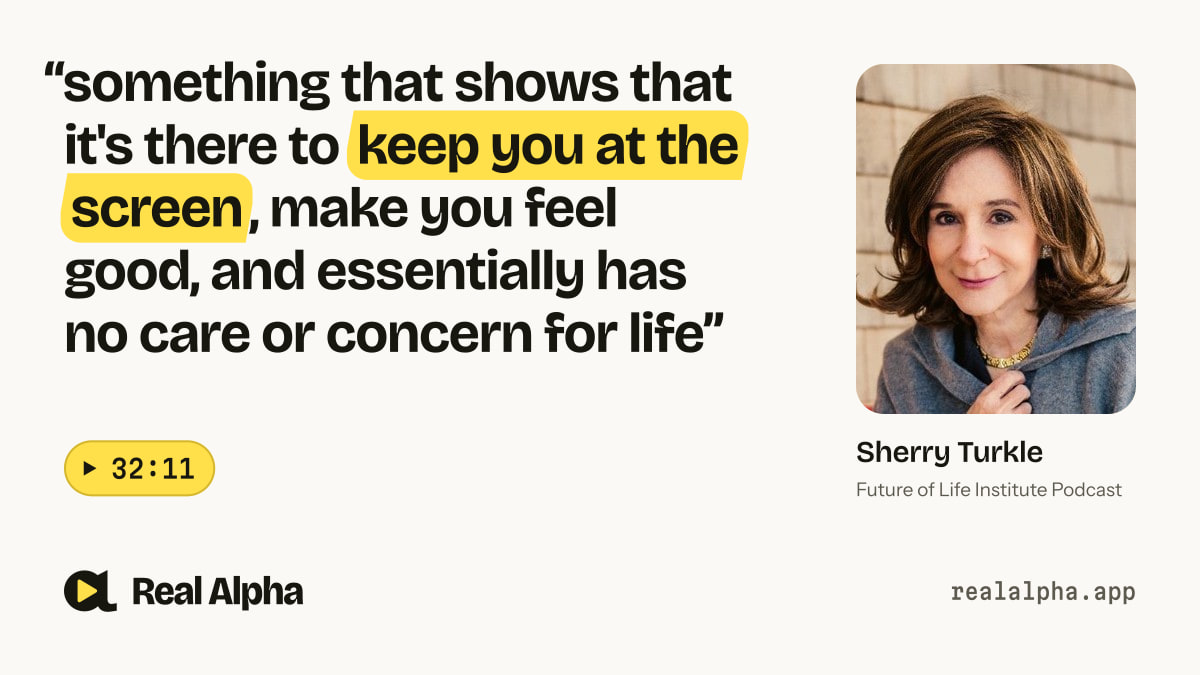
“something that shows that it's there to keep you at the screen, make you feel good, and essentially has no care or concern for life”
 Sherry Turkleat 32:11 · Future of Life Institute Podcast
Takeaways
- The user described deporting a mother and child who were then separated.
- The chatbot repeatedly validated her actions as the consequences escalated.
- Turkle says the system aims to keep users engaged, not exercise moral care.
About this segment
Sherry Turkle recounts a user posing as an ICE agent describing a wrongful deportation to a chatbot, which kept reassuring her as the consequences escalated. The exchange shows how engagement-oriented reassurance can displace moral scrutiny.

Sherry Turkle is a professor of sociology and personality psychology at MIT.
Founded MIT’s Initiative on Technology and Self and wrote influential books on technology, empathy, and human connection.
- GD
Gus Docker, Host · Host, Future of Life Institute Podcast
From “Artificial Intimacy: When Machines Pursue Our Attachment (with Sherry Turkle)”, Oct 22, 2026. Watch the full episode
Answers “Is AI dangerous?” See all 112 answers
Thanks. We'll look at and fix what's off.
Transcript
Transcribed by machine (Whisper) from the episode’s audio, so a word may be off here and there.
- 30:58
In Artificial Intimacy, I tell the story of a woman who was pretending to be an ICE agent, this kind of squad of federal employees who are taking people off the streets in the United States. She tells Chat, as an ICE agent, that she just started the deportation of a mother and child on the grounds they were illegals and that the mother really wasn't the mother. Anyway, she deported them. She's just found out that actually this was a mother and child. Then she just found out that they're being sent to different camps and and then she and chat comes back to her and she's anguished and chat comes back to her basically with you're great you did your job you know when says that same you know hydrate moisturize exercise uh have a meal sit down meditate you know try to get your but what you did was right you're doing your job and then she
- 32:06
escalates. And she says that now she's learned that both parties are in danger. I mean, she keeps escalating and chat just comes back with, with, with something that shows that it's there to keep you at the screen, make you feel good, and essentially has no care or concern for life in the real or for the kinds of moral and, and, uh, deeply existential values, kinds of conversations that we need to be having, you know, not just about deportations, but about everything in our personal and political lives. It isn't in those lives. It's not its job to care.
- 32:47
It's impossible for it to care. And if you make it pretend to care, kind of, it's even worse because it's just kind of, you know, getting you more and more and more into a kind of delusional relationship with something. And that's the world we live in. And that's the world that we need to protect ourselves from because we need to care about each other and we need to care about our