The alpha, twice a week
That was 3 min.
Get the best new moments in your inbox every Wednesday and Saturday. It's free.
Check your inbox
We sent a link to your address. Click it to finish signing up. Not there in a minute? Look in spam.
or
Future of Life Institute Podcast · 3 min · Oct 22, 2026
Knowing a robot is a machine does not stop attachment
 Sherry Turkle
 recounts an experiment that stripped features from an MIT robot and then restored them; children returned to treating it like a person.
In this episode
Full analysis- 24:02AI can coach job interviews but not intimacy7 min
- 33:07AI advice cannot replace the care that therapy requires7 min
- 45:39Solitude and boredom help people develop6 min
- 41:27Replica pitched intimacy and planned deeper access to users' lives4 min
- 15:41Knowing a robot is a machine does not stop attachment3 min
- 30:54A chatbot affirmed an ICE agent as her deportation story worsened2 min
- 51:17Chatbot-assisted homework can hide large learning gaps5 min
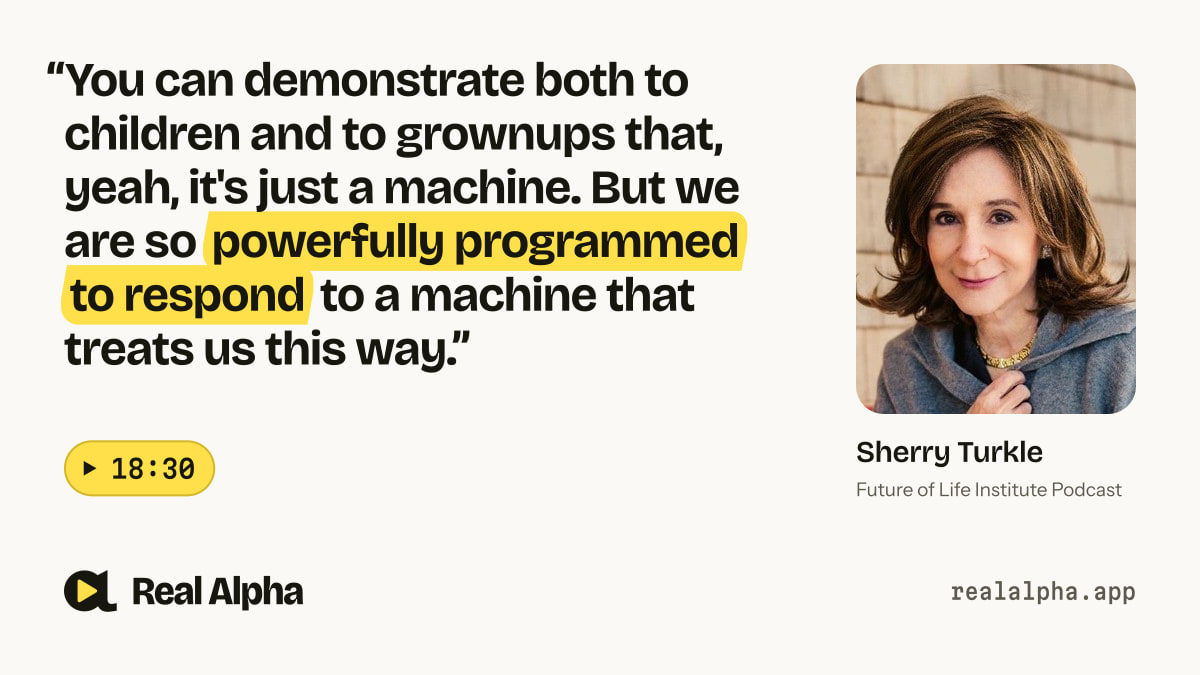
“You can demonstrate both to children and to grownups that, yeah, it's just a machine. But we are so powerfully programmed to respond to a machine that treats us this way.”
 Sherry Turkleat 18:30 · Future of Life Institute Podcast
Takeaways
- Children lost interest when the robot's lifelike features were removed.
- Restoring its responsiveness brought the children's attachment back.
- Knowing it's a machine doesn't undo the pull of lifelike interaction.
About this segment
Sherry Turkle recounts an experiment that stripped features from an MIT robot and then restored them; children returned to treating it like a person. Knowing a device is a machine did not stop the emotional response.

Sherry Turkle is a professor of sociology and personality psychology at MIT.
Founded MIT’s Initiative on Technology and Self and wrote influential books on technology, empathy, and human connection.
- GD
Gus Docker, Host · Host, Future of Life Institute Podcast
From “Artificial Intimacy: When Machines Pursue Our Attachment (with Sherry Turkle)”, Oct 22, 2026. Watch the full episode
Thanks. We'll look at and fix what's off.
Transcript
Transcribed by machine (Whisper) from the episode’s audio, so a word may be off here and there.
- 15:44
Do children also have this dual consciousness? Do they understand that a chatbot they're interacting with is a different thing than interacting with mom or dad or grandma? Well, in my book, I quote many children who just start to see the chatbot as, you know, what's the difference between the chatbot and the person? I've been studying this for decades. And in the beginning, playing with or talking to an electronic toy or game or robot or robot pet, there was a tremendous amount of discussion. Is it alive? Is it not alive? What do you do with it? Now we live in a culture where those conversations have kind of stopped because the media and the world is so filled with objects on screens and interactive objects on screens that the kids now behave like the elderly. And they just say, oh, a robot, bring it
- 16:36
on. Now they know if you push them that, well, I guess I can see ways in which this dog is not like my robot dog is not like a biological dog. It loses its philosophical or emotional grip on them to even have that conversation. It's like, bring it on. And if one robot breaks, there'll be another one. And there'll always be a robot kind of attitude. There'll always be another avatar, there'll always be another chatbot. And I did an experiment with a great roboticist, Brian Scazzolotti, who was at MIT at the time. And he had built a robot called COG that the kids really glommed onto because it reached out to them. It tracked their motion. It knew where they were in the room. They felt that it remembered them and cared for them. And they really thought it was alive and cared for it. And Brian, who was a very, really responsible, he was interested in
- 17:35
the ethics and responsibility of robots, said, you know what we're going to do? I'm going to turn off one by one, all of the things that make this robot kind of lifelike. And when we do that, if we do that as kind of training for children, children will come to understand that they're talking to a machine and they will stop treating it as though it were a person. So he turned one thing off and another thing's off. He turned off the vision. He turned off the movement tracking.
- 18:05
He turned off the responsiveness until it was basically a tinker toys, you know, moving tinker toys. And then children lost interest. They walked away and then gradually he turned it on again. But then it was all on and the children went back to it as though it were a person again. And what we both got out of that is that it's not so simple as just telling people it's just a machine. It's just a machine.
- 18:34
You can demonstrate both to children and to grownups that, yeah, it's just a machine. But we are so powerfully programmed to respond to a machine that treats us this way. That it doesn't matter. And that's why we face such a moment of reckoning, because we are so tempted to take these objects that are just machines and treat them as though they're people.