The alpha, twice a week
That was 7 min.
Get the best new moments in your inbox every Wednesday and Saturday. It's free.
Check your inbox
We sent a link to your address. Click it to finish signing up. Not there in a minute? Look in spam.
or
Knuckle Up with Nakul · 7 min · Nov 10, 2026
A contested sale forced Twitter into a dual operating reality
 Parag Agrawal
 recounts planning layoffs as takeover talks and the war in Ukraine hit Twitter at once, then running the company as if the deal might fail.
In this episode
Full analysis- 39:02Agents need search built for different inputs and latency5 min
- 19:01A CEO should shape the company around how they lead3 min
- 51:41Agent-scale web access needs a way to pay for contentPro pick 7 min
- 25:57A contested sale forced Twitter into a dual operating reality7 min
- 33:20Agents' expected web use became the thesis for Parallel6 min
- 16:34He left ads after forecasting growth would stall below 100 million DAU3 min
- 58:50Agrawal expects agents to shift the web from pull to push3 min
- 1:15:04He hires for potential, then looks for proven outlier-team builders3 min
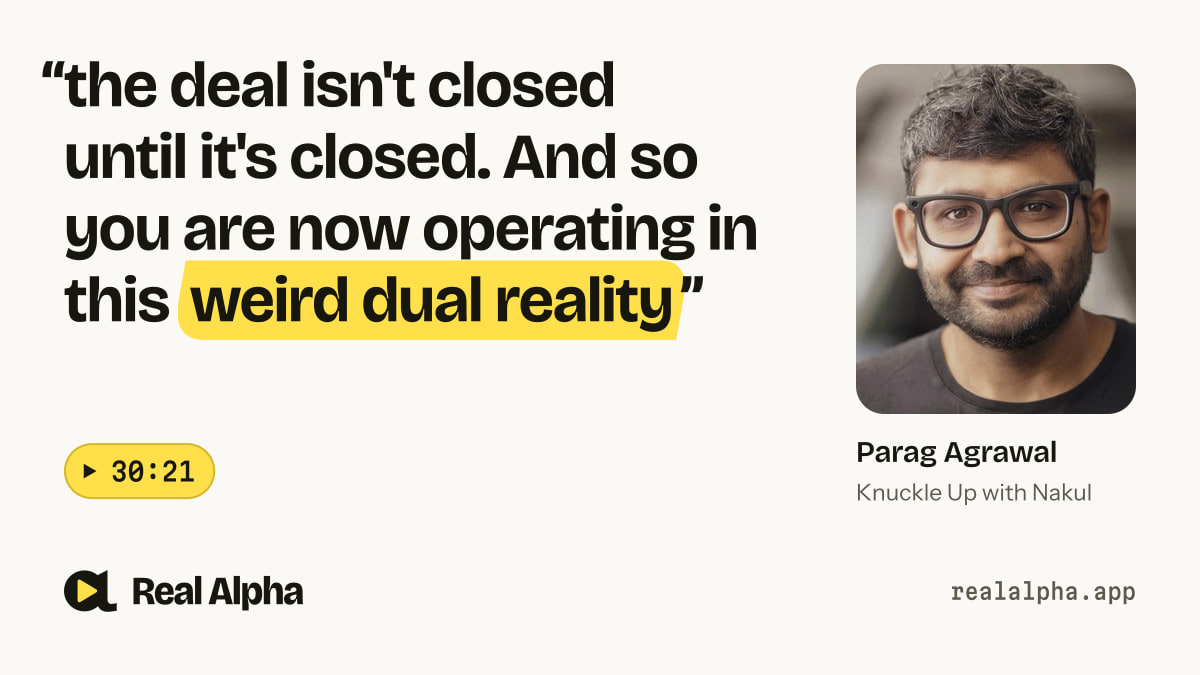
“the deal isn't closed until it's closed. And so you are now operating in this weird dual reality”
 Parag Agrawalat 30:21 · Knuckle Up with Nakul
Takeaways
- He planned layoffs while takeover talks were developing.
- After signing, he kept shipping and managing performance amid uncertainty.
- The deal left him balancing fiduciary duties with running the business.
About this segment
Parag Agrawal recounts planning layoffs as takeover talks and the war in Ukraine hit Twitter at once, then running the company as if the deal might fail. The uncertainty made long-term planning difficult while teams kept shipping.

Parag Agrawal is Founder of Parallel Web Systems.
Founded Parallel Web Systems, which builds agentic web search for AI agents; former Twitter CEO.

Nakul Mandan, Host · Host, Knuckle Up with Nakul
General partner at Audacious Ventures; his show goes deep with founder CEOs on how they build.
From “Ex-Twitter CEO's $2B bet on search for AI agents | Parag Agrawal (Founder of Parallel)”, Nov 10, 2026. Watch the full episode
Thanks. We'll look at and fix what's off.
Transcript
From the transcript Knuckle Up with Nakul publishes with the episode.
- 25:59
Running the public town square of the world, Elon's takeover bed, the ups and downs of it. Unless I was interested in the news story there, the sensationalism more like the operator. How was it to lead through that phase of six to 12 months when the takeover is happening not happening? Elon is tweeting all about it. How did you manage to lead the team and what was going through your own inner game as a CEO then?
- 26:28
So I actually think I think the real interesting operating period was perhaps prior to signing the merger agreement, right? Through that period, we were operating on what my plan would be, which was in fact planning a, I think this is like data that's public and it's out there on the proxy statements that we were planning a significant reduction in force layoff at the company. In parallel, there was a public conversation brewing around potential takeovers in the media, which was a little bit off reality.
- 27:09
And then a private conversation brewing with the other side around whether that was likely and whether that was real, right? And so that few weeks of navigating these multiple things... And simultaneously operating in an intense period, like the other thing that was happening then was like the war in Ukraine had just started, right? Which was causing the entire business to evolve, right? So you're navigating that reality, the business implications, the layoff plans, and a potential two-sided M&A conversation all at the same time.
- 27:52
In a way, all of these were Some of these were my proactive plans. But then there was this confluence of multiple things coming at us all at the same time. So that one month was perhaps the most interesting or intense. In that period, you do learn a lot. Like I learned about public company M&A and all of the things around it in a way that I wouldn't have known. But I think... Once the merger agreement was signed, it was perhaps not interesting.
- 28:32
I think there again, right, it takes a period to close. We found ourselves in a little bit of no man's land. It's no man's land because you can't paint the long-term visions. Especially in a case where there isn't deep cooperation on the two sides, which fell apart within a week, right? So now, the best way to run a company is to have a long-term plan and an ambition and a vision and a collection of steps that get you there, that put you on the path to learning.
- 29:08
Like, that's the only thing I know, right? And once you take away your capability to credibly describe... A long-term ambition, vision, future for the company. That's a hard operating environment, right? And you had lawyers on almost every decision knowing that this was looking like a contested moment. Now, credit to the leadership team there. Twitter continued operating well. We managed, despite the uncertainty, every advertisers feeling the uncertainty and wondering if they should pull out.
- 29:53
Our teams managed to not let that happen through this period of uncertainty. We shipped a lot of valuable things in that period that I'm proud of. We managed to do a lot of performance management in letting people who were not performing go through that period through rigorous management. Because the framework is like, the deal isn't closed until it's closed. And so you are now operating in this weird dual reality of, listen, we are committed to closing this deal and we'll put in every effort in the court of law to make sure it closes.
- 30:39
And simultaneously, we are operating like it won't. Because one day, we might be on our own, and we have to have momentum, we have to have great people, we have to be shipping things, we have to have product velocity. And so you're now... And I could keep these two contradictory things in my mind.
- 31:00
It is very hard to have thousands of people... Operate in this sort of weird dual reality. So how are you communicating that?
- 31:14
Because I agree that dual reality seems like extremely tough. And it's kind of also maybe not a replicable thing. I don't know if there are any lessons that you can take to parallel from that.
- 31:25
No, I think there are base level lessons you can take, right? I think I generally was to the extent possible. I was honest and direct with people. You can actually go see what I was doing because every time I did a lot of all hands through this period where the entire company got to ask me questions, I did several of them and they all leaked, right? Like there was media in every one of them. And so, yeah, that's...
- 32:03
It's just a weird environment. I think the lessons you take away from that are sometimes you don't have agency on certain things. Fiduciary responsibility takes over. I was not born to be only a fiduciary. But I think at some point that's what that job became. When I took the job, I didn't I didn't think it was likely that that's what the job would become. And if you told me that's what I was signing up for, it was like a primarily fiduciary for a period.
- 32:36
That's like not the most exciting thing when you're trying to build for a positive sum game To end up in this sort of zero sum contested M&A transaction, even if that's the best return in the board's view for the shareholders. Yeah, so I think it was not necessarily... So, Something you can take a lot of lessons from. Doing right by people, like all the people that I worked with whether or not we made hard decisions with them.
- 33:08
I feel pretty good that today if you go talk to them, people who were at least close to me and even a few steps removed from me think I conducted myself in a way that I'm proud