The alpha, twice a week
That was 3 min.
Get the best new moments in your inbox every Wednesday and Saturday. It's free.
Check your inbox
We sent a link to your address. Click it to finish signing up. Not there in a minute? Look in spam.
or
Knuckle Up with Nakul · 3 min · Nov 10, 2026
He hires for potential, then looks for proven outlier-team builders
 Parag Agrawal
 separates hiring for potential from hiring leaders who have already built teams of outliers.
In this episode
Full analysis- 39:02Agents need search built for different inputs and latency5 min
- 19:01A CEO should shape the company around how they lead3 min
- 51:41Agent-scale web access needs a way to pay for contentPro pick 7 min
- 25:57A contested sale forced Twitter into a dual operating reality7 min
- 33:20Agents' expected web use became the thesis for Parallel6 min
- 16:34He left ads after forecasting growth would stall below 100 million DAU3 min
- 58:50Agrawal expects agents to shift the web from pull to push3 min
- 1:15:04He hires for potential, then looks for proven outlier-team builders3 min
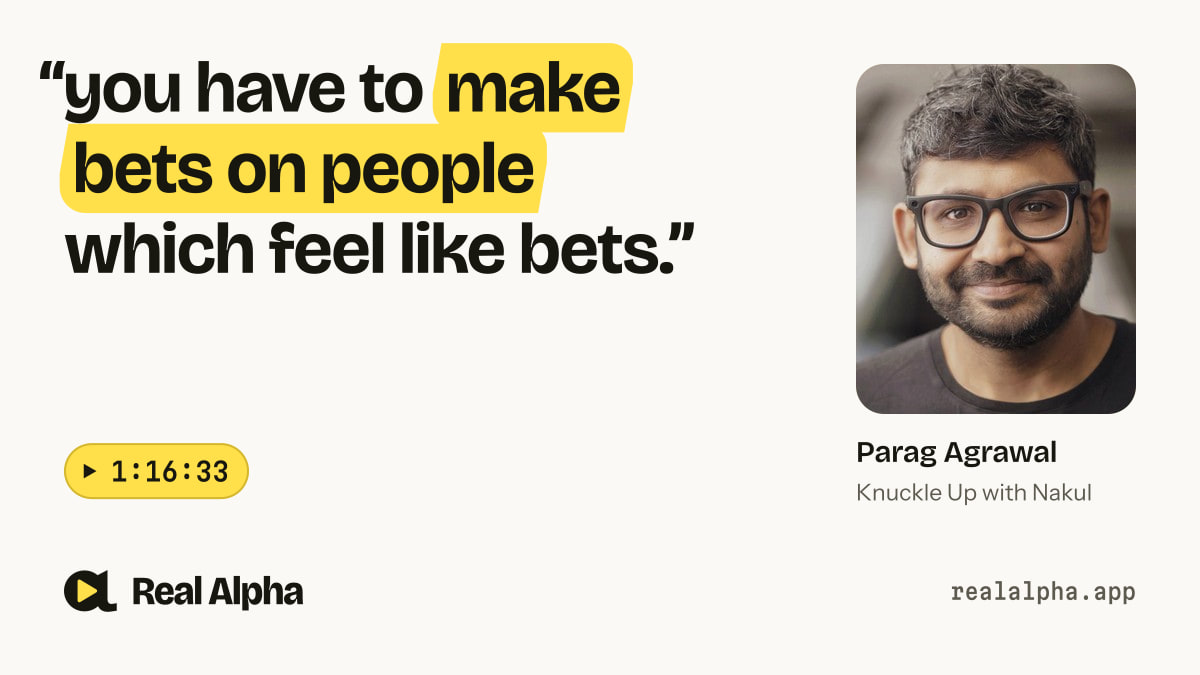
“you have to make bets on people which feel like bets.”
 Parag Agrawalat 1:16:33 · Knuckle Up with Nakul
Takeaways
- Hire some people for potential, not just a repeat of past roles.
- Look for team builders with evidence of leading exceptional outliers.
- Build roles around people rather than slicing up a fixed org chart.
About this segment
Parag Agrawal separates hiring for potential from hiring leaders who have already built teams of outliers. He says bespoke teams can work, but require flexibility from both leaders and hires.

Parag Agrawal is Founder of Parallel Web Systems.
Founded Parallel Web Systems, which builds agentic web search for AI agents; former Twitter CEO.

Nakul Mandan, Host · Host, Knuckle Up with Nakul
General partner at Audacious Ventures; his show goes deep with founder CEOs on how they build.
From “Ex-Twitter CEO's $2B bet on search for AI agents | Parag Agrawal (Founder of Parallel)”, Nov 10, 2026. Watch the full episode
Thanks. We'll look at and fix what's off.
Transcript
From the transcript Knuckle Up with Nakul publishes with the episode.
- 1:15:06
You talked about hiring for two types of alpha when we were chatting before this. So can you double click on that? Like what's your philosophy on what you look for?
- 1:15:16
Yeah. So listen, this is like goes back to Twitter days, at least my biases is I always thought of, listen, like when you are the person that wants to get hired to do jobs that You're not entirely deserving of. And if you decide that for yourself, that is the best way to maximize your career, your prospects, your impact, whatever you might want to do it. Then you have to simultaneously believe that you only want, you want to be able to hire those people, right?
- 1:15:53
Like if there is someone, I have to figure out the best people I believe will want
- 1:16:02
To be hired for things that are a challenge. If they have been there, done that, do they want to do that thing again? Or do they want a new challenge which will push them on a journey to learn and grow and do something that will give you the satisfaction saying like, oh, going into this, I didn't know that I could do this or we could do this. Doesn't it feel great when you do it?
- 1:16:28
So you look for more potential rather than they've done the job. Correct. So that is what you mean by alpha, right? Like you have to make bets on people which feel like bets. But now if you're in the business of hiring a lot of people where you're just making bets, right? You are mostly hiring some form of outliers. Now you also have to pull the team together, a team of outliers together, right? And so now you have to ask the question, Who are the people who are exceptional at building these unique, weird teams where you have bet on potential?
- 1:17:10
And there I at least find that I want to see on that dimension evidence that they have done that. They have worked with teams of exceptional outlier people who aren't Of the type of been there, done that and created an environment where they can all do their best work and grow and learn, which is not like default, like management best practices, but like creating sort of these special teams that create this special moments, right? So you hire people who've done that, but then you challenge them by my principle on a different dimension, which they might not have encountered, right?
- 1:17:53
So that's sort of how you build teams. But I think it's fundamentally a slightly non-scalable way of thinking about team building, where you're trying to take bespoke... Individuals and creating something out of that instead of saying like, oh, I have this thing, I'm going to cut it up, divide up roles and responsibilities, which requires a different kind of agility in leaders or managers, different kind of agility and plasticity among the people who show up and do this.
- 1:18:21
But I think that's what the early special teams are built off. Yeah.