The alpha, twice a week
That was 6 min.
Get the best new moments in your inbox every Wednesday and Saturday. It's free.
Check your inbox
We sent a link to your address. Click it to finish signing up. Not there in a minute? Look in spam.
or
Knuckle Up with Nakul · 6 min · Nov 10, 2026
Agents' expected web use became the thesis for Parallel
 Parag Agrawal
After Twitter, Parag Agrawal built agents as a hobby and became convinced they could use the web 1,000 times more than people.
In this episode
Full analysis- 39:02Agents need search built for different inputs and latency5 min
- 19:01A CEO should shape the company around how they lead3 min
- 51:41Agent-scale web access needs a way to pay for contentPro pick 7 min
- 25:57A contested sale forced Twitter into a dual operating reality7 min
- 33:20Agents' expected web use became the thesis for Parallel6 min
- 16:34He left ads after forecasting growth would stall below 100 million DAU3 min
- 58:50Agrawal expects agents to shift the web from pull to push3 min
- 1:15:04He hires for potential, then looks for proven outlier-team builders3 min
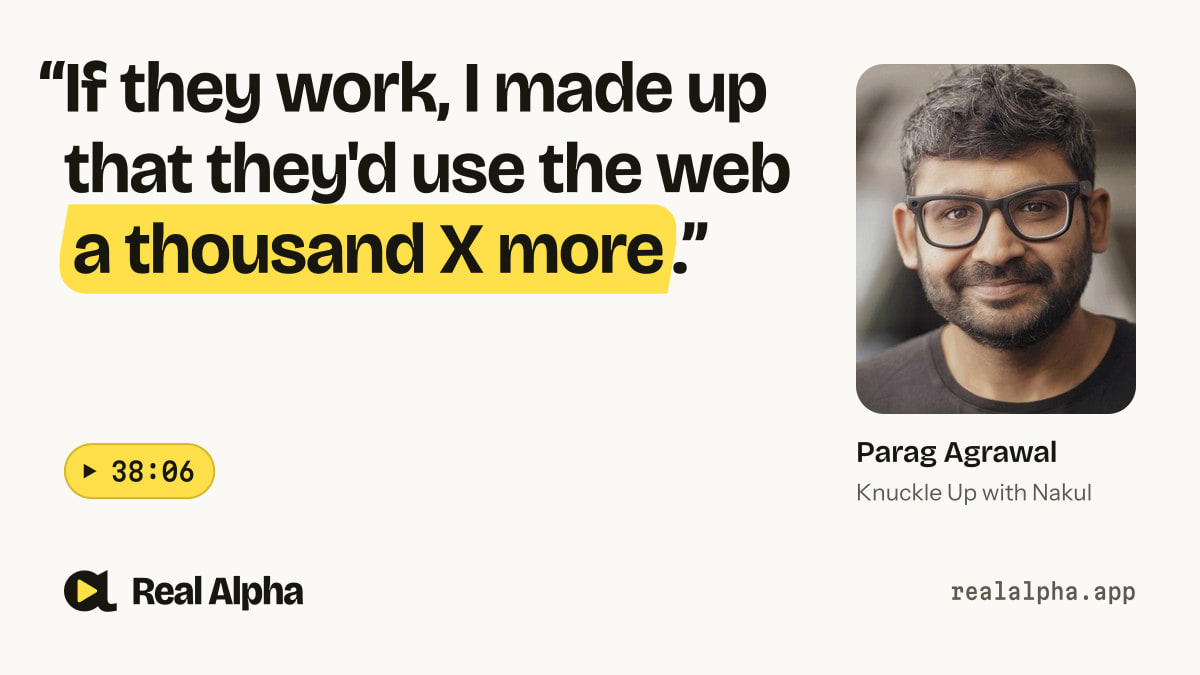
“If they work, I made up that they'd use the web a thousand X more.”
 Parag Agrawalat 38:06 · Knuckle Up with Nakul
Takeaways
- After Twitter, he wanted a small team and hands-on technical work.
- A hobby agent drew him away from other ideas.
- He expected agent success to demand new web technology and economics.
About this segment
After Twitter, Parag Agrawal built agents as a hobby and became convinced they could use the web 1,000 times more than people. That thesis led him to start Parallel around new search infrastructure and business models.

Parag Agrawal is Founder of Parallel Web Systems.
Founded Parallel Web Systems, which builds agentic web search for AI agents; former Twitter CEO.

Nakul Mandan, Host · Host, Knuckle Up with Nakul
General partner at Audacious Ventures; his show goes deep with founder CEOs on how they build.
From “Ex-Twitter CEO's $2B bet on search for AI agents | Parag Agrawal (Founder of Parallel)”, Nov 10, 2026. Watch the full episode
Answers “What will AI look like in the next few years?” See all 197 answers
Thanks. We'll look at and fix what's off.
Transcript
From the transcript Knuckle Up with Nakul publishes with the episode.
- 33:23
You told me earlier you had never planned to be a founder, right? Till that moment. So what post Twitter, what went through your mind? I think you went quiet for a couple of years almost. What went through your mind? Why be a founder at the age of 40? 40 is young. Why be a founder? I don't know. So a couple things.
- 33:50
When I took the CEO job at Twitter, It was like a real process, right? Like you have a bunch of interviews with the board. You have to think about what you're going to build, what your vision is, what your ambition is. It is like real intense six to eight weeks prior to announcing of intense work. And in that work, what at least my process was like,
- 34:15
I put a lot of fuel into myself and a lot of energy. Like you like load yourself up with like energy to go for Before you get to refuel again, it's going to be like five to seven years and you're going to go all in and do everything you have because that's what it will take to transform this already large consequential thing into something it could be or should be, right? So now you have all of a sudden all of this unspent fuel sitting around without a clear output channel for it.
- 34:48
Like which way do I point this thing, right? Like I... Put all of it in over this intense period. Now I have all of this reserve. What do I do with it? And I was pretty open-minded initially, but I was hacking and building. I've said before, it's a good time to be a technical person who was unemployed. It was as good a year as one you could choose to be in that position. In that position, it felt like the world was about to change and transform.
- 35:27
And whenever I looked at working in places, it felt to me that one, I wanted to work with like a small number of people. Like this whole desire of like special small number of people that I get to choose, that was almost the most important criteria. Two, something technically hard. I want it to be much more technical again. I think you lose a little bit of touch, even if you try really hard, to the technical work.
- 36:03
If you're in a large place as a senior executive, you can allocate only so much of your time to it. And... I really want it. Like I'm starting to write a bunch of code again. I was really enjoying it. Being in the weeds on like just technically solving problems with my own hands in like a real way. And so like all the big jobs felt to me like they didn't like they didn't pull me in. And so I relatively quickly realized like maybe two, three months that like I would have To become a founder.
- 36:42
But then, it was not clear what I wanted to do. What convinced you on this idea? I think the idea found me. I was... Perhaps like I wasn't proactively looking for this idea. I was proactively perhaps looking for other ideas running in other dimensions. And this was like the side hustle, which was just like my hobby or fun, like write fun code. And then, you know, you're trying to understand various markets and dynamics and finding a point of view on various things.
- 37:11
And, you know, I'm the engineer who ended up being like, okay, I'm going to actually write an agent to make my life and doing so easier. And at the time, agents didn't work. We were on pretty bad models. But I found myself spending more time doing that rather than actually doing the work I signed myself up to do. And then over time, this thing became an obsession of sorts. And then you start thinking about like, oh, these are all the problems I see.
- 37:43
But really, what will happen if agents work? They don't work yet. What does it take to make them work? If they work, what happens? What happens to the web if they work? And it started to germinate that like agents will eventually work. I'd spent a lot of time with like labs and researchers through this journey that like I was a believer that models will keep getting better. Agents will work. If they work, I made up that they'd use the web a thousand X more.
- 38:15
And if that happened, you'd have to invent new technology. It was really exciting. New business models, really exciting. And it felt like I had extraordinary confidence in that moment that this was just going to happen. And it was like, to me, it felt in that moment obvious. When I spoke to others, it didn't yet feel obvious. So the same trick of, oh, Twitter needs machine learning in the consumer product.
- 38:45
Because like, how else do you use people's time most effectively when they choose to spend five minutes on Twitter and show them the most relevant, fun stuff? It felt obvious it wasn't happening. This thing felt similarly obvious. Yet others around me didn't believe me by and large.