The alpha, twice a week
That was 3 min.
Get the best new moments in your inbox every Wednesday and Saturday. It's free.
Check your inbox
We sent a link to your address. Click it to finish signing up. Not there in a minute? Look in spam.
or
Knuckle Up with Nakul · 3 min · Nov 10, 2026
Agrawal expects agents to shift the web from pull to push
 Parag Agrawal
He expects people to do most web work through agents, with proactive systems monitoring changes instead of waiting for queries.
In this episode
Full analysis- 39:02Agents need search built for different inputs and latency5 min
- 19:01A CEO should shape the company around how they lead3 min
- 51:41Agent-scale web access needs a way to pay for contentPro pick 7 min
- 25:57A contested sale forced Twitter into a dual operating reality7 min
- 33:20Agents' expected web use became the thesis for Parallel6 min
- 16:34He left ads after forecasting growth would stall below 100 million DAU3 min
- 58:50Agrawal expects agents to shift the web from pull to push3 min
- 1:15:04He hires for potential, then looks for proven outlier-team builders3 min
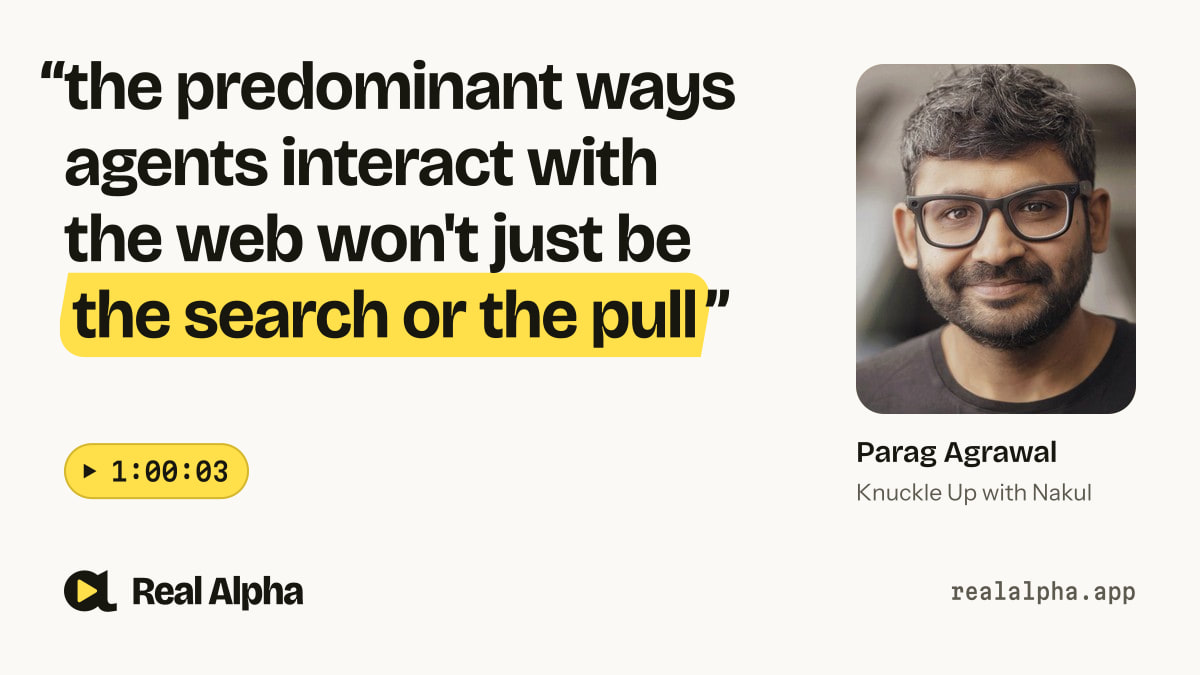
“the predominant ways agents interact with the web won't just be the search or the pull”
 Parag Agrawalat 1:00:03 · Knuckle Up with Nakul
Takeaways
- Agents may shift from fetching answers to monitoring what changes.
- Context could let web systems push relevant updates to users or companies.
- He cites early always-on, proactive agents as the first signal.
About this segment
He expects people to do most web work through agents, with proactive systems monitoring changes instead of waiting for queries. Always-on agents are the signal he sees for that shift.

Parag Agrawal is Founder of Parallel Web Systems.
Founded Parallel Web Systems, which builds agentic web search for AI agents; former Twitter CEO.

Nakul Mandan, Host · Host, Knuckle Up with Nakul
General partner at Audacious Ventures; his show goes deep with founder CEOs on how they build.
From “Ex-Twitter CEO's $2B bet on search for AI agents | Parag Agrawal (Founder of Parallel)”, Nov 10, 2026. Watch the full episode
Answers “What will AI look like in the next few years?” See all 197 answers
Thanks. We'll look at and fix what's off.
Transcript
From the transcript Knuckle Up with Nakul publishes with the episode.
- 58:53
I'm curious for your take on three, four years out to the extent we can predict anymore. It's a crazy time to make any kind of predictions. What does the internet look like or what does our world look like in three years? Do we only talk to agents, never go to, you know, a website really other than maybe social media like Instagram?
- 59:13
Yeah, I think we spend most of our interactions with the web as we think of it today happen via agents. I think we continue to use experiences online. Those experiences perhaps don't really look like a traditional HTML website loading. They perhaps look a little bit more like a app, perhaps with more AI blended into it. But I think there is the, it would be rare-ish to go to the web to do work. Right?
- 59:50
So you'd go to the web for what I'd call experience or connection, some of these other needs. I think the biggest thing that to me feels, again, totally obvious about the future three, four years out is the predominant ways agents interact with the web won't just be the search or the pull, as I call it, like agents pulling information from the web. And will transform into a push where your web system like Parallel will have enough context to know what you are interested in.
- 1:00:31
You're kind of subscribed to a feed or a push stream which tells you this is what just changed in the world which now requires your agent to To do some computation to bring something to you the person or you the company. So this transformation of the web from pull to push I think is what we start seeing. And I think until a few months ago there were no agents which felt like they were always on and proactive.
- 1:01:08
Now we are starting to see the very first set of agents which are creating this Abstraction for you or an expectation for you that they are always on, they're proactive, and they're trying to know from your data and learn from their interactions with you what you might care about and go bring those to you proactively, right? I think if this plays out in the way I imagine that The web has to change to go from this sort of pull to a push model.
- 1:01:45
And that I think is what I'm really excited about. That is the singular thing that we think we will end up building. Do you think Google is toast in this new world?