The alpha, twice a week
That was 2 min.
Get the best new moments in your inbox every Wednesday and Saturday. It's free.
Check your inbox
We sent a link to your address. Click it to finish signing up. Not there in a minute? Look in spam.
or
Masters in Business · 2 min · Nov 7, 2026
A portfolio company drew its revolver before trouble arrived
 Ann Berry
At Goldman, Ann Berry saw an oilfield-services company draw down its revolver and cut costs as trouble approached.
In this episode
Full analysis- 26:09She expects early-stage companies to reach cash flow in two years3 min
- 21:11Running a company changed how she evaluates investmentsPro pick 2 min
- 48:11AI’s investment risk is unclear returns, not unclear potentialPro pick 3 min
- 6:11A portfolio company drew its revolver before trouble arrived2 min
- 14:29Frontline workers flagged COVID risk before lockdowns2 min
- 36:57Walmart turned its data into a $6.5 billion ad business2 min
- 42:04Retailers will need to market products to shopping agents5 min
- 56:53Acquisition buyers talk about fit before valuation3 min
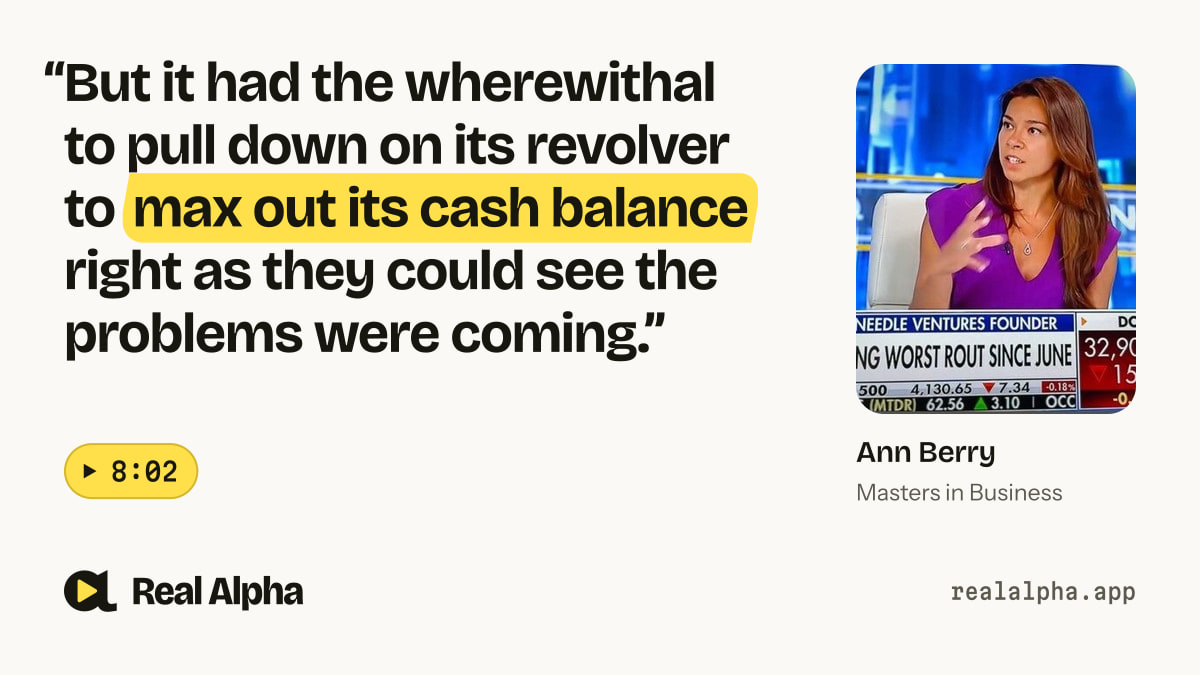
“But it had the wherewithal to pull down on its revolver to max out its cash balance right as they could see the problems were coming.”
 Ann Berryat 8:02 · Masters in Business
Takeaways
- The company maxed out its revolver before problems hit.
- Berry was tasked with finding cost cuts and preserving cash.
- She carried the lesson into running a company during COVID.
About this segment
At Goldman, Ann Berry saw an oilfield-services company draw down its revolver and cut costs as trouble approached. The experience made cash preservation a crisis lesson she carried into COVID.

Ann Berry is founder and managing partner of Threadneedle.
Built investment experience at Goldman Sachs and Wheelhouse, then founded Threadneedle to pair capital with operating support.
- BR
Barry Ritholtz, Host
From “Providing Capital to Tech Companies: Masters In Business with Ann Berry | At the Money”, Nov 7, 2026. Watch the full episode
Thanks. We'll look at and fix what's off.
Transcript
From the transcript Masters in Business publishes with the episode.
- 6:13
So to paint the picture, I joined Goldman at a time and every couple of weeks people would just disappear from the cubes around me. And I'm pretty sure I. Was kept because I was just very cheap, right? Because I was really entry-level coming out of business school. And the stress levels were incredibly high. Incredibly high. And I remember Lloyd Blankfein, who was CEO at the time, I remember he was actually very good about sending out frequent voicemails.
- 6:37
It was a big voicemail culture. And you'd see your phone bleeping, your desk phone bleeping, and his voicemails would start, this is Lloyd, with an update. And those would come around pretty frequently. And I learned. Weekly? Daily? Yeah. Sometimes several times a week, particularly if the headlines were rolling, just to clarify what was going on. And I will say, I was very impressed that while I'm sure the senior folks were incredibly stressed, both personally and professionally, I will say the people I worked with did a pretty good job of emanating at least a feeling of calm that things will be all right. And no one was under any illusion that things were going to be easy. And there was always a question around which of the banks would survive. I remember the moment that Goldman became a
- 7:22
bank holding company. Lots of people who'd grown up at Goldman weren't particularly excited about that. But there was a sense that Goldman would figure it out. So I was lucky to be there at that time. And I learned a lot, by the way, from my portfolio companies, the businesses, because I was in private equity at Goldman in 08. The things you have to do to help companies survive. And I'll just plant one, because it became very important later in my career, Barry. I inherited an oilfield services company.
- 7:47
Mm-hmm. Meaning someone else at the firm was responsible. Had made the investment.
- 7:52
Had made the investment. And I joined the team. So I was supporting a senior person. And this business had struggled, as many did. Had a lot of leverage on it. But it had the wherewithal to pull down on its revolver to max out its cash balance right as they could see the problems were coming. And I was tasked with figuring out where to cut costs. how to reserve that cash. It was very operational. It was unusual for private equity. And it's a lesson that I held onto when fast forward to COVID, I was CEO of a business where all of my clients were hotels. So a lesson that I learned, I carried with me and it came out.
- 8:31
To be important.