The alpha, twice a week
That was 5 min.
Get the best new moments in your inbox every Wednesday and Saturday. It's free.
Check your inbox
We sent a link to your address. Click it to finish signing up. Not there in a minute? Look in spam.
or
Masters in Business · 5 min · Nov 7, 2026
Retailers will need to market products to shopping agents
 Ann Berry
 distinguishes AI that helps consumers from systems that serve irrelevant ads.
In this episode
Full analysis- 26:09She expects early-stage companies to reach cash flow in two years3 min
- 21:11Running a company changed how she evaluates investmentsPro pick 2 min
- 48:11AI’s investment risk is unclear returns, not unclear potentialPro pick 3 min
- 6:11A portfolio company drew its revolver before trouble arrived2 min
- 14:29Frontline workers flagged COVID risk before lockdowns2 min
- 36:57Walmart turned its data into a $6.5 billion ad business2 min
- 42:04Retailers will need to market products to shopping agents5 min
- 56:53Acquisition buyers talk about fit before valuation3 min
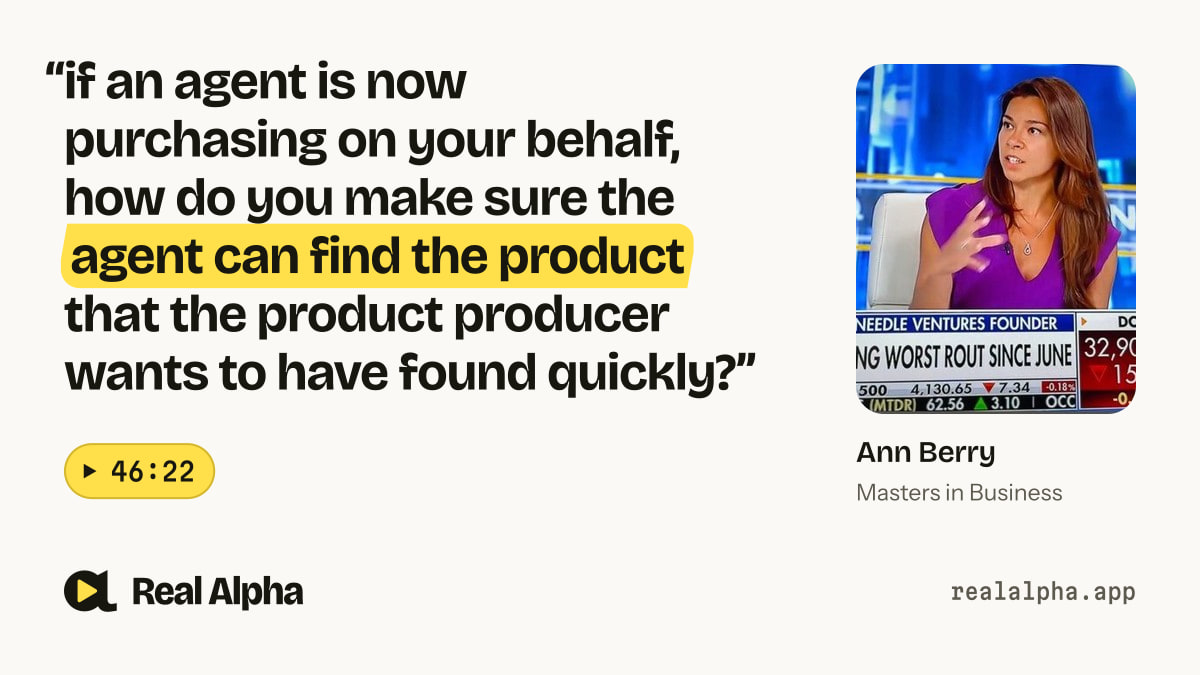
“if an agent is now purchasing on your behalf, how do you make sure the agent can find the product that the product producer wants to have found quickly?”
 Ann Berryat 46:22 · Masters in Business
Takeaways
- Agents may shop on consumers' behalf.
- Retailers will compete to make products discoverable to agents.
- Search tools need to surface the product a shopper means.
About this segment
Ann Berry distinguishes AI that helps consumers from systems that serve irrelevant ads. She predicts retailers will need to make product data discoverable to agents shopping for customers.

Ann Berry is founder and managing partner of Threadneedle.
Built investment experience at Goldman Sachs and Wheelhouse, then founded Threadneedle to pair capital with operating support.
- BR
Barry Ritholtz, Host
From “Providing Capital to Tech Companies: Masters In Business with Ann Berry | At the Money”, Nov 7, 2026. Watch the full episode
Thanks. We'll look at and fix what's off.
Transcript
From the transcript Masters in Business publishes with the episode.
- 42:07
dynamic pricing, the not favored word for that is price discrimination, or the ultimate expression of personalization, which is something consumers have long believed to be wanting to have. Well, you just described, Barry, though, if you had an agent that you could deploy to look around for you and find the place to stash your money that's going to get the highest return for you, I don't think you're going to have a, I don't think you would have a backlash against that use of AI.
- 42:37
Is that fair to say as a consumer? You wouldn't. So that's a case where AI could be proven to help the consumer. Different from the first example you gave of the quote and crapification of things like ads, where in that instance, the AI is not working to serve up what you want. And I think there's two different issues. I think there are companies out there, I invested in one of them actually, a business called Vodi, which went to one of the big e-commerce platforms and typed in on their search engine, I want to find a red sofa or a red sofa with buttons. And the quality of the feed, the search results that came back, was just really, really poor. And what founder Stephanie Horbachevsky did was build this company, Vodi, to work with retailers to say, you've got to get your platforms better. Consumers
- 43:26
don't want to be served up the wrong way. answer to their searches. They want you to understand what they mean.
- 43:31
Well, if we can monetize it through ads, that seems to be like search and advertising have an inherent conflict with, we want people scrolling through pages of results and ads being served alongside it, or we're going to show you whoever pays the most for an ad, which may not be the best fit for what you're searching for. How do you resolve that? To me, I'm going to bet that some states, probably California, New York, and then it spreads, are going to outlaw dynamic pricing in supermarkets. When you buy a price a dozen eggs, it shouldn't be able to figure out who you are, what you drive.
- 44:11
Your credit score, right. Right. There was something, Walmart was working on a thing that they'll charge you more for mayonnaise if the cart you're driving around with senses you already have tuna fish in your cart. Yeah. That sort of stuff, this is what the Consumer Finance Protection Board that was more or less gutted this presidency was supposed to stop. If you think inflation is bad now, wait till these license plate readers and AI maxing out, it's going to add 30-40% to the price of goods unless there's either legislation or an arms race with consumer AI saying, no, thank you.
- 44:57
And people vote with their feet. And they say, I don't want to deal with this. There is a backlash.
- 45:00
But inertia is eventually, but there's still, look, I think that a lot of people discovered there are retailers worth sharing your credit card with during the pandemic. For the longest time, Amazon was clearly the low price provider. Not only is that no longer the case, it's not even remotely close to the case anymore. But I had, there was a TV I wanted to buy that I thought was kind of exorbitant. And Claude just alerted me, hey, it's on sale $ 500 less at Amazon. Hey, fantastic. Are we going to have dynamic pricing versus agentic consumer apps?
- 45:44
I don't think it's one versus the other necessarily. One of the things I will share with you, which was interesting, I was moderating at the World Department Store Summit. in Mexico, in Mexico City earlier this year.
- 45:58
By the way, where they're building giant data centers along the border. Yes, huge data centers. And one of the things that the CEO of Liverpool, which is a big department store there, talked about was how consumer products companies and retailers are going to have to figure out how to market to agents in the same way that they've been figuring out how to market to consumers. Isn't that fascinating?
- 46:21
That is absolutely fascinating. Because exactly using... the example you gave, Barry, if an agent is now purchasing on your behalf, how do you make sure the agent can find the product that the product producer wants to have found quickly? So I think we've got that coming. I think we've got a shift in how we see the retailers and the consumer product companies figure out how are they going to be found the quickest with the data that they want to control and relay by these agents who are doing shopping on the behalf of consumers.