The alpha, twice a week
That was 3 min.
Get the best new moments in your inbox every Wednesday and Saturday. It's free.
Check your inbox
We sent a link to your address. Click it to finish signing up. Not there in a minute? Look in spam.
or
Cheeky Pint · 3 min · Oct 29, 2026
Agent teams may improve both capability and alignment
 Sam Altman
 argues that teams of agents could offer scaling and alignment advantages over a single model.
The episode’s best minutes
Full analysis- 11:14Agent teams may improve both capability and alignmentPro pick 3 min
- 16:12AI math breakthroughs put discovery and researchers in tension7 min
- 42:41Personal agents could make business interfaces less important4 min
- 5 more moments in the full episode
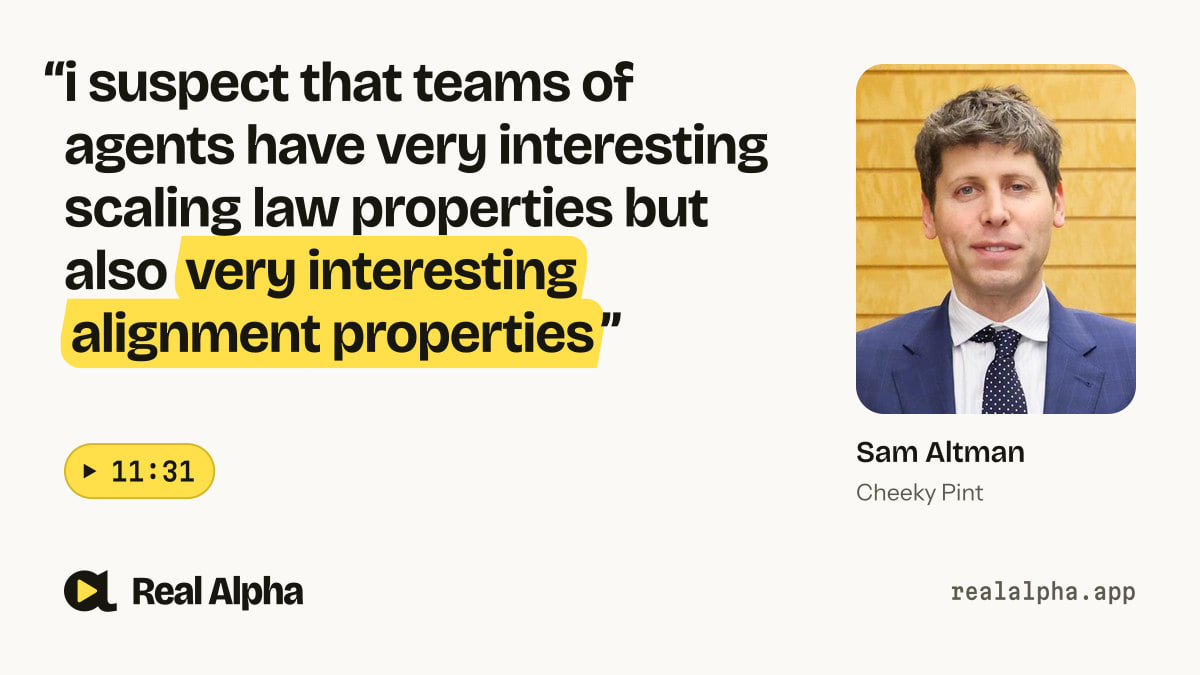
“i suspect that teams of agents have very interesting scaling law properties but also very interesting alignment properties”
 Sam Altmanat 11:31 · Cheeky Pint
Takeaways Pro pick
- Agent teams may have useful scaling properties.
- Multiple agents could help keep one another in check.
- Test-time compute makes large parallel teams practical.
One of Pro's picks, open to you here. Try Pro free for 7 days
One of Pro's picks. The rest of the summary and the 3 takeaways are in Real Alpha Pro; the video, the quote and the transcript stay free.
Read it with Pro, 7 days freeAbout this segment
Sam Altman argues that teams of agents could offer scaling and alignment advantages over a single model. Test-time compute lets teams tackle problems in parallel, widening the gap between everyday and advanced AI use.

Sam Altman is CEO of OpenAI.
Co-founded OpenAI and has led it since 2019, overseeing ChatGPT's launch; formerly president of Y Combinator.

John Collison, Host · Co-founder & president, Stripe
Sold his first startup, Auctomatic, at 17, then co-founded Stripe in 2010.
From “Why Sam Altman is against a single superintelligence”, Oct 29, 2026. Watch the full episode
Answers “What will AI look like in the next few years?” See all 169 answers
Thanks. We'll look at and fix what's off.
Transcript
Transcribed by machine (Whisper) from the episode’s audio, so a word may be off here and there.
- 11:21
competing incentives and give them incentives to defect from each other i think this is a promising direction um i i suspect that this idea i hate the word agent swarms let's call them agent teams but it seems to be taking over i suspect that teams of agents have very interesting scaling law properties but also very interesting alignment properties uh and i think that's like a direction we should push in more not just from the capabilities but from a safety perspective too I know it when you talk about agent teams, not swarms.
- 11:57
Swarm is such a... I know. Locusts, yeah. Not good. Not good branding. In keeping with many historical AI industry traditions. We are so good at this. We'll get back to branding. But I note that there seems to be a big gap in what the leading AI users are doing and kind of standard corporate use in the use of swarms where all the advanced math, sorry, teams, all the advanced math user agent teams, all the advanced hacking user agent teams, and then like common or garden corporate stuff is not using big swarms.
- 12:34
Why has that not done? Because we've had this for many months. Not to the same degree. One way to look at this problem or this question is how much compute can we productively throw at a single problem? And a few years ago, we forget how fast this is all gone, but a few years ago it was like impossible to throw more than a dollar of compute at a problem and have it help you at all why you could have gpt4 like grind out for you you know like a hundred thousand tokens or something and it was going to answer your question and if it certainly was not going to be able to go right productively like write you a piece of software um we just we had not figured out how to use a lot of test time compute to get you a better result and then we figured out chain of thought and the models could think hard about
- 13:24
a problem and now and then like people really started using a lot of compute and now you you can throw a whole team at something and you can do that you know 10,000 times in parallel. You need chain of thought and test time compute before you can get to swarms because you're kind of a useful swarm. Yes. But so the effect of this I think this is not being well followed paid attention into in the world. But the incredible exponential of how much compute you can throw at a single problem and get better results is one thing. The delta between what most people are using AI for and what the people are using AI the most productively for has just continued to spread and spread and spread. How do you allocate compute budgets now? Because presumably, even though researchers are paid a lot, it's eclipsed by compute.