The alpha, twice a week
That was 7 min.
Get the best new moments in your inbox every Wednesday and Saturday. It's free.
Check your inbox
We sent a link to your address. Click it to finish signing up. Not there in a minute? Look in spam.
or
Cheeky Pint · 7 min · Oct 29, 2026
AI math breakthroughs put discovery and researchers in tension
 Sam Altman
 describes letting agent teams explore math at high compute, including work on Navier–Stokes, then weighs publishing discoveries against the impact on researchers.
The episode’s best minutes
Full analysis- 11:14Agent teams may improve both capability and alignmentPro pick 3 min
- 16:12AI math breakthroughs put discovery and researchers in tension7 min
- 42:41Personal agents could make business interfaces less important4 min
- 5 more moments in the full episode
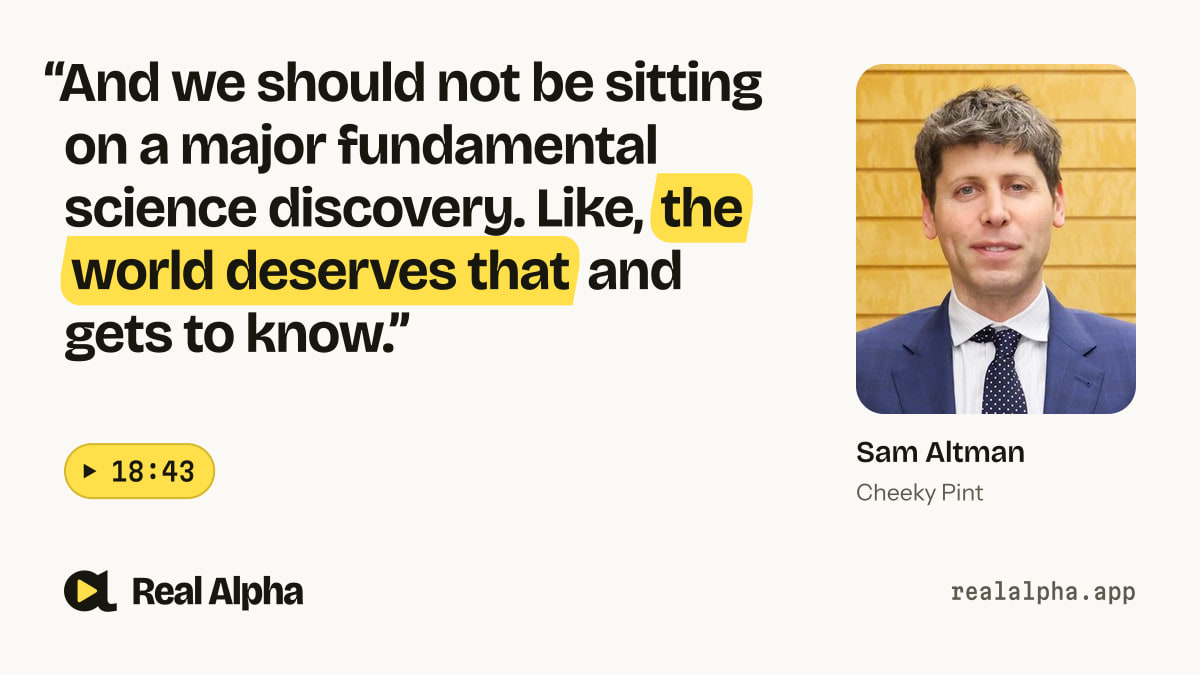
“And we should not be sitting on a major fundamental science discovery. Like, the world deserves that and gets to know.”
 Sam Altmanat 18:43 · Cheeky Pint
Takeaways
- OpenAI spent roughly $10–20 million on the Navier–Stokes work.
- Altman says fundamental scientific discoveries should benefit everyone.
- He wants researchers to share in the future their work creates.
About this segment
Sam Altman describes letting agent teams explore math at high compute, including work on Navier–Stokes, then weighs publishing discoveries against the impact on researchers. He recalls feeling excitement and sadness as familiar ways of doing science began to change.

Sam Altman is CEO of OpenAI.
Co-founded OpenAI and has led it since 2019, overseeing ChatGPT's launch; formerly president of Y Combinator.

John Collison, Host · Co-founder & president, Stripe
Sold his first startup, Auctomatic, at 17, then co-founded Stripe in 2010.
From “Why Sam Altman is against a single superintelligence”, Oct 29, 2026. Watch the full episode
Thanks. We'll look at and fix what's off.
Transcript
Transcribed by machine (Whisper) from the episode’s audio, so a word may be off here and there.
- 16:18
And I think it's important to have when there's a new paradigm. I think it's important to let people be fairly unconstrained So when we did the Navier Stokes proof, we understood absolutely nothing about the scaling laws of teams of agents. Are you supposed to like... The very recent Navier Stokes proof. Are you supposed to give them like the smartest model? Are you supposed to give them like many copies, fewer copies, longer rollouts, shorter rollouts?
- 16:43
We did not understand that at all. And now we understand it a little bit. I think we can still understand it like much better. But like has happened in every other new paradigm we've discovered, I am confident that we will find our, you know, 10x improvements per year at how we allocate dollars or computer flops, whatever you want to measure, into useful things. So I think this is a thing that our company is particularly good at, but also, like, fits an important property of the field, which is let people explore at the limit of what is possible and then trust that the incredible optimization pressure will figure out how to do this in an efficient way.
- 17:23
I, and, you know, directionally speaking, I would rather us be more willing to let people use crazy amounts of compute and let users have extremely high-end plans to figure out the edge of the possible and then figure out how to make that efficient at a mass scale. But when does the optimization function come in? Well, I think we're already doing it. I mean, like, I bet we could redo Navier's Stokes at one one hundredth of the cost a year from when it was done.
- 17:57
So we did it in, like— Not just knowing how the proof works, but, like, just with better approaches. Yes. Yeah. Smarter models and better approaches. How much did all the math cost? Order 10 million for, like, Navier's Stokes, I think. Okay. Maybe a little more. 10 million-ish. 10, 20. That order makes you, yeah, yeah. But for one proof, and so times 700? Well, no, no, because then we kept getting better so fast.
- 18:17
Like, we understood more. Got it. We spent way less than that on the average one of those. But like hundreds of millions of dollars of math. Yeah, yeah, yeah, that kind of work. Okay, interesting. But that includes, like, much more other discovery than what we have published. Yes. So it was like, maybe we spent that much. We have more than the 700 proofs? Of course. When do we get those? We are trying to learn how to...
- 18:40
This is like a real tension. I think on one hand, very clearly, and I feel unequivocal on this point, humanity deserves fundamental knowledge. And we should not be sitting on a major fundamental science discovery. Like, the world deserves that and gets to know. And I think that outweighs another very important equity, which is if you are a scientist, your career and, you know, a significant amount of your enjoyment and fulfillment in life comes from discovery and science.
- 19:15
And so if we're going to continue to do this for math or begin to do this for other fields, then I think we more than owe it to the people that work in those fields to figure out, you know, what is the solution space where the world gets to benefit from the knowledge and they also get the best version of the future that they can have. So we are working through that right now. I did not, I don't know, I think you may be too contrite.
- 19:42
I did not interpret that moment as particularly bad for AI, where you had, I think everyone saw the mathematicians' union up in arms, and I think everyone else says, yeah, I mean, have you paid attention to 2026? As I said, I don't think it was bad for AI, and I think on net, the world deserves. to understand how the universe works. But I do have empathy for the math. Like, I think we need to do this.
- 20:06
I think we should do this. I think, like, if we can go understand how to, you know, a theory of all of physics or how to cure a bunch of diseases, like, clearly, that is knowledge the world should have. But I would like to figure out a way to do this that is as sensitive to the communities that have driven these fields forward for centuries as we can. and it's just it's a hard thing I wasn't that worried about the math I thought it was great but you agree the mathematicians are not that happy yeah it's fine like the longshoremen union weren't happy about the Porsche automation remember the guy the old Chris no no no I do why do I feel differently about this there was one weekend when we got a new model and in I'm actually probably not supposed to say this but I will since we're drinking exactly
- 20:54
perfect time the name of the channel was model name dash hold my beer and people were just throwing that at the hardest problems they could and people just like didn't think the model was going to do these things and and we had this collective experience of people's like hardest research problems from their academic career the model was just knocking down one after the other many different fields it was incredible to watch and kind of two nights in a row i was up most of the night because i was so excited i couldn't go to bed it was it was like moves many of those problems that we published many other things and i was tremendously excited and happy but i also had like much more sadness and melancholy and like a feeling of like something ending than i was expecting so again i agree this is the right
- 21:45
thing on behalf of the world and and also i agree that this is just like the shape of reality and nothing that anyone can stop or should stop. But I do have, like, real... I think it's a wistfulness and nostalgia you can feel. It's more than nostalgia. Wistfulness. Yeah. Like, my dad describes how, you know, growing up in Ireland in the 1950s, he observed people around him still using horses productively in industry.
- 22:12
In the 50s? Yeah. And, I mean, obviously, there were also tractors, but, you know, it was being phased out. and uh but it still for sure happened and observing that this was a technology that humans had been using for thousands of years and he was witnessing the very tail end of it and yeah i think there's always that feeling of witnessing the the closing of a chapter that leads to some wistfulness but it's okay it's like it's people's lives and it's something that has brought them great joy and you know maybe most most i mean certainly most mathematicians never solve a millennium prize problem but the idea that you might be able to and the idea that there is stuff out there that we don't understand yet that through great effort and you know pushing aside other things in your life and dedicating yourself to you can still solve and understand like
- 23:07
there's something beautiful about that what else are you excited about from a safety point of view