The alpha, twice a week
That was 4 min.
Get the best new moments in your inbox every Wednesday and Saturday. It's free.
Check your inbox
We sent a link to your address. Click it to finish signing up. Not there in a minute? Look in spam.
or
Cheeky Pint · 4 min · Oct 29, 2026
Personal agents could make business interfaces less important
 Sam Altman
 and Collison discuss why consumers may prefer using agents through a familiar app and trust brands like Amazon over a business’s website.
The episode’s best minutes
Full analysis- 11:14Agent teams may improve both capability and alignmentPro pick 3 min
- 16:12AI math breakthroughs put discovery and researchers in tension7 min
- 42:41Personal agents could make business interfaces less important4 min
- 5 more moments in the full episode
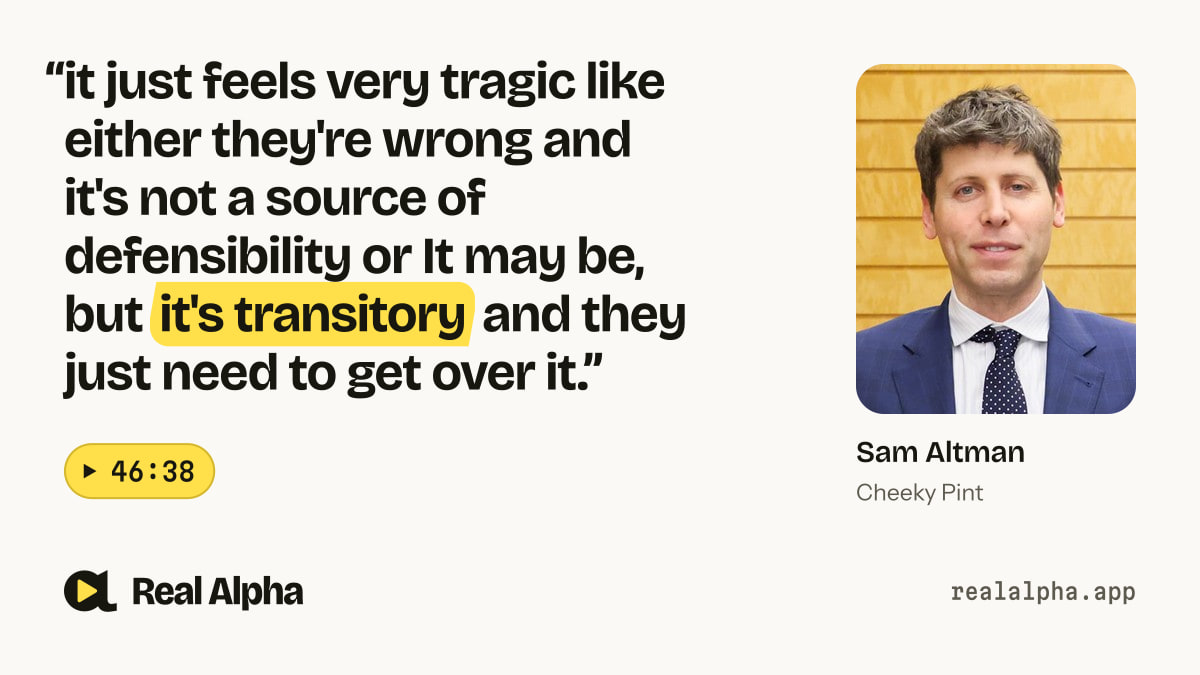
“it just feels very tragic like either they're wrong and it's not a source of defensibility or It may be, but it's transitory and they just need to get over it.”
 Sam Altmanat 46:38 · Cheeky Pint
Takeaways
- Consumers may prefer agents in their existing chat apps.
- Brand trust and fulfillment can matter more than a website.
- Many web forms ask people to repeat information they already gave.
About this segment
Sam Altman and Collison discuss why consumers may prefer using agents through a familiar app and trust brands like Amazon over a business’s website. They argue that web forms and HTML are unlikely to be lasting sources of defensibility.

Sam Altman is CEO of OpenAI.
Co-founded OpenAI and has led it since 2019, overseeing ChatGPT's launch; formerly president of Y Combinator.

John Collison, Host · Co-founder & president, Stripe
Sold his first startup, Auctomatic, at 17, then co-founded Stripe in 2010.
From “Why Sam Altman is against a single superintelligence”, Oct 29, 2026. Watch the full episode
Answers “What will AI look like in the next few years?” See all 169 answers
Thanks. We'll look at and fix what's off.
Transcript
Transcribed by machine (Whisper) from the episode’s audio, so a word may be off here and there.
- 42:48
which is every company is really eager to add AI to their products in a very specific way, which is there is a tab or pop-up widget or something that gives you a messaging type UI. And it's often surprisingly capable. And so you can say, hey, I actually want to return my most recent order. And then you're kind of surprisingly impressed when it actually is able to find your most recent order. And, you know, it's a bit janky and it can do all those things.
- 43:28
However, no consumer really wants this UI because consumers have strong, not immovable, but strong preferences for their existing primary chat app, the kind of top of wallet app that they open when they want to go to do something. And what they want is to be able to say, hey, go find my recent order on this business and refund it or something like that. And I noticed that businesses are really reluctant.
- 44:00
to allow people to use those businesses inside another AI app. Because like, oh, we're going to lose control on our motive, whatever. And it just strikes me as fine, because your defensibility probably did not come from your ability to put together HTML. Your defensibility came from the brand loyalty and the product selection. And the new UI is that agentic interaction inside ChatGPT or Gemini, you know, or whatever it is.
- 44:28
but all businesses disagree with me and they're very good at business so maybe they're right I mean again I have like a bias here but I so directionally agree with you like I have such an extreme preference to buy something from Amazon versus some random e-commerce vendor that I don't know if I can return to or I don't know if I can like trust to deliver it quickly or something like if I ask ChatGPT to buy me something and I can choose Amazon versus some other thing like 10 out of 10 times I click Amazon I'll pay a higher price.
- 45:00
I have just like such. Yes. And it's nothing to do with like my experience of clicking around Amazon.com. Exactly. And now I think you could say we have not done a good enough job offering partners or platform inside of ChatGPT if they don't want this to happen. But, and again, maybe I'm really biased here. I think Amazon's like in a great, I think they're in a great place of commerce moves like much more agentic.
- 45:23
Amazon in particular has this amazing defensibility by the fulfillment network. And so you can use Amazon kind of from anywhere. I super trust that. Yeah. I'm just really struck by this dynamic. Like my new thinking, in particular with regards to Agenda Commerce, but also anything, is any time there is a web form field that you as a human are filling out, these days that is below your pay grade. Because you are probably not inventing that information for the first time.
- 45:51
Like we've all filled out the medical forms where it's like, oh, your family history or whatever. And that's so frustrating because how many times have you filled out your dad's and your mom's medical history and things like that? It just feels so wasteful. But there's a million versions of that. You're never inventing new information for a web form. I would be so happy to never do fake work at a computer again.
- 46:12
Yeah. And my argument is that any web form is basically fake work. I agree. But I was one of the very earliest adopters that I knew of, of those like plugins that put in your like name and address like very clumsily you know because I was just like this is I cannot do this again but I kind of feel like that using like most of the web at this point. Yeah I just find this phenomenally interesting where businesses right now are really attached to their HTML and mobile apps as sources of business defensibility and it just feels very tragic like either they're wrong and it's not a source of defensibility or It may be, but it's transitory and they just need to get over it.
- 46:54
The last example of this that I think we really witnessed was like the app stores, the iPhone app stores specifically.