The alpha, twice a week
That was 4 min.
Get the best new moments in your inbox every Wednesday and Saturday. It's free.
Check your inbox
We sent a link to your address. Click it to finish signing up. Not there in a minute? Look in spam.
or
Unsupervised Learning · 4 min · Sep 10, 2025
Agentic AI and real-time video could drive new workloads
 Tri Dao
 predicts tool-using agents will be a major next application, requiring links to professional software and data.
In this episode
Full analysis- 24:02Inference got cheaper through memory and model co-design9 min
- 32:54Inference providers will optimize for three workload patterns6 min
- 43:32Expert AI requires scarce domain data and better economics6 min
- 1:45Chip startups need a workload-specific bet8 min
- 40:07Agentic AI and real-time video could drive new workloads4 min
- 17:37AI coding tools make Dao 1.5x more productive6 min
- 11:43GPU code still needs rewrites across chip generations4 min
- 49:17Robots need real-world data and multi-timescale control3 min
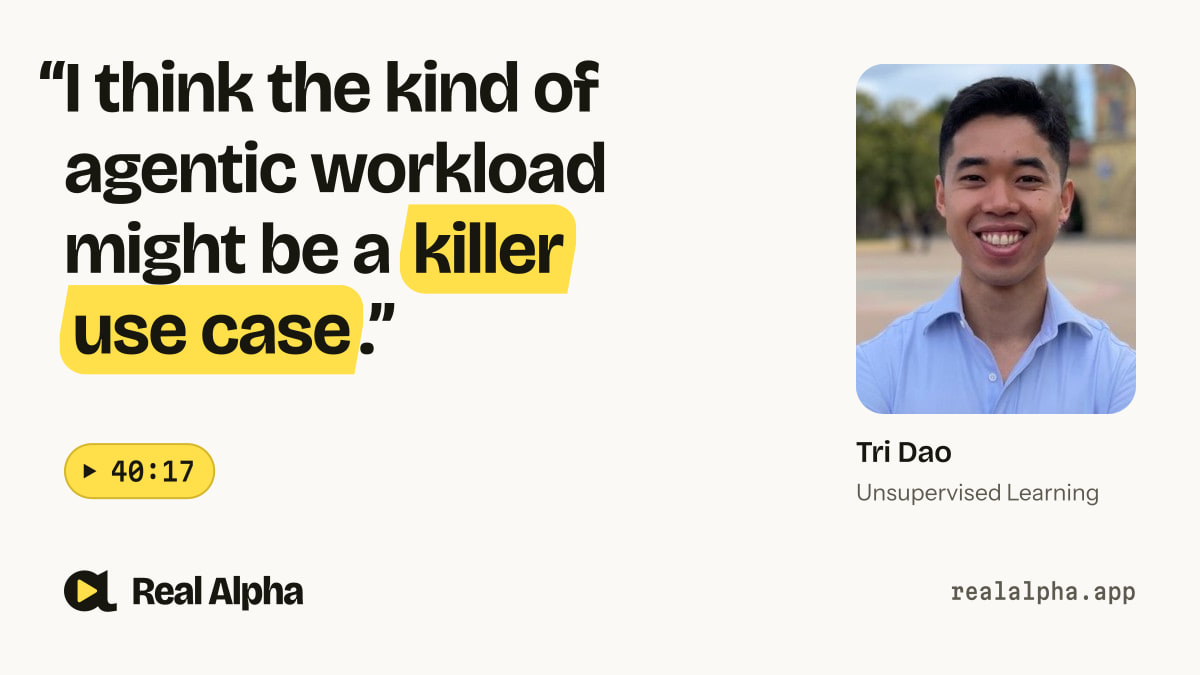
“I think the kind of agentic workload might be a killer use case.”
 Tri Daoat 40:17 · Unsupervised Learning
Takeaways
- Agents will need access to tools such as design software and databases.
- Dao sees agentic AI as a major next application.
- Real-time video generation could drive more inference demand.
About this segment
Tri Dao predicts tool-using agents will be a major next application, requiring links to professional software and data. He also expects real-time video generation to expand consumer use and increase compute demand.

Tri Dao is Chief scientist at Together AI and Princeton professor.
Created FlashAttention and worked on Mamba; Together AI chief scientist, Princeton assistant professor.

Jacob Effron, Host · Managing director, Redpoint Ventures
Growth investor in Abridge, Ramp and Physical Intelligence; ex-Flatiron Health.
From “Tri Dao: The End of Nvidia's Dominance, Why Inference Costs Fell & The Next 10X in Speed”, Sep 10, 2025. Watch the full episode
Answers “What will AI look like in the next few years?” See all 395 answers
Thanks. We'll look at and fix what's off.
Transcript
Transcribed by machine (Whisper) from the episode’s audio, so a word may be off here and there.
- 40:19
Do you feel like fast-forwarding a year or two from now, it's like 27 or a ton of different ways, and each requiring its own kind of operation? I think it's still going to coalesce, right? I think the kind of agentic workload might be a killer use case. I think it's maybe a step change from maybe ChatGPT was a step change in terms of application, right? That was sort of the first time users are exposed to this kind of language models they can talk to and maybe help them debug their code or look up information and analyze information and synthesize information.
- 40:59
But I think the next set of application is going to be agentic, which is, hey, can AI, can these models sort of take actions and collect information by themselves, right? And that is going to require sort of different sets of optimizations, right? So now it's not just running the models really, really fast on GPUs. It's like how do you connect with the tools that humans usually do? Web search is an easy example.
- 41:28
But as these workloads move to different verticals, let's say you're an engineer. I don't know. You're designing airplanes or something. You want the model to be able to access your design software. Or if you're a financial analyst, you have a certain database that you want the model to tap into. So I think this kind of workload will be one of the main workloads that we have in the next year or so.
- 42:03
That's my prediction. And that systems-level workaround agents then obviously becomes a whole new set of problems to solve. And so it feels like even if the original set of workloads, you know, there's great open source tooling, there's now entirely new set of workloads that also require, you know, optimizations and getting into some of that systems work and accessing like, you know, external databases and other things is different than just optimizing inference.
- 42:24
But it seems like a natural evolution of the product you guys are providing. Yeah, yeah. I think that's the sort of the main going to be the main use use case for more like professional level or enterprise level. I think on the consumer level, you know, one of the one of I think one of my bets is like we'll get real time video generation. Yeah. And we're starting to see some of that. And I think it's going to really change sort of the consumer landscape to the effect of like TikTok really changed that landscape.
- 42:55
Right. You know, for better or for worse. I don't know. But it's very, very engaging. Right. And so on the consumer side, I think some of the companies we work with, like Pica Labs and Hydra, they're focusing on real-time video generation. That's the bet. There's a whole new set of problems to solve. Right, right. And so it's just a lot more compute. Video generation is very, very demanding on the compute side.
- 43:23
So that might be fueling even more chips, even more inference optimization. Super interesting.