The alpha, twice a week
That was 3 min.
Get the best new moments in your inbox every Wednesday and Saturday. It's free.
Check your inbox
We sent a link to your address. Click it to finish signing up. Not there in a minute? Look in spam.
or
Unsupervised Learning · 3 min · Sep 10, 2025
Robots need real-world data and multi-timescale control
 Tri Dao
 says robot models lack data for interacting with the physical world, and joint control must run faster than route planning.
In this episode
Full analysis- 24:02Inference got cheaper through memory and model co-design9 min
- 32:54Inference providers will optimize for three workload patterns6 min
- 43:32Expert AI requires scarce domain data and better economics6 min
- 1:45Chip startups need a workload-specific bet8 min
- 40:07Agentic AI and real-time video could drive new workloads4 min
- 17:37AI coding tools make Dao 1.5x more productive6 min
- 11:43GPU code still needs rewrites across chip generations4 min
- 49:17Robots need real-world data and multi-timescale control3 min
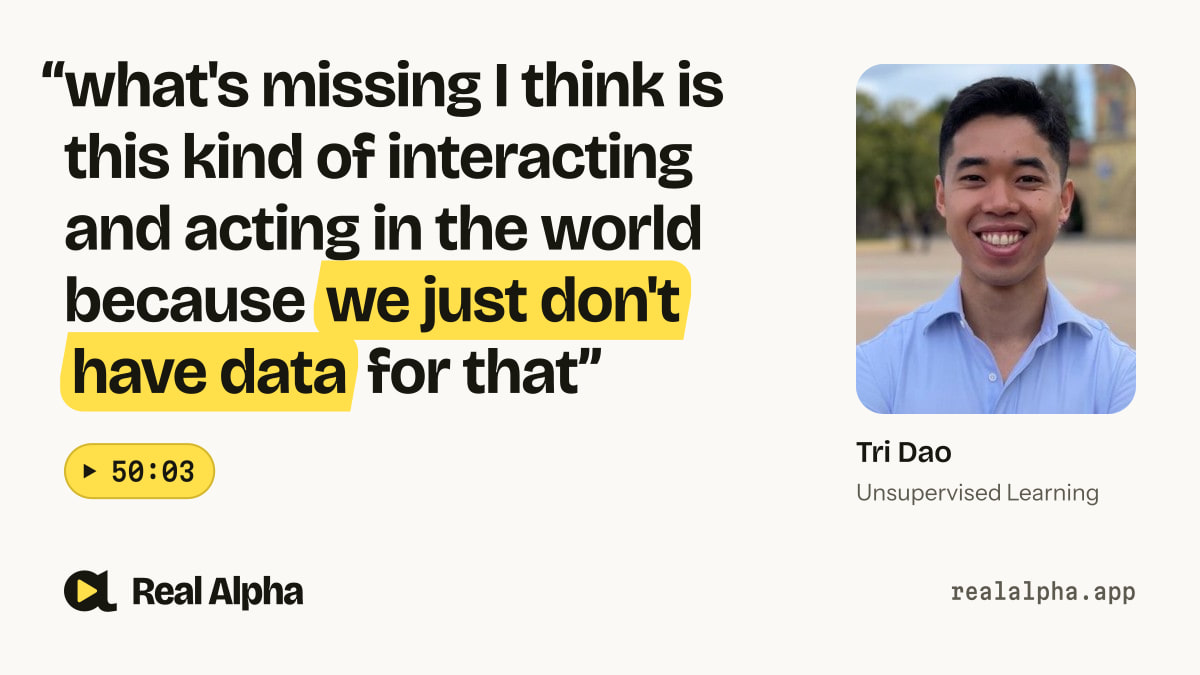
“what's missing I think is this kind of interacting and acting in the world because we just don't have data for that”
 Tri Daoat 50:03 · Unsupervised Learning
Takeaways
- Language models can plan, but physical interaction data is scarce.
- Joint control needs faster computation than route planning.
- Robotics may require a system that stitches together multiple models.
About this segment
Tri Dao says robot models lack data for interacting with the physical world, and joint control must run faster than route planning. He sees robotics as a system that combines models operating on different timescales.

Tri Dao is Chief scientist at Together AI and Princeton professor.
Created FlashAttention and worked on Mamba; Together AI chief scientist, Princeton assistant professor.

Jacob Effron, Host · Managing director, Redpoint Ventures
Growth investor in Abridge, Ramp and Physical Intelligence; ex-Flatiron Health.
From “Tri Dao: The End of Nvidia's Dominance, Why Inference Costs Fell & The Next 10X in Speed”, Sep 10, 2025. Watch the full episode
Thanks. We'll look at and fix what's off.
Transcript
Transcribed by machine (Whisper) from the episode’s audio, so a word may be off here and there.
- 49:30
And robotics, like how far are we away from having really good humanoid robots that work in homes? Maybe five years? Maybe ten years? Yeah. I don't know, right? And that usually means a lot of interesting and exciting questions on the research side that we want to answer. So that's a direction, you know, on the research side. What's most interesting to you within the robotics research area? So robots, you know, we can initialize a model controlling a robot with some of the foundation models that we have already.
- 50:02
You know, you can use a language model to do the planning. Like you say, if you ask a robot to, like, pick up a coffee cup, then the language model can say, you know, go walk over to that table and pick up the coffee and so on. but what's missing I think is this kind of interacting and acting in the world because we just don't have data for that we have data we have language data some folks are trying to scale simulation data other folks are doing tell-off but clearly a data problem on the actual actuation side so that's certainly one the other one is I think have to process information in a sort of multi-resolution multi-tamscale way, so some of which is, you know, if you're controlling the joins, you have to act very, very, very rapidly. But if you're planning a route for the robot, you can do it much, much
- 50:56
slower. So it's like different architectures you might want to use. I mean, that seems very analogous to some of the states-based model work you've done. Right, right. So explicitly taking you know, timescale into account? Do I want to do very lightweight computation to just control the joints? Or do I want to do much heavier weight sort of reasoning to plan the optimal route for the robot? So I think it's going to be this sort of composite system initialized from language models, vision model, audio model, world model.
- 51:28
But how do you stitch them together? I think that's the big question. With some fascinating hardware questions for people to run this stuff locally and fast enough. Yeah, yeah. I feel like you could kind of probably work anywhere you want.