The alpha, twice a week
That was 6 min.
Get the best new moments in your inbox every Wednesday and Saturday. It's free.
Check your inbox
We sent a link to your address. Click it to finish signing up. Not there in a minute? Look in spam.
or
Unsupervised Learning · 6 min · Sep 10, 2025
AI coding tools make Dao 1.5x more productive
 Tri Dao
 says Claude Code helps with GPU-kernel implementation while he focuses on design.
In this episode
Full analysis- 24:02Inference got cheaper through memory and model co-design9 min
- 32:54Inference providers will optimize for three workload patterns6 min
- 43:32Expert AI requires scarce domain data and better economics6 min
- 1:45Chip startups need a workload-specific bet8 min
- 40:07Agentic AI and real-time video could drive new workloads4 min
- 17:37AI coding tools make Dao 1.5x more productive6 min
- 11:43GPU code still needs rewrites across chip generations4 min
- 49:17Robots need real-world data and multi-timescale control3 min
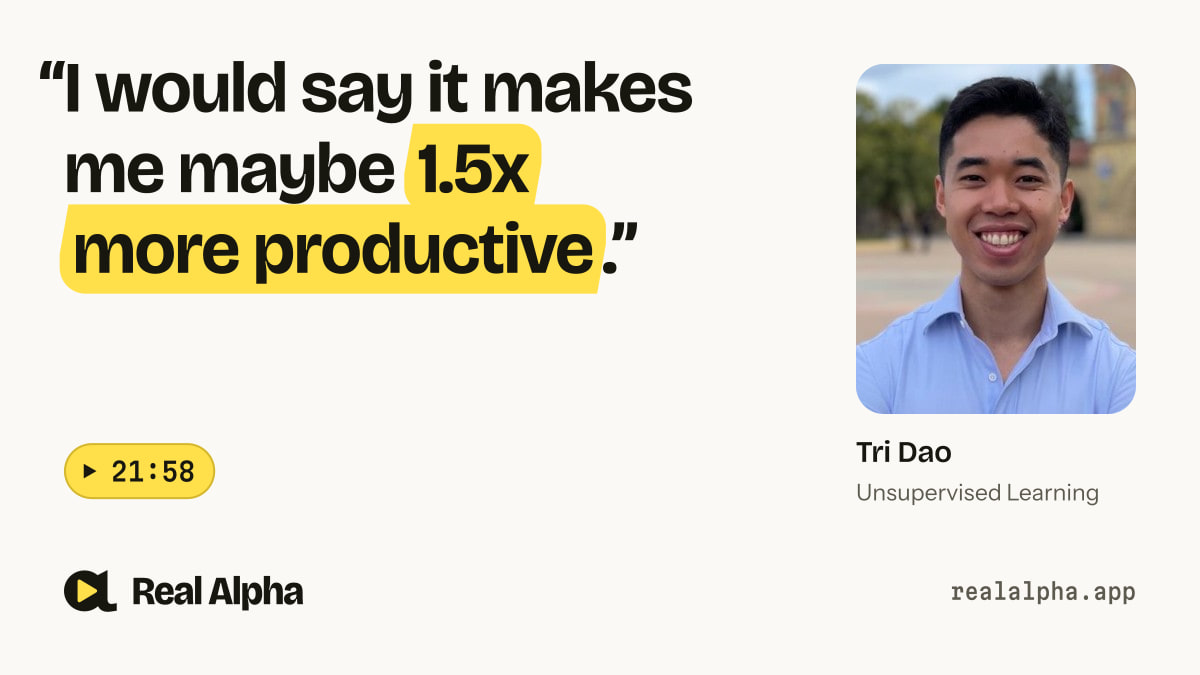
“I would say it makes me maybe 1.5x more productive.”
 Tri Daoat 21:58 · Unsupervised Learning
Takeaways
- Claude Code helps with implementation-heavy kernel work.
- Dao estimates a 1.5x productivity gain.
- Fully automatic kernel generation still struggles with complex code.
About this segment
Tri Dao says Claude Code helps with GPU-kernel implementation while he focuses on design. He finds tool-using models more useful than expecting them to write complex kernels unaided.

Tri Dao is Chief scientist at Together AI and Princeton professor.
Created FlashAttention and worked on Mamba; Together AI chief scientist, Princeton assistant professor.

Jacob Effron, Host · Managing director, Redpoint Ventures
Growth investor in Abridge, Ramp and Physical Intelligence; ex-Flatiron Health.
From “Tri Dao: The End of Nvidia's Dominance, Why Inference Costs Fell & The Next 10X in Speed”, Sep 10, 2025. Watch the full episode
Answers “Which jobs will AI replace, and which are safe?” See all 241 answers
Answers “Will AI replace software engineers?” See all 66 answers
Thanks. We'll look at and fix what's off.
Transcript
Transcribed by machine (Whisper) from the episode’s audio, so a word may be off here and there.
- 17:50
Well, you've alluded to it a few times, so I have to ask. You talked about kind of making these abstractions suitable for LLMs, maybe, as well as kind of just using AI in these processes themselves. How much are you using AI itself in determining this stuff, and how do you kind of see that changing over the next few years? Yeah, yeah. I think models are starting to become useful for this stuff, actually very, very recently.
- 18:11
This really surprised me. On one level, what people are after is like fully automatic GPU kernel writing. You describe the problem and the LM will just generate the kernel for you. This is kind of maybe we're there with some of the other areas like simple Python script or data analysis or web front end. You can do this. So could we do that for GPU kernel? Five code, some kernels. Right, right. I would say if that's what you want, then I think we're not, we're very, very early.
- 18:48
So these models can generate some simple kernels, like element-wise, you know, you take in an array and you do some operation on each element, right? Or you do some kind of reduction, like summing and some normalization, things like that. So the models can do a reasonably good job. But once it gets a little bit more complicated, these models just don't generate correct code. I think it's just a function of we don't have enough training data.
- 19:16
Training data is really, really tough for this stuff because if you scrape the internet for kernel code, you'll get, I don't know, class projects. You'll get documentations that were meant for GPUs maybe three generations ago that these are things you shouldn't be doing now kind of thing. so training data is really really difficult so I think the answer to that is you probably have to start with some expert level data and then you generate synthetic data out of that or hooking up to a tool like compiler and profiler so that you can get lots of training data or getting the right environment. I think it will be solved in a year or two but it's certainly a difficult problem Who has that data?
- 20:02
I don't think, you know, this kind of data, I don't think is private. There are a couple of places where you have expert level code, but I think it's more about sort of the workflow. How do you start from a small amount of expert level data and generate lots of synthetic data, right? So some of the, I think the folks at this. Discord GPU mode, they've been really trying to do this. So they took compiler, the PyTorch compiler, which go from PyTorch code to Triton code, which is this lower level kernel code.
- 20:38
And they could generate, I don't know, I think 15,000 pairs of these program of PyTorch and Triton. You have to be a little bit creative. I think there's just not that much data on the internet. So you have to be a little bit creative of how How are you going to generate this kind of data? So I'd say that's one angle if you want fully automatic kernel generation. I'd say we're super early there. The other side is, can they work alongside humans?
- 21:07
Can models work alongside humans? And I've been pleasantly surprised that these models are actually quite useful. Yeah, was there a specific moment where you're like, whoa, these models have gotten good enough to be quite helpful to me? Yeah, yeah. I would say maybe there were two recent milestones. One was O3. O3 has gotten really good at reasoning. Some of the questions I was brainstorming with O3 and then GPT-5 was like, hey, I have this function.
- 21:34
How would I optimize it? What are the things I would pay attention to? And it's surprisingly good at the high level. The other one is Cloud Code. Somehow it's actually pretty decent at writing Trident Carls, which is fantastic. As much as I love writing kernels, a lot of my time is thinking about the design, thinking about, oh, what kind of architecture should we design so that we can take advantage of the hardware?
- 22:00
And so the implementation part of it is, design is really fun, but the implementation is usually quite heavy. And Cloud Code turned out to be quite helpful here. I would say it makes me maybe 1.5x more productive. Wow, that's pretty good. Yeah, so I've been a heavy user of CloudCode. If you have these models working alongside with humans, maybe they are a lot more helpful rather than just relying on them fully automatically generating kernels.
- 22:29
What are the next milestones you're waiting for? I guess when a new model comes out, are there things you test that you're like, God, if the models could just get to this stage, I'd go from 1.5 to 2x. Right. So I would say I think CloudCode is a good example of kind of a step change, where it's a lot more agentic, right? And somehow, you know, they post-train cloud to do really well there. And I'm sure, you know, other folks, OpenAI and Google will soon get to a very, very similar point.
- 22:57
So agentic here just means it can use tools really well, and it knows when to use the tools. So it knows that, hey, oh, I'm probably not having the right API, so how do I look up the API? Or, oh, the program is not compiling, or the program's not fast, how do I get information from the profiler? That sort of thing, right? So I think I would say for new models, I would see how well they know whether they don't know.
- 23:33
When do they need to seek out new information? And that's kind of a vague thing. I think people are starting to come out with benchmarks for this kind of agentic capabilities.