The alpha, twice a week
That was 4 min.
Get the best new moments in your inbox every Wednesday and Saturday. It's free.
Check your inbox
We sent a link to your address. Click it to finish signing up. Not there in a minute? Look in spam.
or
Big Technology Podcast · 4 min · May 7, 2025
AI coding still struggles with debugging and maintenance
 Gary Marcus
 says benchmark results and polished demos can hide errors on unfamiliar tasks.
In this episode
Full analysis- 1:17Scaling stopped delivering the gains investors expected6 min
- 9:18Reasoning models improve most on problems with verifiable answersPro pick 3 min
- 48:35Neurosymbolic AI combines learning with explicit reasoning3 min
- 24:02Marcus expects another scaling round but sees little moat8 min
- 17:45AI coding still struggles with debugging and maintenance4 min
- 32:06Marcus says three of five capabilities would qualify as AGI6 min
- 42:30AI assistants could create incentives to monetize private data3 min
- 38:58Open-source releases are hard to reverse once shared3 min
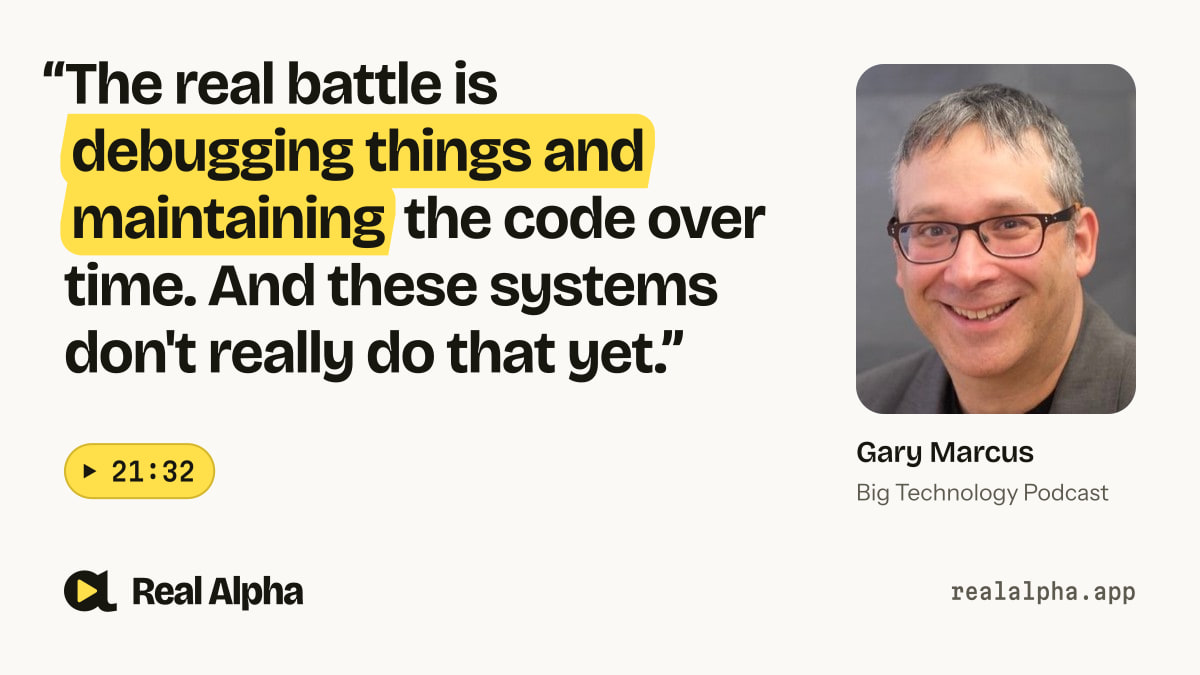
“The real battle is debugging things and maintaining the code over time. And these systems don't really do that yet.”
 Gary Marcusat 21:32 · Big Technology Podcast
Takeaways
- Benchmark performance can obscure errors on real tasks.
- He says coding models struggle with debugging.
- Maintaining code over time remains a major gap.
About this segment
Gary Marcus says benchmark results and polished demos can hide errors on unfamiliar tasks. He argues debugging and maintaining software remain harder than generating code.

Gary Marcus is a cognitive scientist, author, and longtime AI skeptic.
Founded Geometric Intelligence, acquired by Uber, and researches human language development and cognitive neuroscience.

Alex Kantrowitz, Host · Founder, Big Technology
Former BuzzFeed News senior tech reporter and author of Always Day One.
From “Are We at the End of Ai Progress? — With Gary Marcus”, May 7, 2025. Watch the full episode
Answers “Is vibe coding the future?” See all 12 answers
Thanks. We'll look at and fix what's off.
Transcript
Transcribed by machine (Whisper) from the episode’s audio, so a word may be off here and there.
- 17:50
that so one is on a lot of benchmarks there's improvements but there's also issues of data contamination alex reisner wrote an excellent piece in the atlantic about the issues of data contamination and we've seen a lot of studies where people are like well we tried it my company it's not really that much better so they're better on the benchmarks are they better in general Not so clear. It was a new benchmark released by a company called Val AI or something like that.
- 18:15
Val's AI, the Washington Post talked about yesterday, where they looked at things like, can you pull out a chart based on a series of financial statements, SEC statements from a bunch of companies? And these systems all claimed to do it, but accuracy was under 10%. And overall, on this new benchmark, accuracy was at 50%. Would these new models be better than GPT-4? maybe, but they weren't that good. So I think people tend to notice when they do well. They don't notice as much when they do poorly. And although I think there's been some improvement, there has not been the quantum leap that people are expecting.
- 18:52
we have not moved past hallucinations we have not moved past stupid reasoning errors if you go back to my 22 uh 2022 paper deep learning is hitting a wall i didn't say there'd be no progress at all what i said is we're going to have problems with hallucinations we're going to have problems with reasoning planning until we have a different architecture in some sense and i think that that's still true we're still stuck on the same kinds of things so if you have your deep research write you a paper it's going to make up references okay it's probably going to make up numbers like you know did you actually go back and check so for example with i think it's called they all have similar names now whatever grok's version is deep search deep research yeah it's had some i don't know deep research i won't be convinced that we have agi until these companies learn how
- 19:38
to call deep research something other than deep research they all use the same exact name it's really bizarre so whichever version grok has i asked it for example to list all of the major cities that were west of denver and to somebody who wasn't paying attention to be super impressive but because i really wanted to know how well it was working i checked and it left out um billings montana right so you got a list that looks really good and then um there are errors this often happens and then i had a crazy conversation with after that i said what happened to billings And it said, well, there was an earthquake there on February 10th or whatever.
- 20:14
And I looked up in the seismological data. I use Google because I want to have a real source or DuckDuckGo. And there was no earthquake then. And I pushed it on and said, well, I'm sorry for the error or whatever. So we're still seeing those kinds of things. We may see them less, but they are still there. We still have those kinds of problems. So I don't doubt that there's been some improvement. But the quantum across the board that people were hoping for is not there.
- 20:40
The reliability is still not there. And there's still lots of subtle errors that people don't notice. And then, you know, if you want to talk to me about retirement calculators, there are a lot of those on the web. So the easy cases for these systems are the ones where the source code is actually already there on the web. Like Kevin Roose talked about this example of having, he quote, vibe coded a system to look in a refrigerator and tell them what recipe to make.
- 21:06
But it turns out that app is already there on the web and there are demos of that with source code. And so like if you ask a system to do something that's already been done, that's always been true with all of these systems. That's their sweet spot is regurgitation. And so, yeah, they can build the stuff that's. But if you want to code things in the real world, you usually want to code something that's new. And these systems have a lot of problems with that. And another recent study showed that they're good at coding, but they're not good at debugging. And coding is just the tiniest part of the battle. The real battle is debugging things and maintaining the code over time. And these systems don't really do that yet.