The alpha, twice a week
That was 3 min.
Get the best new moments in your inbox every Wednesday and Saturday. It's free.
Check your inbox
We sent a link to your address. Click it to finish signing up. Not there in a minute? Look in spam.
or
Big Technology Podcast · 3 min · May 7, 2025
Open-source releases are hard to reverse once shared
 Gary Marcus
 says AI can create risks even without AGI, including tools that may help bad actors.
In this episode
Full analysis- 1:17Scaling stopped delivering the gains investors expected6 min
- 9:18Reasoning models improve most on problems with verifiable answersPro pick 3 min
- 48:35Neurosymbolic AI combines learning with explicit reasoning3 min
- 24:02Marcus expects another scaling round but sees little moat8 min
- 17:45AI coding still struggles with debugging and maintenance4 min
- 32:06Marcus says three of five capabilities would qualify as AGI6 min
- 42:30AI assistants could create incentives to monetize private data3 min
- 38:58Open-source releases are hard to reverse once shared3 min
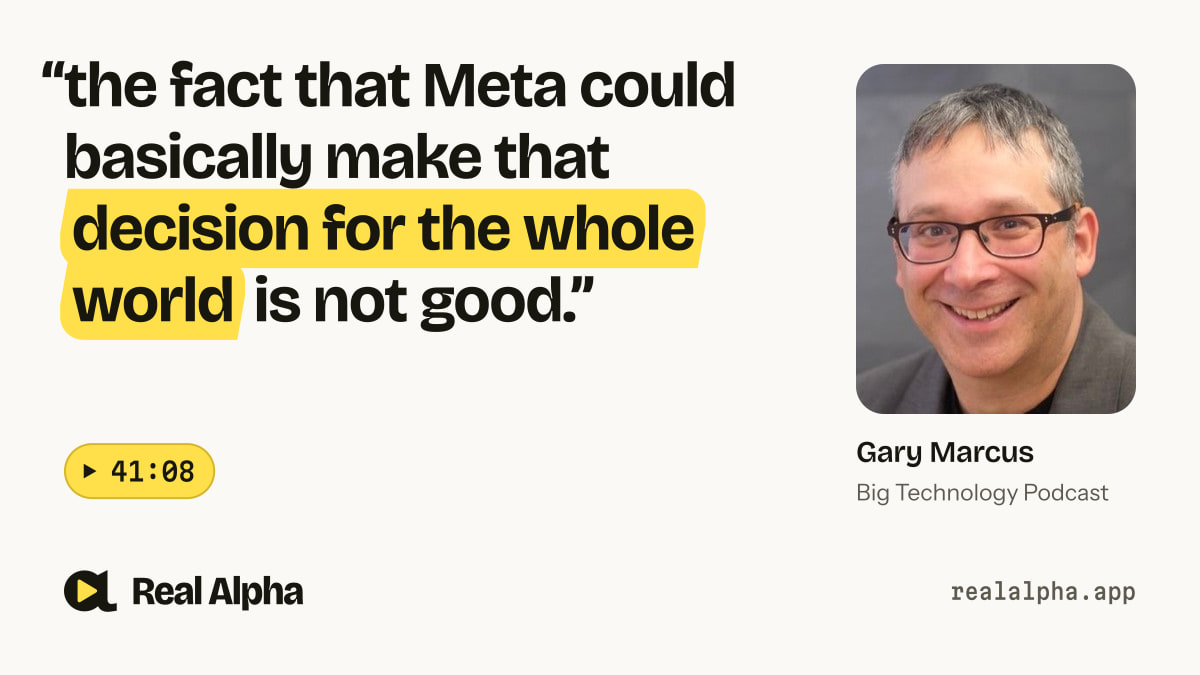
“the fact that Meta could basically make that decision for the whole world is not good.”
 Gary Marcusat 41:08 · Big Technology Podcast
Takeaways
- AI can pose risks even without reaching AGI.
- He worries open models could aid bad actors.
- He says releases need more government and scientific oversight.
About this segment
Gary Marcus says AI can create risks even without AGI, including tools that may help bad actors. He argues open releases need more oversight because they cannot easily be recalled.

Gary Marcus is a cognitive scientist, author, and longtime AI skeptic.
Founded Geometric Intelligence, acquired by Uber, and researches human language development and cognitive neuroscience.

Alex Kantrowitz, Host · Founder, Big Technology
Former BuzzFeed News senior tech reporter and author of Always Day One.
From “Are We at the End of Ai Progress? — With Gary Marcus”, May 7, 2025. Watch the full episode
Answers “Is AI dangerous?” See all 224 answers
Answers “Should AI be regulated?” See all 145 answers
Thanks. We'll look at and fix what's off.
Transcript
Transcribed by machine (Whisper) from the episode’s audio, so a word may be off here and there.
- 39:02
So what are you worried about here? Is that the core concern or is there other stuff? I think there's actually multiple worries and different worries from different architectures and architectures used in different ways and so forth. So dumb AI can be dangerous. so if dumb ai is empowered to control things like the electrical grid and it makes a bad decision that's a risk right if you put a bad driverless car system in you know a million cars a lot of people would die right the main thing that has saved a lot of people from dying in driverless cars is there aren't that many of them and so you know even though they're not actually super safe at the moment you know restrict where we use them and so forth we don't put them in situations where they wouldn't be very bright. So dumb AI can cause problems. Super smart AI could maybe lock
- 39:53
us all in cages if it wanted to. I mean, we have to talk about the likelihood of it wanting to, but there are definitely worries there and we need to take them seriously. And then you have things that are in between. So for example, the virology stuff is AI that's not generally all that smart, but it can do certain things. And in the hands of bad actors, it can do those things. And I think it is true, either now or will be soon enough, that these tools can be used to help bad actors create viruses that cause problems.
- 40:23
And so I think that's a legitimate worry, even if we don't get to AGI. So we have dumb AI right now is a problem. Smarter AI, even if it's not AGI, can cause a different set of problems. And if we ever got to superintelligent, that might open a different can of worms. I mean, you can think like human beings of different degrees of brightness and with different skills. if they choose to do bad things, can cause different kinds of harm.
- 40:48
And so what's your view on open source then? I worry about it. I do worry about it because bad actors are using these things already. They're mostly using them for misinformation. Not sure how much biology they're doing, but they will, and they're going to be interested in that. State actors that want to do terrorist kinds of things will do that. I am worried about open sourcing and all, And I think the fact that Meta could basically make that decision for the whole world is not good.
- 41:19
I think there should have been much more government oversight, scientists. This should have contributed more to the discussion. But now, those kinds of models are open source. They've been released. We can't put that genie back in the bottle. And over time, just like people, I should have said this earlier, even if the models don't get any better, we will still find new uses for them. And some of those new uses will be positive, and some of them will be negative, right?