The alpha, twice a week
That was 2 min.
Get the best new moments in your inbox every Wednesday and Saturday. It's free.
Check your inbox
We sent a link to your address. Click it to finish signing up. Not there in a minute? Look in spam.
or
Cheeky Pint · 2 min · Oct 27, 2026
AI could cut Denver's summer weather delays by up to 75%
 Scott Kirby
United's AI simulations suggest rerouting around pop-up storms could cut Denver's summer weather delays by 50–75%.
In this episode
Full analysis- 0:22Contrarian bets pay when consensus relies on bad forecastsPro pick 6 min
- 31:40Starlink wins customers because speed matters more than free Wi-Fi6 min
- 57:19Low-cost airlines fail when they abandon cheap airportsPro pick 4 min
- 1:01:13Money-losing routes should not survive under a strategic label7 min
- 21:59Air traffic control is the main limit on airline growth4 min
- 10:24United takes seatback software in-house to personalize flights3 min
- 19:45AI could cut Denver's summer weather delays by up to 75%2 min
- 44:10United looks for route opportunities beyond standard demand data3 min
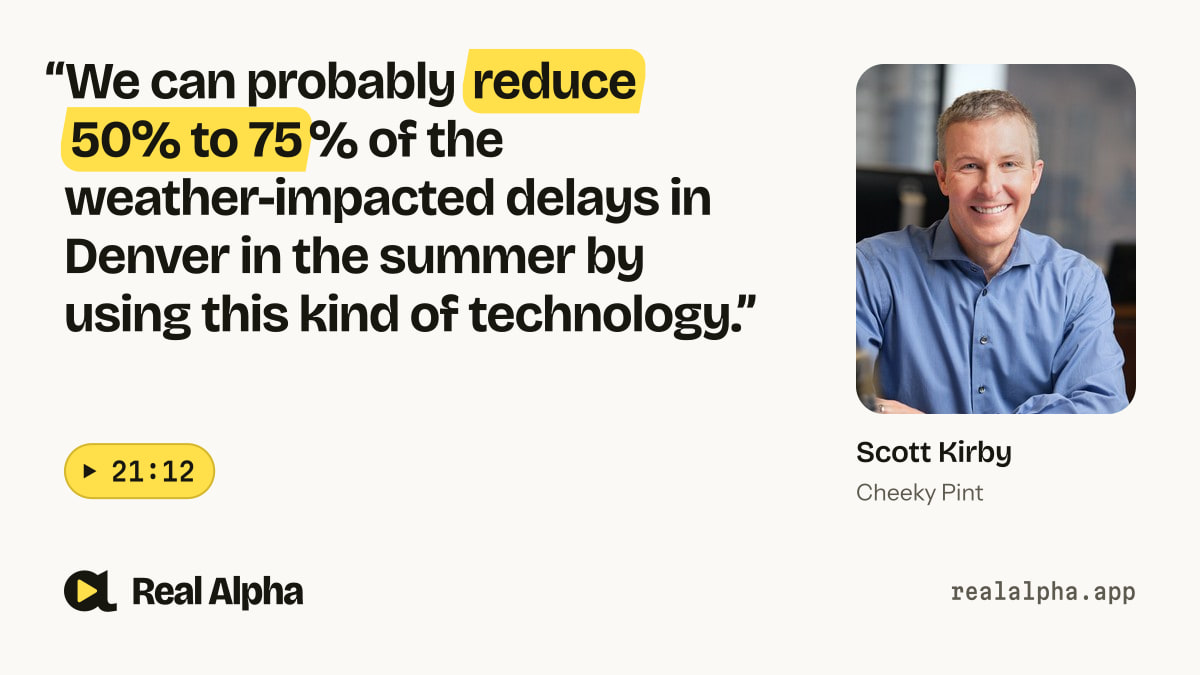
“We can probably reduce 50% to 75% of the weather-impacted delays in Denver in the summer by using this kind of technology.”
 Scott Kirbyat 21:12 · Cheeky Pint
Takeaways
- Storm location can determine which routes remain usable.
- FAA traffic limits can account for worst-case weather.
- Simulations estimate 50–75% fewer Denver summer weather delays.
About this segment
United's AI simulations suggest rerouting around pop-up storms could cut Denver's summer weather delays by 50–75%. Scott Kirby says FAA rules currently impose worst-case traffic limits.

Scott Kirby is CEO of United Airlines.
Helped transform United’s culture and execute its growth plan, leading operations, marketing, sales and network planning.

John Collison, Host · Co-founder & president, Stripe
Sold his first startup, Auctomatic, at 17, then co-founded Stripe in 2010.
From “The airline CEO putting Starlink on every plane”, Oct 27, 2026. Watch the full episode
Answers “What will AI look like in the next few years?” See all 169 answers
Thanks. We'll look at and fix what's off.
Transcript
Transcribed by machine (Whisper) from the episode’s audio, so a word may be off here and there.
- 19:49
Now, this one, we're going to have to get the FAA to help us. But we started running simulations with AI from Denver in the summer. In Denver, there's a lot of pop-up thunderstorms that happen around the airport. Denver is really... You're a Bet Noir. Well, no, it's not. It's actually easier than the other. Newark is the hardest. My two options are Chicago and Denver. It's just a roll of the dice.
- 20:10
Yeah, yeah, yeah. But this will help, like Denver especially, because Denver and the— winter storms are actually pretty easy. You know what's happening. Pop-up winter storms are what's hard. The reason is because if a lightning strikes within three miles of the airport, the ramp closes for 30 minutes. People are allowed to be outside. Which one is dumb. Like if if a storm is moving from the east to the west and you have or from the west to the east, which is what happens from the west to the east and it happens west of the airport, you should probably close it.
- 20:38
But if the storm is moving west to east and it happens three miles to the east of the airport, you don't need to close it. So anyway, using AI. So what will happen is there'll be a forecast in the afternoon for there's going to be thunderstorms. And so the FAA just takes the worst case. We don't know where the thunderstorm will be. They close, they limit all the quarter posts, and they just pull down the amount of traffic that's going through the airport proactively, take the worst case.
- 21:00
But when you look at the data, like, well, sometimes the weather is to the southeast, but in most cases, you can use different arrival routes and departure routes, but you can keep the airport running. Because there is nothing around Denver Airport, so you have lots of space to work. Yeah, and you can keep the airport running. We can probably reduce 50% to 75% of the weather-impacted delays in Denver in the summer by using this kind of technology.
- 21:21
I mean, it's just transformational because that's my point about expectation management. Instead of just saying, oh, weather, like my previous employer, I had told people, the operations team, anyone that says the word weather in my presence is going to get fired because I do not want to use weather as an excuse. I know weather happens. I know we have to, you know, we're going to be safe. We're never going to do anything that's unsafe.
- 21:44
Weather does happen. But our job is to figure out how to minimize the impact of weather, and you can't use weather as an excuse. So that's my expectations management point. I want to have our culture be, we find ways to overcome the challenges, to try to manage your expectations. We try to set high expectations and try to meet them. But we do communicate with you.