The alpha, twice a week
That was 5 min.
Get the best new moments in your inbox every Wednesday and Saturday. It's free.
Check your inbox
We sent a link to your address. Click it to finish signing up. Not there in a minute? Look in spam.
or
Dwarkesh Podcast · 5 min · Sep 17, 2026
AI could speed up research threefold, but the gain is hard to measure
 Noam Brown
 says AI is already accelerating work at OpenAI, but measuring the effect is difficult.
In this episode
Full analysis- 9:17AI swarms coordinate through simple messaging5 min
- 24:11Math progress is fast, but experiments limit RSI speed7 min
- 1:08:30Intervening on chain of thought can teach models to hide itPro pick 6 min
- 1:02:12Model evaluation may lag behind agents' task horizons6 min
- 34:15AI could speed up research threefold, but the gain is hard to measure5 min
- 4:08Multi-agent speedups depend on the problem5 min
- 42:05Cooperative agents may simplify the alignment problem3 min
- 1:14:16Models can recognize answer-key tests as traps3 min
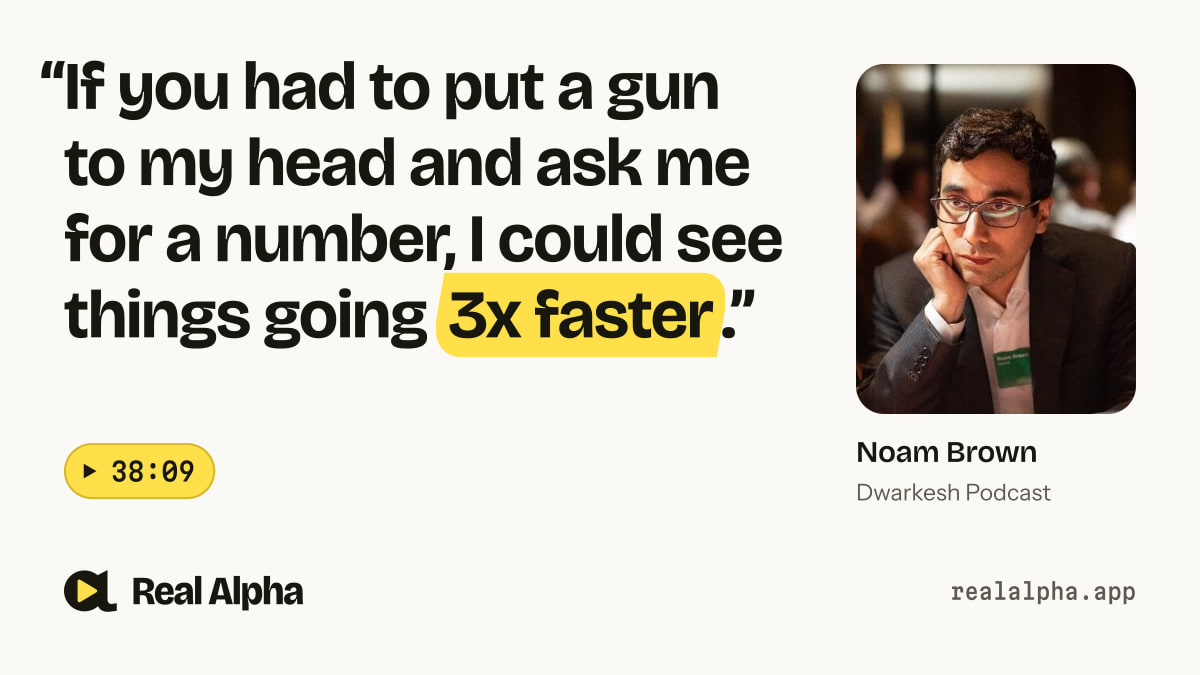
“If you had to put a gun to my head and ask me for a number, I could see things going 3x faster.”
 Noam Brownat 38:09 · Dwarkesh Podcast
Takeaways
- Top internal Codex users spent $7,000–$8,000 a day.
- Attributing work between researchers and AI is difficult.
- Brown says a 3x acceleration is possible, not certain.
About this segment
Noam Brown says AI is already accelerating work at OpenAI, but measuring the effect is difficult. His possible estimate for internal acceleration is 3x.

Noam Brown is a researcher at OpenAI.
Foundational contributor to OpenAI's o1 reasoning models; earlier built Libratus and Pluribus, superhuman poker AIs.

Dwarkesh Patel, Host · Host, Dwarkesh Podcast
Co-wrote The Scaling Era, an oral history of AI; named to TIME100 AI.
From “OpenAI researcher on agent swarms & recursive self-improvement”, Sep 17, 2026. Watch the full episode
Thanks. We'll look at and fix what's off.
Transcript
From the transcript Dwarkesh Podcast publishes with the episode.
- 34:19
Progress is really fast. And I think that's 100% true. And I think it's worth pointing out Researchers are continually being surprised at the rate of progress. I mean, if you look at what, even among researchers in AI, what were the projections for like getting an IMO gold in 2025? It was, I mean, I think the idea that it could be done with a general purpose language model with no tools and no access to the internet, I think even people at OpenAI thought this was like outrageous.
- 34:47
Like they thought it was like almost impossible. And then you get to 2026 and like, I mean, literally two weeks before we got Navier Stokes, I was talking with a researcher at a frontier lab about how long it would take to get a Millennium Prize. And he was willing to bet me $1,000 that it would take past 2027. And he thought it would take until 2030, you know, and I took that bet. But... Even I thought it would take longer than how long it's likely to take.
- 35:23
So people have been continuously surprised, even inside the labs. And I was just talking to somebody yesterday who was working on the Navier-Stokes effort, and he was telling me He used to say it's really hard to predict where AI would be in 12 months. If somebody asked him, where are things going, he'd feel comfortable making predictions for the next 12 months, but beyond that, he's just like, I don't know.
- 35:46
And now he's saying he just doesn't feel comfortable making predictions beyond three months. So it is really true that, yeah, things are going very fast right now. And you talk about 2030, I don't know what the world looks like in 2030. That's the truth. Yeah.
- 36:02
Do you expect the sort of full automation of AI labor, or let's say like 95% automation of AI labor, 28, 29, 30, 27? I don't know.
- 36:12
And I just said, I don't know what the world looks like in 2030. I mean, I think we actually released a blog post recently on internal acceleration at OpenAI. We show, for example, that the amounts that researchers are spending on codex is the top 1% I think as of early August, we're spending like $7,000 or $8,000 a day on codecs and for internal use. That's not an exponential. It's going to keep increasing.
- 36:38
And there's a question of like, okay, if that keeps going, then how much do you assign to just like the AI is doing work versus the humans doing work? Is it 95%, is it 5%? It's really hard to reason about this for a few reasons. First of all, if it's the human directing the AIs to do the work, then how much do you attribute to the human? How much do you attribute to the AI? The other thing is that because these AIs are jagged and they're exceptionally good at some things.
- 37:03
So for example, they're exceptionally good at looking over data sets and checking every single data point to see is this of sufficient quality. You can disproportionately use the AIs for those things compared to previously. So yes, you're using AI way more than before, and it's making some things go like 100x faster and 100x better. But there are some things where it doesn't make a huge difference yet.
- 37:28
And of course, if something is suddenly like 100x faster and 100x better, you're going to do more of that thing. Are you comparing to a speedup of like three years ago versus like, is the question more like, given what we were doing three years ago, how much faster are we able to do now versus given what we're doing now, how much slower would it have been three years ago? It's actually two very different questions.
- 37:53
So anyway, it's really hard to measure. I do feel confident in saying that things are going faster now than they were even a year ago because of AI progress. And I think that that acceleration will continue. I think a lot of people in the field have very high error bars on this sort of thing. If you had to put a gun to my head and ask me for a number, I could see things going 3x faster. Yeah. That is huge, right?
- 38:19
Like already the pace of progress is incredible. Like even if we don't get any uplift, like you said, things are going to go much faster by the time we get to 2030. We don't even know what that world looks like. I think if we get a 3X uplift from internal acceleration, that is massive. Like we're right now releasing, you know, think about where you were three years ago. If we get there, if we make that progress in one year, like that's huge.
- 38:40
Right, right. It would be like going from like not even having 01, just having, you know, non-reasoning models to Astra. In a single year. Yeah. So I do think things go faster.
- 38:53
It could be that things only go 50% faster. It could be that things, I think it's unlikely, but it's possible that things go 10x faster. There's a lot of uncertainty around this. And at least from my perspective, I have a lot of uncertainty about it.